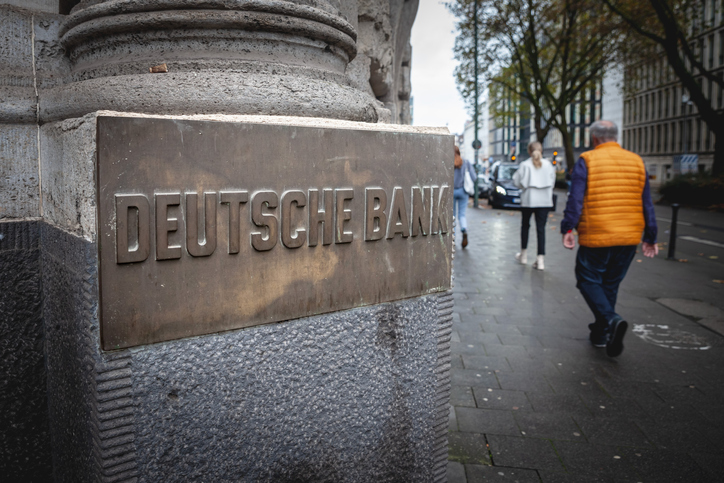
Deutsche Bank, despite years of efforts to distance itself from past regulatory issues, continues to face financial penalties.
The US Federal Reserve issued a penalty of $186 million to the German bank on Wednesday due to its failure to rectify “unsafe and unsound practices” it had committed to address as early as 2015.
Deutsche Bank was found by the Fed to have made insufficient advancements since 2018 in areas such as tightening anti-money laundering protocols, enhancing customer due diligence, and ensuring compliance with sanctions, among other shortcomings. The bank had previously been penalized with a combined total of $99 million in 2015 and 2017 for these same concerns.
The fine also related to Deutsche Bank’s role in a money laundering scandal at Danske Bank Estonia.
The US regulatory authority highlighted that even though Deutsche Bank has made “some progress” lately, the bank’s US operations continue to face increased levels of compliance risk, such as the danger of not detecting money laundering activities or violations of US sanctions.
The authority has instructed the bank to make “substantial” advancements regarding these matters by the end of the current year or face further penalties.
This penalty underscores the reality that Germany’s largest bank still has to address numerous regulatory breaches, including the mis-selling of toxic mortgage securities, which have led to over $10 billion in penalties since the financial crisis of 2008.
Deutsche Bank has made concerted efforts to refurbish its image and rejuvenate its financial performance over the recent years, initiating an $8.3 billion transformation program in 2019, which CEO Christian Sewing has described as a reinvention.
The bank’s efforts at turning around its fortunes have started to show results, with the previously struggling lender reporting its highest quarterly profit since 2013 in the first quarter.
On Wednesday, Deutsche Bank stated that it has “considerably invested in controls” since 2019 and expanded its global anti-financial crime team by over 25%, resulting in a team of more than 2,000 employees.
The bank acknowledged the necessity of meeting its commitments, as highlighted by the Fed’s actions, and stated that it is suitably equipped to fulfill the expectations of its regulators.
In its directive, the Fed pointed out that a “significant portion” of the $267 billion in transactions that Deutsche Bank processed for Danske Estonia were related to “high-risk” customers. Deutsche Bank ended this relationship in 2015.
In November, Germany’s financial regulator, BaFin, warned Deutsche Bank of a potential penalty if it did not address issues related to money laundering and terrorist financing controls.
About Author