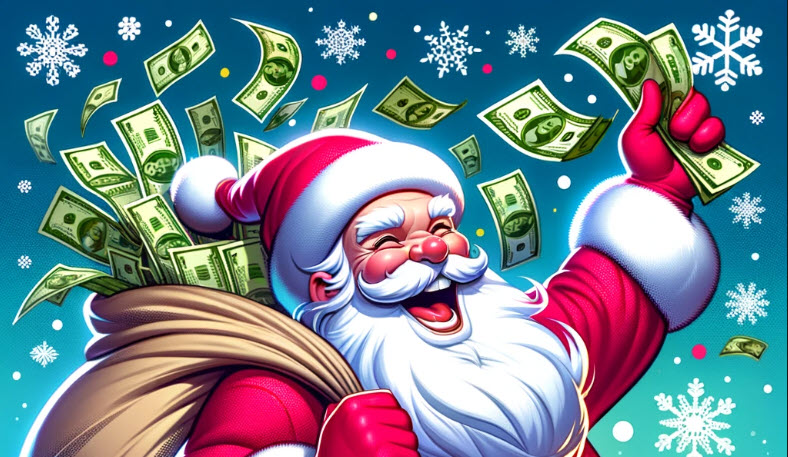
The stock market’s much-anticipated “Santa Claus Rally” might be losing its sparkle. This festive financial pattern, where the market typically ascends during the last five trading days of December and the first two of January, historically yields a 1.3% gain. It’s the season of financial cheer, often marking the most lucrative seven-day streak of the year. However, this year tells a different tale, with the S&P 500 trailing by 0.1% in the past six days, raising eyebrows and concerns.
Beyond Merrymaking: Santa’s Predictive Power
The Santa Claus Rally isn’t just a merry market trend; it serves as a bellwether. Jeff Hirsch, the scribe of the Stock Trader’s Almanac, points out a crucial fact: when Santa skips the market, it often forebodes bearish times ahead or opportunities to buy stocks at lower prices later in the year.
Rare but Noteworthy: The Rarity of a Negative Santa Season
It’s not all gloom, though. Negative Santa Claus Rally periods are a rarity, occurring only 12 times since 1969. That’s less than a quarter of the time. But here’s a twist: Tom McClellan, another astute market analyst, notes that in years following a downbeat Santa season, the market only slumps 40% of the time. So, even when Santa’s sleigh doesn’t soar, the market often does, albeit with a slightly dimmer glow.
Seasonal Signals: Other Indicators in Play
The “Early Warning” of the First Five Days
We’re currently navigating through other seasonal indicators, like the “First Five Days Early Warning” System. Especially potent during presidential election years, this predictor has an impressive 83% accuracy rate in forecasting the market’s direction for the year, based on its performance in the first five days.
January Barometer: A New Year’s Gauge
Another critical marker is the “January Barometer,” stating, “as goes January, so goes the year.” With an 83.6% accuracy rate since 1950, it’s a formidable forecast tool, though its precision wanes slightly in election years.
The Election Factor: Politics and the Market
Presidential Election Years: A Boost for the Market?
In the U.S., election years with an incumbent president typically spell stronger market performance. Dan Clifton from Strategas highlights a remarkable trend: the S&P 500 has risen in every presidential re-election year since 1944, a streak unbroken even in recession years like 2020. This trend is partly attributed to incumbent administrations pulling economic levers to sustain growth. For instance, Clifton notes the Biden administration’s decision to finance deficits with T-bills, a move that sets the stage for the Fed’s anticipated rate cuts in 2024.
Global Elections: A World of Market Implications
But the U.S. isn’t alone in its electoral influence on markets. 2024 is a bumper year for national elections globally, with 40 scheduled, including major economies like Mexico, India, and Indonesia. Jason Trennert from Strategas observes that with nearly 80% of the world’s market cap facing elections, policy makers will be keen to dodge recessions, sometimes at significant costs. However, this also opens the door to politically motivated, confrontational stances by elected officials.
In summary, while Santa’s market magic seems to be waning this year, it’s crucial to keep an eye on these broader indicators and global political dynamics for a complete picture of what 2024 holds for the markets.
About Author