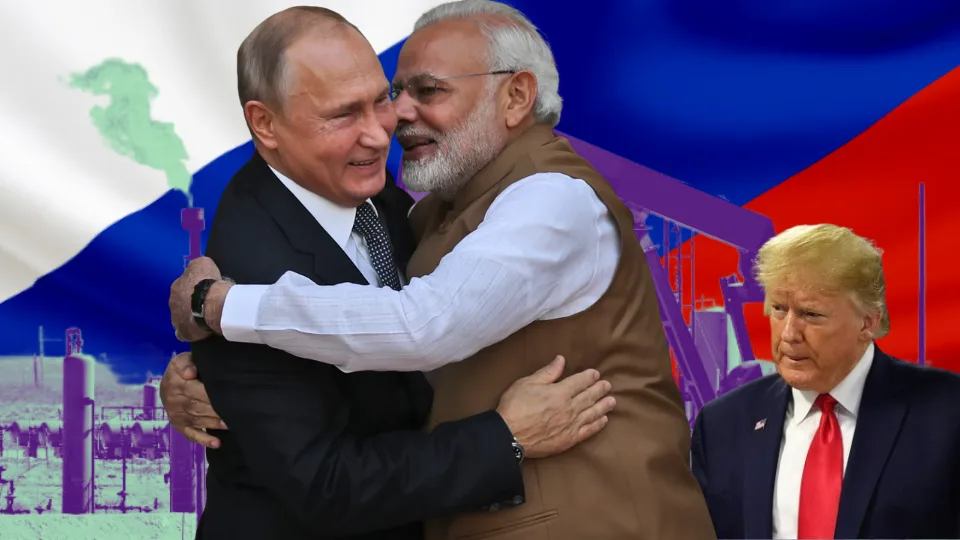
India and Russia are doubling down on their decades-long partnership, brushing aside tariff threats from Washington that were meant to squeeze New Delhi over its Russian oil imports. Instead of bowing to pressure, India is expanding trade flows, boosting exports, and even sending skilled workers to Russia—cementing a relationship that could reshape global trade alliances at a time of heightened geopolitical tension.
What Investors Need to Know
For investors, this deepening India–Russia alliance signals potential headwinds for U.S. trade relations, fresh volatility in global energy markets, and an evolving supply chain that may undermine Washington’s leverage. The stronger New Delhi–Moscow axis also complicates U.S. efforts to isolate Russia and could accelerate a multipolar economic order where emerging markets increasingly trade outside the dollar system.
India Defies Tariff Pressure
The Trump administration has threatened tariffs as high as 50% on Indian goods in response to its ballooning Russian oil imports. Yet India’s foreign minister Subrahmanyam Jaishankar stood firm in Moscow, calling India–Russia ties among the “steadiest of the major relationships in the world after the Second World War.”
India’s position is straightforward: U.S. and EU buyers are still trading with Russia despite sanctions, so New Delhi sees little reason to back down. Instead, India is recalibrating its trade portfolio, expanding exports of pharmaceuticals, agriculture, and textiles to Russia. Bilateral trade hit a record $68.7 billion in the year ended March 2025, though India ran a $59 billion deficit due to oil imports.
New Avenues of Cooperation
Beyond commodities, India and Russia are broadening their economic relationship:
- Skilled labor exports: India will send IT, construction, and engineering workers to Russia to ease labor shortages.
- Energy cooperation: Russia’s foreign minister Sergei Lavrov reaffirmed joint energy projects in the Far East and Arctic shelf, alongside steady oil shipments to Indian refiners.
- Strategic depth: Lavrov framed the partnership as critical for “regional security and stability,” a clear rebuke to U.S. efforts at isolation.
The Energy Factor: India’s Oil Imports Surge
India has rapidly scaled up Russian oil purchases, now importing 1.6 million barrels per day—a staggering leap from 50,000 bpd in 2020. This places India just behind China’s 2 million bpd imports, according to the U.S. Energy Information Administration.
While Washington has not sanctioned China for similar activity, it has escalated criticism of India, accusing New Delhi of “profiteering from cheap Russian crude.” The double standard underscores a U.S. strategy that prioritizes leverage rather than principle, analysts argue.
Trump’s Real Endgame: Leverage, Not Oil
Several experts suggest the tariff threats are less about curbing Russian oil revenue and more about extracting concessions. Trump is angling for two outcomes:
- A trade deal with India. By applying tariff pressure, the administration hopes to force New Delhi into economic compromises more favorable to Washington.
- A ceasefire play with Putin. Trump recently hosted Vladimir Putin in Alaska, a meeting that symbolized thawing relations but produced no concrete ceasefire in Ukraine. India was briefed on these talks, with Jaishankar emphasizing “dialogue and diplomacy” as the only path forward.
Western Sanctions and Global Pushback
Western governments argue India’s purchases bankroll Moscow’s war machine, but New Delhi insists Washington encouraged the imports to stabilize global oil markets. India’s logic: the West can’t have it both ways—pressuring New Delhi while maintaining its own trade flows with Russia.
Russian officials, meanwhile, are betting India will not only keep buying oil but also join Moscow and Beijing in a potential trilateral alignment. Roman Babushkin, Russia’s envoy in India, said oil flows would continue “despite the political situation,” and that Moscow hoped for a trilateral summit soon.
A Multipolar Trade Order
The India–Russia pivot illustrates a larger shift: emerging markets are building parallel trade networks, reducing reliance on Western markets and currencies. For decades, the U.S. dollar’s dominance gave Washington unrivaled leverage. But as India deepens energy and labor cooperation with Russia—and potentially aligns with China—alternative trade corridors could accelerate.
This trend is a wake-up call for investors: the global economy is fragmenting into spheres of influence. Betting solely on U.S.-centric trade assumptions could leave portfolios exposed to geopolitical shocks.
Investor Takeaways
- Energy Market Volatility: India’s sustained Russian oil purchases will keep crude prices unpredictable. Energy stocks, refiners, and shipping firms could see outsized swings.
- Emerging Market Bonds and Currencies: India’s resilience against U.S. tariff threats suggests stronger autonomy, making rupee-denominated bonds and Indian equities worth monitoring.
- Defense and Technology Partnerships: Expect India to seek alternative defense and tech arrangements with Russia and China, potentially sidelining U.S. defense contractors.
- Geopolitical Hedging: Gold and other safe-haven assets could benefit as global trade blocs fracture further.
Why This Matters to Americans
For everyday Americans, these shifts could mean higher import costs if tariffs escalate, more volatility at the gas pump, and an investing landscape that feels less predictable. While Washington aims to apply pressure abroad, the blowback often lands at home in the form of inflation and market turbulence.
Conclusion
India and Russia are betting that U.S. tariff threats will not derail their partnership—and early signs suggest they’re right. By expanding trade, energy cooperation, and labor exchanges, New Delhi and Moscow are not only shielding themselves from U.S. pressure but also laying groundwork for a more multipolar global economy.
For investors, this isn’t just a diplomatic standoff—it’s a reminder that geopolitics increasingly drives markets. Ignoring these shifts is a mistake; adapting to them could be the key to protecting and growing wealth in a rapidly changing world.
About Author