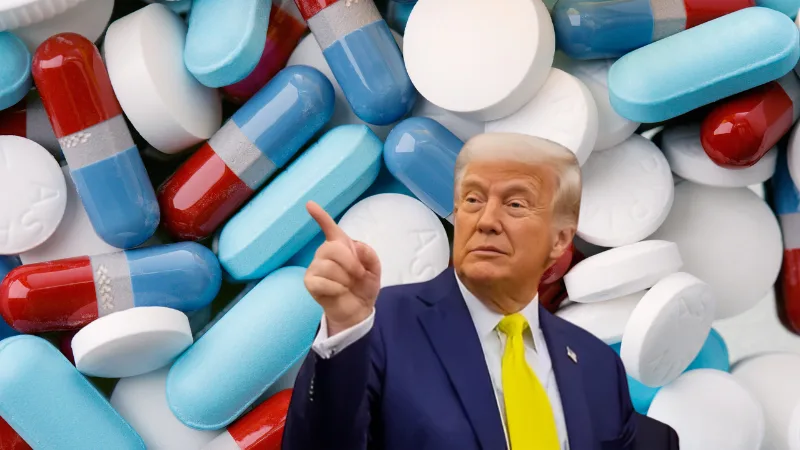
President Donald Trump has unveiled one of his most aggressive trade moves yet: a 100% tariff on imported branded or patented pharmaceuticals, scheduled to begin October 1, 2025. According to the White House, companies actively building U.S. manufacturing facilities—defined as projects that have broken ground or are under construction—would be exempt from the penalty.
The same announcement also included new tariffs on heavy trucks, kitchen cabinets, and upholstered furniture, but it’s the pharmaceutical provision that has drawn the sharpest reaction from markets and policy circles.
The administration frames the move as a way to “bring drug manufacturing back home” to secure supply chains and protect national security. Supporters see it as a long-overdue push to end U.S. dependence on foreign-made medicines. Critics warn it could increase drug costs, trigger shortages, and violate trade agreements.
What’s Actually in the Plan
The tariff package features:
- 100% tariff on branded or patented drug imports beginning October 1, 2025.
- Exemption for companies “building” U.S. plants, meaning those with projects that have broken ground or are under construction.
- New tariffs on heavy trucks, kitchen cabinets, and upholstered furniture at rates ranging from 25% to 50%.
Administration officials say the authority comes from national security powers and Section 232 trade law, a legal hook also used in previous Trump-era tariffs on steel and aluminum. Legal experts expect immediate court challenges to test whether the scope of these new tariffs can withstand judicial review.
Allies Push Back, Seek Exceptions
The European Union and Japan have already signaled that a previously negotiated tariff cap of 15% on pharmaceutical exports should protect their companies from the full 100% rate. EU trade officials say the deal was designed to “avoid exactly this kind of disruption.”
Whether the White House agrees is another matter. Trade lawyers note that the administration could argue that the new tariffs are based on national security emergencies rather than normal trade policy, which may override prior deals. Expect disputes over which products are covered and which are exempt.
In the meantime, some drugmakers are already announcing or accelerating U.S. factory investments to fall under the “building” carveout. But constructing and validating pharmaceutical facilities is a multi-year process, not something that can be done overnight.
Why This Matters: Prices, Supply, and Inflation
Tariffs act like a tax on imports, and the pharmaceutical market is highly globalized. Even U.S.-based companies often rely on overseas plants for active ingredients or finished doses.
That means this policy could:
- Raise costs for payers, providers, and patients if imported drugs become more expensive.
- Strain supply chains for critical or specialized medicines that have no immediate domestic alternative.
- Complicate the Fed’s inflation fight by introducing new upward pressure on goods prices just as disinflation has stalled.
Generics may escape the full brunt if the final rule sticks to “branded or patented” products. But components or active ingredients in generics could still face indirect disruption, leading to ripple effects across the market.
The Investor Lens: Who’s Hit, Who Could Benefit
Potential Losers
- Multinationals with limited U.S. manufacturing footprints
European and Asian companies exporting high-value branded drugs are most exposed. Think hubs in Ireland, Switzerland, Germany, and Japan, which supply a large share of U.S. imports. - Contract development and manufacturing organizations (CDMOs) abroad
Specialized biologics production isn’t easily relocated. Even with fast-tracked construction, the regulatory approvals for new plants can take years. - U.S. payers and providers
Hospitals and insurers may face higher procurement costs before contracts can be renegotiated, putting pressure on margins.
Potential Winners
- U.S.-based CDMOs and capacity providers
Companies offering fill-finish, sterile manufacturing, and advanced biologics production in the U.S. stand to benefit from a rush of new demand. - Construction, validation, and automation suppliers
Firms with pharma expertise in facility design and compliance could see a wave of orders as multinationals race to qualify under the carveout. - Select European large caps with U.S. plants
If the EU-Japan 15% tariff ceiling holds, and these companies have existing U.S. manufacturing, they may gain a relative advantage over peers more dependent on non-covered jurisdictions.
The Legal Wild Card
Trump’s team is invoking national security authorities to justify the move. Courts have become more skeptical of sweeping tariff powers, and some earlier Trump-era trade actions are already on a path to Supreme Court review this fall.
Investors should expect months of litigation and possibly preliminary injunctions that delay or narrow the tariffs. A single district court ruling could reset the timetable.
This legal uncertainty makes it harder to price the policy into stocks. It also creates volatility opportunities for investors who can track which companies have genuine U.S. capacity versus those relying on exemptions or diplomatic deals.
Scenario Planning for Investors
Base Case: Negotiated Soft Landing
Litigation plus diplomacy reduces the effective rate for allies. Many firms qualify under the “building” exemption. Price increases are real but more modest and concentrated. Supply disruption risk is present but manageable. Market impact: rotation within health care rather than a broad sell-off.
Upside Case: Domestic Capacity Boom
Washington narrows exemptions, timelines slip, and companies scramble to contract U.S. capacity. Domestic CDMOs and suppliers gain pricing power. Certain U.S. manufacturers enjoy operating leverage as plants run hotter.
Downside Case: Hard Line + Legal Green Light
Courts allow broad application, the EU cap proves narrower than hoped, and key specialty categories face the full brunt. Import flows slow. Drug shortages pop up. The Fed gets a fresh inflation headache. Equity winners are scarce outside niche capacity providers.
What to Watch Next
- Federal Register text spelling out “branded,” “patented,” and “building” definitions.
- Early lawsuits and motions for injunction.
- EU and Japan enforcement of the 15% tariff cap—does it apply product-wide or SKU-by-SKU?
- Corporate capital expenditure announcements for new U.S. plants.
- Guidance from payers into Q4 and Q1 on medical cost trends.
- Inflation prints and Fed commentary to see if goods prices pick up around the tariff start date.
Takeaways for Your Portfolio
This is less about a single shock and more about a multi-year localization theme. Winners will be U.S. capacity providers and firms with diversified manufacturing footprints. Losers will be companies that rely on foreign plants for high-value drugs without near-term plans to build in the U.S., as well as payers and providers caught in cost squeezes.
Until the legal and diplomatic dust settles, investors should assume higher procurement friction, selective price pressures, and a premium on companies that can prove U.S. manufacturing credibility.
About Author