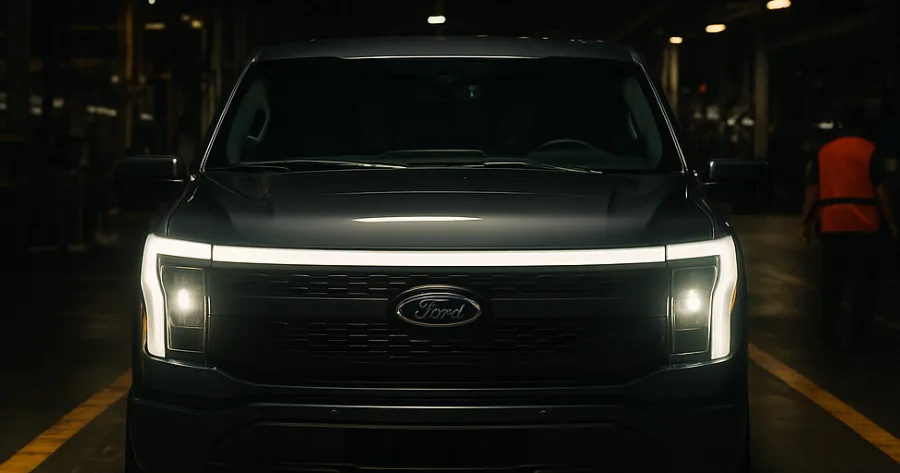
Ford Motor Company is at a crossroads with its flagship electric truck.
Multiple reports from Bloomberg, Car and Driver, and Electrive confirm that executives are actively debating whether to end production of the F-150 Lightning, the all-electric counterpart to America’s best-selling vehicle line.
The conversations come amid a trifecta of pressure points:
- Demand shortfall – Sales of full-size electric pickups have fallen far short of internal projections, with dealer inventory climbing and reservation cancellations ticking higher.
- Financial strain – Ford’s EV division, Model e, has racked up roughly $13 billion in cumulative losses since 2023, driven by battery costs, warranty issues, and price competition.
- Supply-chain disruption – A recent fire at aluminum supplier Novelis forced Ford to idle Lightning production in October, diverting resources to its hybrid and gas-powered F-150 lines.
Taken together, these challenges are forcing Ford to confront an uncomfortable truth: the Lightning may be technologically impressive, but it’s economically unsustainable under current market conditions.
The Larger Story Behind the Pivot
The F-150 Lightning was never just another model—it was Ford’s proof-of-concept for mainstream EV adoption. Launched with fanfare in 2022, it symbolized the automaker’s transition from legacy manufacturer to future-ready innovator. But the economics never matched the enthusiasm.
Electric trucks are expensive to build, heavy to ship, and still face weak charging infrastructure in key truck markets like Texas and the Midwest. Buyers remain skeptical of range loss while towing or hauling—real-world tests show range can plunge by 40 % or more with a trailer attached. Those practical limitations collide with a $70,000 + price tag.
Ford has poured billions into the Lightning platform, its battery plants, and dedicated EV assembly lines. But even with federal incentives, the math hasn’t penciled out. Production costs remain stubbornly high, while consumer subsidies are set to decline under tightened sourcing rules. The result: every Lightning sold is a drag on margin.
If Ford pulls the plug, it won’t be because the technology failed—it’ll be because the business case never scaled.
Making Sense of the Decision
Investors should view this moment not as a retreat, but as a recalibration. Here’s how the decision breaks down across three possible paths.
Scenario 1: Best Case — “Pause and Re-launch”
In the optimistic scenario, Ford treats the Lightning pause as a reset, not a funeral. Production remains suspended into early 2026 while management trims complexity, renegotiates supplier contracts, and reduces material costs.
If achieved, Ford could bring the truck back leaner—targeting breakeven margins at far lower volumes.
That outcome would preserve the EV halo while improving unit economics. It would also signal that Ford learned from its early mistakes: scaling before proving profitability.
Investor takeaway: modest upside. The company could recover roughly $1–1.5 billion in annual EBIT by cutting the Lightning’s red ink without abandoning the segment entirely.
Scenario 2: Base Case — “Sunset and Shift to Hybrids”
The base case—and the one Wall Street increasingly expects—is a controlled exit. Ford winds down the Lightning over the next year, absorbs one-time write-downs of roughly $1–2 billion, and re-allocates capital toward hybrids and smaller, sub-$30 k EVs already under development.
The optics may sting, but the financial logic is sound. Hybrids like the F-150 PowerBoost and Maverick Hybrid are selling briskly with solid margins. Shifting production toward those high-volume, lower-risk platforms could lift Ford’s consolidated EBIT by $0.5–1 billion as soon as 2026.
Investor takeaway: near-term cash flow improves; long-term EV credibility takes a dent. Markets would likely reward the discipline—Ford’s stock already ticked higher on rumors of the Lightning’s demise.
Scenario 3: Worst Case — “Prolonged Limbo”
The nightmare outcome is indecision. If Ford hesitates—starting, stopping, and restarting production amid supplier constraints and pricing pressure—the Lightning could become a slow-motion drag on the balance sheet.
In that case, Ford would face additional warranty reserves, asset impairments of up to $3 billion, and a continued perception problem: a company unwilling to admit defeat in a shrinking niche.
Investor takeaway: dead capital. Lingering losses from the Lightning could overshadow gains in hybrids or commercial fleets and cap valuation multiple expansion relative to GM or Toyota.
The Strategic Context
The Lightning’s fate matters beyond Ford. It’s a bellwether for the viability of large EV trucks, a category once expected to dominate American electrification.
Rivals are quietly retrenching too. GM delayed its Silverado EV rollout; Ram postponed production of its electric 1500 REV. Across the industry, the enthusiasm of 2021 has given way to reality: big trucks, big batteries, small margins.
At the same time, hybrids are booming. U.S. hybrid sales jumped nearly 50 % year-over-year, outpacing pure EV growth for the first time since 2019. Ford’s hybrid F-150 sales alone now exceed Lightning volumes by a wide margin.
That market pivot is driving Ford’s strategy. CEO Jim Farley has said repeatedly that hybrids “make sense for where customers are today.” Translation: Ford will follow demand, not ideology.
What’s Next
Here’s what investors should watch heading into 2026:
- Ford’s official statement. The company hasn’t confirmed or denied the reports. Expect clarity by the next quarterly earnings call.
- Capex re-allocation. How much of Ford’s $8–9 billion in annual investment shifts from EVs to hybrids will reveal the real priority.
- Aluminum supply recovery. Novelis’s restoration timeline could determine whether a relaunch is even feasible.
- Hybrid penetration rates. Every uptick in hybrid take-rate strengthens Ford’s case for pivoting away from full electrics.
- Competitor responses. If GM or Stellantis also scale back their EV truck ambitions, Ford’s decision will look less like surrender and more like prudence.
A Market Reset
The Lightning saga underscores a harsh but necessary truth: the EV transition will not be linear. Early exuberance has collided with consumer pragmatism, infrastructure gaps, and profit realities.
For Ford, that means the path to electrification likely runs through hybrids and affordable small EVs—not $70 k luxury trucks.
For investors, it’s a reminder to follow economics, not narratives. The companies that balance innovation with discipline—earning money while building the future—will win the next phase of this transition.
Evolution?
Ford’s potential retreat from the F-150 Lightning isn’t a sign of failure; it’s a sign of evolution. The electric truck that was once the face of Ford’s EV revolution may now become its cautionary tale—but also its catalyst for smarter growth.
If management executes the pivot decisively—cutting losses, leaning into hybrids, and developing a truly affordable EV platform—Ford could exit this episode stronger, leaner, and better aligned with market reality.
The era of the “EV arms race” is giving way to an era of EV economics. Ford’s next move will tell investors which side of that divide it wants to be on.
About Author