In a late-night post on Truth Social, Trump made it clear that the U.S. could intensify its military response against Iran in a way that goes far beyond previous strikes.
“The New Regime leadership knows what has to be done, and has to be done, FAST!” Trump wrote.
He followed that with an even more direct warning:
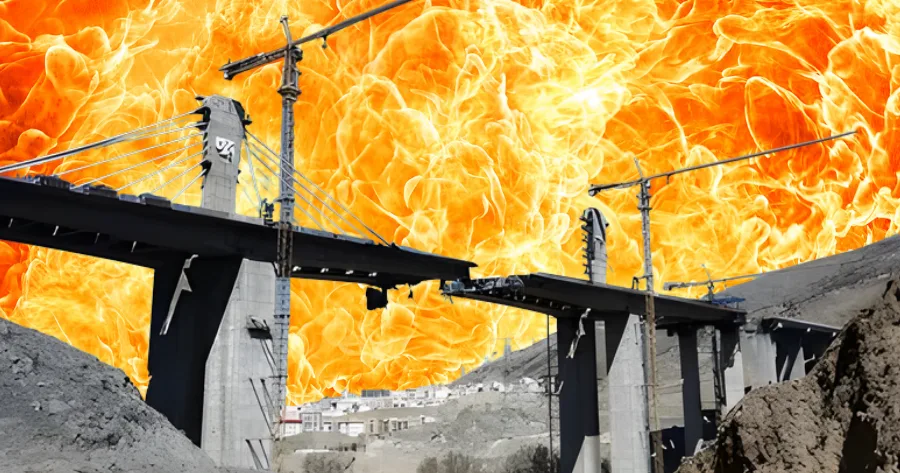
“We haven’t even started destroying what’s left in Iran. Bridges next, then Electric Power Plants!”
The statement marks a significant shift. Targeting infrastructure such as power grids and transportation systems moves beyond military objectives and into areas that could severely disrupt civilian life and economic activity inside Iran.
That escalation matters not just geopolitically, but financially.
What’s Already Happening on the Ground
The situation is not hypothetical. It is already unfolding in real time.
A newly built bridge near Tehran was reportedly destroyed in an airstrike, with Iranian state media confirming casualties. Meanwhile, Iranian outlets claimed that a U.S. fighter jet had been shot down, though that report has not been independently verified by United States Central Command.
At the same time, fallout from the conflict is spreading beyond Iran’s borders.
Operations at gas facilities in Abu Dhabi were suspended after debris from intercepted aerial threats caused a fire. While no injuries were reported, the incident highlights how quickly the conflict is spilling into key energy infrastructure hubs across the region.
Iran Fires Back With Defiance
Iran’s leadership has not backed down.
Foreign Minister Abbas Araghchi pushed back directly against Trump’s comments, criticizing what he described as an attempt to roll back the region into chaos.
“Are POTUS and Americans who put him in office sure that they want to turn back the clock?” he wrote, referencing Trump’s repeated warnings about sending Iran “back to the Stone Age.”
Iran has also denied claims that it is seeking a ceasefire, contradicting statements from Trump suggesting otherwise.
That disconnect signals a dangerous reality: there is currently no clear diplomatic off-ramp.
Legal Experts Warn of War Crime Risks
Trump’s comments about targeting infrastructure have also triggered warnings from legal experts.
More than 100 international law scholars signed a letter stating that attacks on civilian infrastructure, such as power plants and water systems, could violate international law.
Under the Geneva Conventions, targeting “objects indispensable to the survival of civilians” can constitute a war crime.
That adds another layer of complexity.
Because beyond military and economic risks, the situation could also escalate into legal and diplomatic fallout on the global stage.
Global Powers Block Military Escalation at the UN
Efforts to formalize a broader international military response have stalled.
At the United Nations, a proposal led by Gulf states to authorize force to secure shipping routes was blocked after vetoes from China, Russia, and France.
This effectively removes any near-term coordinated global military response under UN authority.
But it also increases uncertainty.
Because without a unified international framework, the conflict risks becoming more fragmented and unpredictable.
Gulf States Are Being Pulled Into the Conflict
Regional players are already being drawn deeper into the situation.
The Gulf Cooperation Council has accused Iran of crossing “all red lines” after missile and drone attacks impacted infrastructure across member states.
A refinery operated by the Kuwait Petroleum Corporation was reportedly hit by drones, further raising concerns about supply disruptions.
If these attacks intensify, it could force Gulf nations into a more direct military role.
And that would significantly raise the stakes for global markets.
The Bottom Line
Trump’s latest threats are not just rhetoric. They signal a potential shift toward more aggressive military targeting that could reshape the conflict.
And markets are paying attention.
The combination of infrastructure targeting, disrupted oil flows, and regional spillover creates a high-risk environment that investors cannot afford to ignore.
If the Strait of Hormuz remains constrained or if attacks expand to additional energy infrastructure, the next move in markets could be fast and significant.
About Author