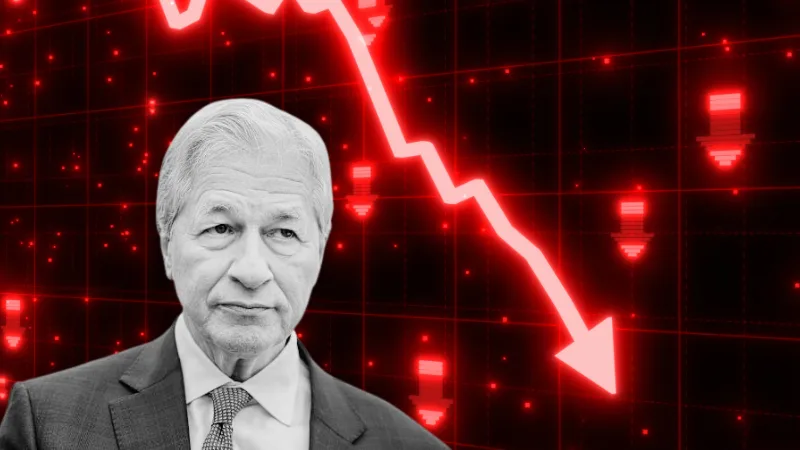
In his latest annual shareholder letter, the CEO of JPMorgan Chase introduced a new metaphor for risk. Not a financial crisis, not a recession, but what he calls a “skunk at the party.” In plain terms, something that quietly shows up, lingers, and eventually forces everyone to react.
That “skunk” is inflation. And according to Dimon, it may be the single biggest threat to markets heading into 2026.
The Core Warning: Inflation Isn’t Dead
Dimon’s concern is not that inflation will spike suddenly. It is something more dangerous.
“The skunk at the party—and it could happen in 2026—would be inflation slowly going up, as opposed to slowly going down.”
That distinction matters. Markets can typically handle a sharp shock because policymakers react quickly. Slow, persistent inflation is different. It forces central banks like the Federal Reserve to keep rates higher for longer, tightening financial conditions across the board.
Dimon reinforced this with a blunt reminder:
“Interest rates are like gravity to almost all asset prices.”
If rates stay elevated or move higher, valuations across stocks, real estate, and private markets face pressure. That is not theoretical. It is mechanical.
Why Inflation Could Reaccelerate
The backdrop today is not calm. It is increasingly unstable.
One major factor is the ongoing geopolitical tension involving Iran and Ukraine. Conflict in these regions is already affecting global supply chains, particularly energy markets.
The Strait of Hormuz, one of the most critical oil shipping routes in the world, has seen disruptions that pushed oil prices higher. That feeds directly into inflation through transportation, manufacturing, and consumer costs.
Higher oil prices tend to ripple through the entire economy. Gas prices rise, shipping costs increase, and companies pass those costs on to consumers.
That is exactly the kind of slow-building inflation Dimon is warning about.
The Market Has Already Shifted
Investors are not ignoring this risk. In fact, expectations around interest rates have changed dramatically in a short period of time.
Just weeks ago, markets were betting heavily on rate cuts. Now, the outlook has flipped.
Traders are increasingly pricing in a scenario where the Federal Reserve keeps rates steady, or even considers tightening again if inflation proves sticky. That shift alone is enough to reprice risk assets.
When rate expectations move, stock valuations follow.
Growth stocks, which depend heavily on future earnings, are especially sensitive. But even value stocks and dividend plays are not immune if borrowing costs remain elevated.
The Domino Effect on Asset Prices
Dimon’s warning goes beyond inflation itself. He is focused on the chain reaction.
Higher inflation leads to higher interest rates.
Higher rates lead to lower asset valuations.
Falling asset prices can trigger a shift in investor sentiment.
And once sentiment breaks, things can move quickly.
“Falling asset prices at one point can change sentiment rapidly and cause a flight to cash.”
That last point is critical. Markets do not decline in a straight line. They often hold up longer than expected, then drop quickly when confidence disappears.
Structural Risks Are Still Building
Dimon also pointed to deeper, long-term risks that are not getting enough attention.
He compared them to tectonic plates constantly moving beneath the surface. They do not always cause immediate damage, but when they collide, the impact can be severe.
Among the biggest concerns:
- Rising global debt levels
- Massive government deficits
- Growth in private credit markets
These are not short-term issues. They are structural pressures that increase the fragility of the financial system over time.
If combined with rising inflation, they could amplify market volatility significantly.
It Is Not All Bearish
Despite the warnings, Dimon did not paint a completely negative picture.
He also outlined several tailwinds that could support markets, especially in the United States.
These include:
- Pro-growth economic policies under Donald Trump
- Continued government spending and fiscal support
- Deregulation across key industries
- Massive capital investment in artificial intelligence
The AI boom alone has already driven billions in spending from major tech companies, fueling economic activity and productivity gains.
That creates a push and pull dynamic.
On one side, inflation and rates threaten valuations.
On the other, economic growth and innovation support earnings.
Why This Matters for Investors Right Now
Dimon’s message is not about panic. It is about positioning.
The biggest mistake investors can make in this environment is assuming the inflation battle is already over.
If inflation does begin creeping higher again, markets may not be prepared for it.
Here is how investors should think about it:
1. Rate sensitivity matters more than ever
Assets that rely on cheap capital could underperform if rates stay elevated.
2. Energy and commodities become more important
If geopolitical tensions keep oil prices high, these sectors could benefit.
3. Cash is not dead
Higher interest rates mean cash and short-term bonds offer real returns again.
4. Volatility is likely to increase
Markets are shifting from a liquidity-driven environment to a more uncertain one.
The Bigger Picture
Dimon has built a reputation for identifying risks early, even if the timing is not exact.
His “skunk at the party” analogy is less about a specific date and more about a shift in conditions.
Inflation may not dominate headlines the way it did in 2022. But that does not mean it is gone.
If anything, the risk now is complacency.
Markets have rallied on the assumption that inflation is under control and rate cuts are coming. If that assumption proves wrong, the adjustment could be sharp.
Bottom Line
The takeaway is simple.
The biggest risk to the market may not be a sudden crisis. It may be something slower, quieter, and harder to react to.
Inflation that refuses to go away.
That is the “skunk” Dimon is talking about. And if he is right, investors who ignore it could find themselves reacting too late.
About Author