Amazon is no longer competing on price alone. It is now competing on time itself.
The company’s decision to aggressively expand 30-minute deliveries across major U.S. cities marks a major escalation in the battle for consumer spending. Investors should pay attention because this is bigger than shipping faster. Amazon is attempting to fundamentally reshape shopping behavior again, pulling consumers deeper into its ecosystem while increasing pressure on retailers, grocery chains, delivery apps, and even commercial real estate tied to physical retail traffic.
This is not a side project. It is a direct assault on every company that still depends on customers making “quick trips” to stores.
The New Front in Amazon’s Growth Machine
Amazon announced Tuesday that it is expanding its “Amazon Now” ultra-fast delivery service into dozens of U.S. cities, including Austin, Denver, Minneapolis, and Phoenix, while broadening coverage in Seattle, Dallas, Atlanta, Philadelphia, and other metro areas.
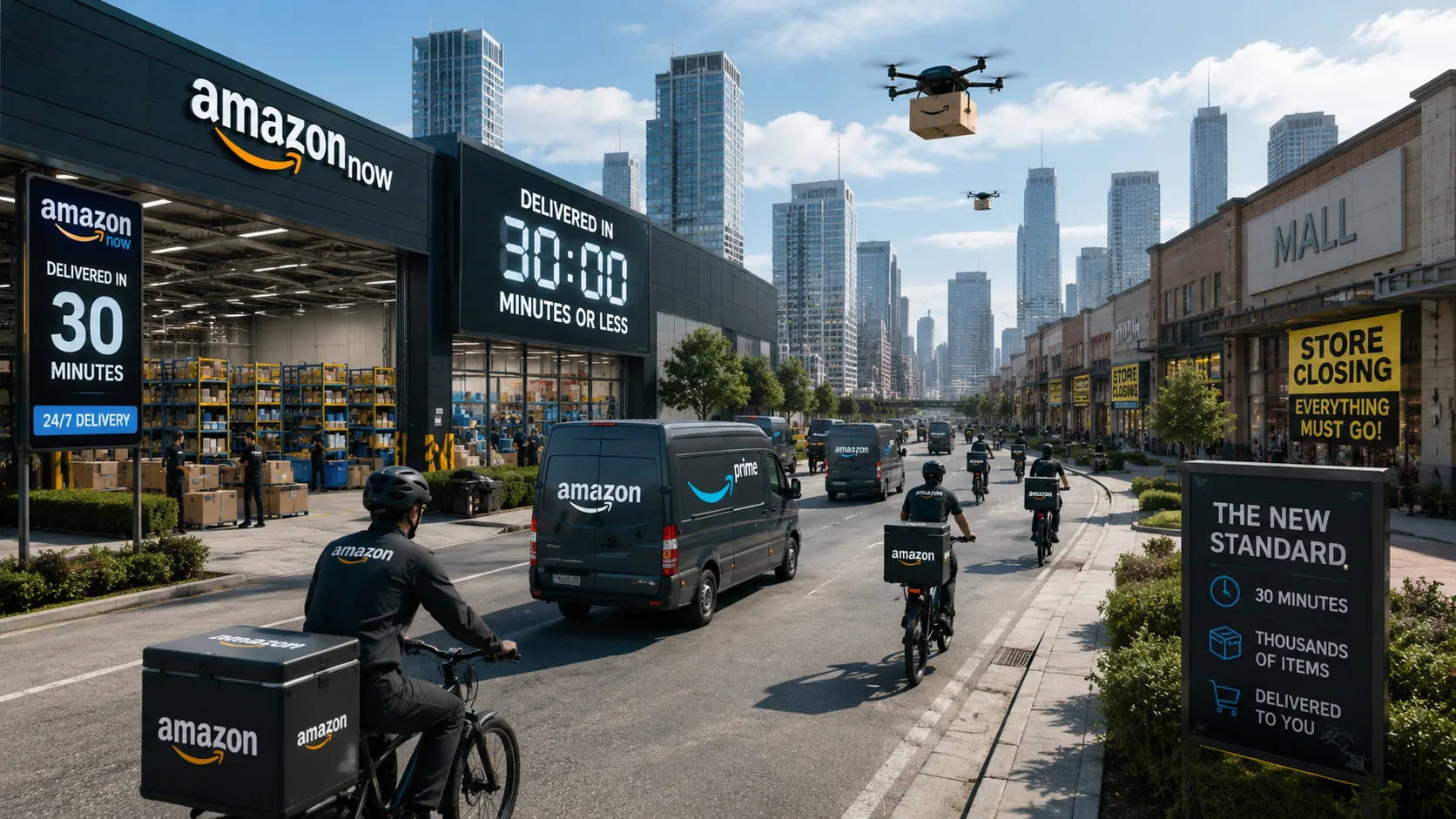
The service promises delivery in 30 minutes or less, operating 24 hours a day in many locations.
That changes the equation for convenience commerce.
Customers can now order groceries, electronics, toiletries, and household items with delivery times approaching the speed of an actual store visit. Amazon says the service is powered through micro-fulfillment centers, commonly referred to as “dark stores,” which are smaller facilities positioned closer to dense population centers.
These locations are radically different from Amazon’s traditional warehouse model. Instead of giant fulfillment centers outside cities, Amazon is building compact urban logistics nodes that can rapidly move high-demand inventory.
The company is using its Flex driver network for deliveries, though management indicated additional transportation methods, including e-cargo bikes, could expand in certain markets.
Pricing also reveals Amazon’s strategy.
Prime members pay $3.99 for Amazon Now deliveries, plus an additional fee for low-cost orders. Non-Prime customers face significantly higher costs. That pricing structure is designed to deepen Prime loyalty while simultaneously nudging more households into subscriptions.
CEO Andy Jassy has already made it clear why Amazon is spending aggressively here. Faster delivery improves conversion rates and increases shopping frequency.
That matters because Amazon’s core retail business increasingly revolves around habit formation.
The Pressure Is About to Spread Across Retail
The obvious losers here are delivery platforms like DoorDash, Instacart, and Uber.
These companies built premium valuations around convenience and rapid fulfillment. Amazon is now attacking that moat directly.
Amazon already owns the customer relationship, has Prime penetration, operates one of the world’s largest logistics systems, and can subsidize delivery economics through its broader ecosystem. That creates a dangerous setup for gig-delivery firms whose margins are already thin.
The bigger threat, however, may be to traditional retailers.
Walmart has spent years emphasizing its own rapid delivery capabilities and proximity advantage through thousands of physical stores. Walmart can still compete aggressively, particularly in groceries, but Amazon’s move raises the cost of staying relevant.
Target, grocery chains, pharmacy chains, and convenience retailers face an even tougher challenge.
The old consumer impulse looked like this:
“I need toothpaste, detergent, batteries, or dinner ingredients. I’ll stop at the store.”
Amazon wants to replace that thought process entirely.
Once delivery becomes nearly instantaneous, physical convenience starts losing its advantage.
That threatens foot traffic across multiple retail categories simultaneously.
Wall Street May Be Underestimating the Real Goal
Many investors will initially frame this as a logistics story.
That misses the larger picture.
Amazon is trying to compress the gap between desire and purchase down to almost zero. Every minute removed from delivery times increases the odds consumers stay inside Amazon’s ecosystem instead of shopping elsewhere.
This has enormous implications for advertising revenue, data collection, subscription retention, and long-term pricing power.
The company is effectively building an operating system for urban consumption.
That is why Amazon continues pouring money into fulfillment infrastructure despite investor concerns about margins. Jassy appears willing to sacrifice near-term efficiency for behavioral dominance later.
There is also a second layer investors should watch closely.
Ultra-fast delivery dramatically increases the strategic value of dense urban logistics real estate. Warehouses located closer to population centers become more valuable than sprawling facilities far outside metro areas.
That creates ripple effects across industrial REITs, local transportation networks, labor demand, and city zoning battles.
Amazon’s expansion may also intensify political scrutiny around gig labor. The service heavily relies on Flex drivers using personal vehicles, which raises familiar debates around contractor classification, compensation, and labor protections.
If regulators eventually tighten rules around gig labor economics, delivery costs across the sector could rise sharply.
Investors Should Watch These Areas Closely
Key Potential Winners
- Amazon
- Industrial REITs with urban logistics exposure
- Warehouse automation providers
- Cold-chain and micro-fulfillment technology firms
- Last-mile delivery infrastructure companies
Companies Facing Intensifying Pressure
- DoorDash
- Instacart
- Convenience retail chains
- Regional grocery operators
- Big-box retailers with weaker e-commerce ecosystems
Catalysts Investors Need to Monitor
- Amazon Prime subscriber growth
- Same-day and ultra-fast delivery adoption rates
- Margin compression among delivery competitors
- Regulatory developments tied to gig workers
- Expansion of dark store infrastructure
- Walmart’s counter-response strategy
- Consumer spending shifts away from in-store purchases
The Clock Is Becoming Amazon’s Biggest Weapon
Amazon already changed consumer expectations once with two-day shipping.
Then it normalized next-day delivery.
Now it is attempting to make 30 minutes feel standard.
That is the real story investors should focus on.
Every time Amazon successfully shortens delivery windows, it strengthens customer dependency while weakening competitors that still rely on physical friction to survive. The company is slowly converting convenience into a monopoly-like advantage.
And unlike many expensive AI experiments dominating markets today, this strategy directly impacts purchasing behavior immediately.
That makes it dangerous for competitors.
It also makes it potentially very profitable for Amazon shareholders over the long run.
About Author