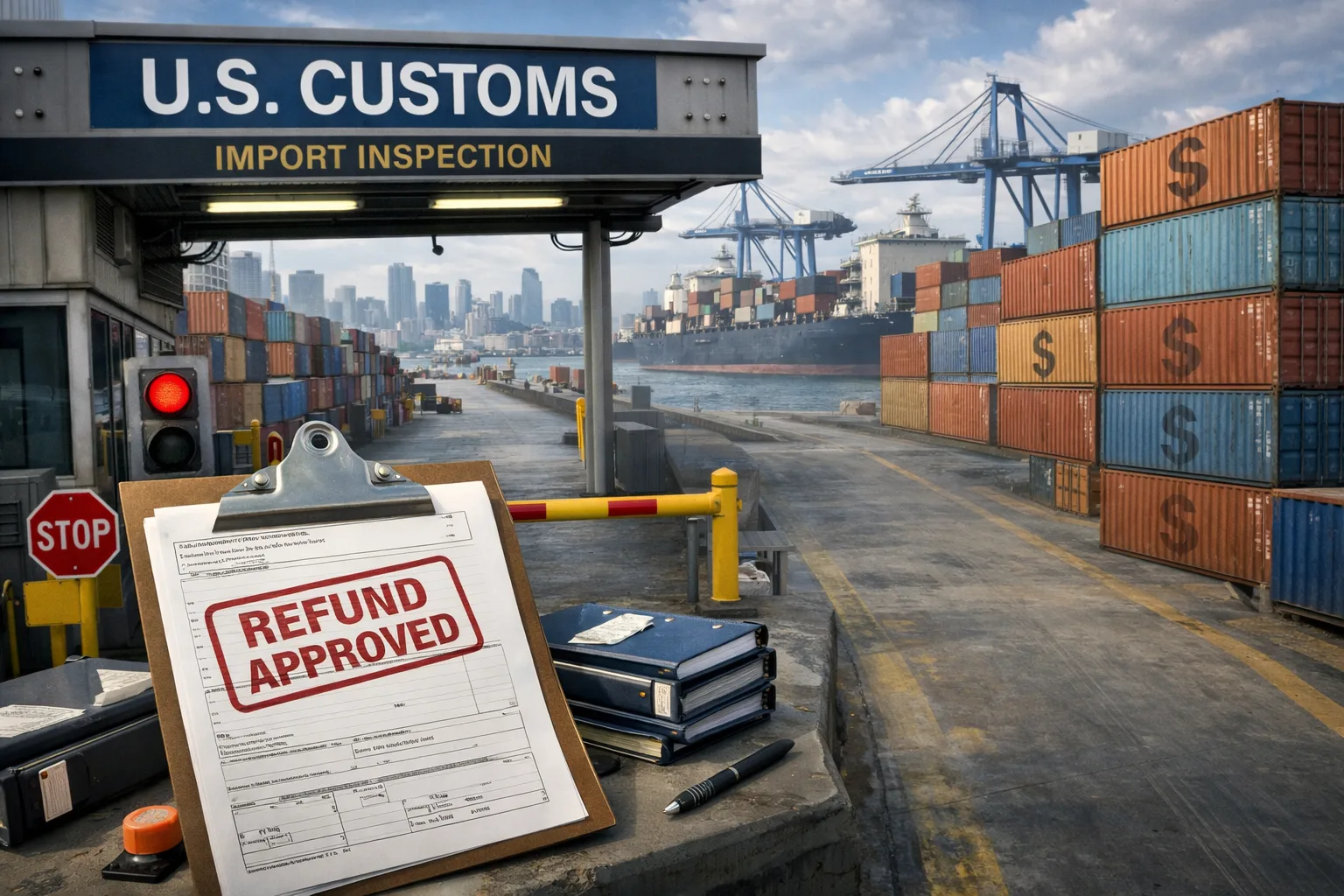
The first real financial consequences from the Supreme Court’s decision striking down parts of President Donald Trump’s tariff regime are now hitting corporate balance sheets.
On Tuesday, companies confirmed they have started receiving tariff refund payments from the U.S. government after the Court ruled several tariffs imposed under the International Emergency Economic Powers Act were unconstitutional. The refunds could eventually total more than $35 billion across millions of shipments, creating an unexpected liquidity injection for parts of corporate America while reopening political and legal tensions around Trump’s trade agenda.
For investors, this is no longer a theoretical court fight. Real money is moving.
A Sudden Cash Windfall Begins Hitting Corporate America
Oshkosh Corporation confirmed Tuesday it has already started receiving tariff refund payments.
CFO Matt Field told CNBC:
“Following acceptance of our initial filing, we have begun receiving payments on our tariff refund claims, representing an initial portion of our total claims submitted.”
The company said it has not yet verified the full amount it expects to recover.
Basic Fun!, the company behind Care Bears and Tonka trucks, also confirmed receiving early refund payments. CEO Jay Foreman said the initial refunds represent only about 5% of the company’s claims so far, but management already plans to use the funds to stabilize operations and increase employee compensation.
That matters because it shows these refunds are immediately affecting corporate decision-making. This is not dormant accounting noise sitting on balance sheets. Companies are deploying the cash.
Foreman said:
“We will utilize the refund dollars to help support our 2026 cash flow and invest in our team.”
Meanwhile, logistics giants including UPS, FedEx, and DHL have previously stated they intend to file tariff refund claims on behalf of customers.
That opens the door for a much broader corporate reimbursement cycle across manufacturing, retail, transportation, and industrial sectors.
The Market Impact Is Bigger Than Most Investors Realize
The immediate investor takeaway is straightforward: some companies are about to receive sizable unexpected cash inflows during a period where financing costs remain elevated and margins remain under pressure.
For heavily import-dependent businesses, tariff refunds effectively operate like retroactive margin expansion.
That changes earnings math.
Companies that absorbed tariff costs over the past several years may now report improved free cash flow, stronger liquidity positions, and potentially reduced borrowing needs. Small and mid-sized importers could see the largest proportional impact because many were forced to absorb costs directly rather than pass them to consumers.
This also creates a new earnings wildcard for analysts.
Refund timing, accounting treatment, and disclosure standards will vary widely by company. Some firms may recognize gains immediately. Others may stagger recognition over quarters depending on claim verification and accounting guidance.
Investors should pay close attention during upcoming earnings calls for mentions of:
- Tariff refund receivables
- Customs recovery claims
- One-time trade recovery adjustments
- Retroactive duty reimbursements
- Margin normalization commentary
Industrial manufacturers, consumer goods companies, toy makers, electronics firms, and import-heavy retailers could all see temporary boosts.
The Real Story: This Quietly Weakens Trump’s Trade Weapon
The deeper story here is political and structural.
Trump’s tariff strategy relied heavily on the International Emergency Economic Powers Act of 1977, which gave the executive branch broad authority during national emergencies. The Supreme Court’s ruling effectively narrowed how aggressively future presidents can use emergency powers to impose sweeping tariffs without congressional backing.
That has enormous implications for markets.
For years, investors operated under the assumption that tariffs could be deployed rapidly and unpredictably as geopolitical leverage. This ruling injects legal friction into that process.
Trade policy may now become slower, more litigated, and harder to execute unilaterally.
That matters for:
- Global supply chain planning
- Manufacturing reshoring strategies
- Commodity pricing
- Inflation expectations
- Long-term capital investment decisions
Markets hate uncertainty, but they also dislike unpredictably aggressive policy shocks. The Court’s decision potentially reduces some of that volatility risk moving forward.
At the same time, Trump’s comments Tuesday suggest the political battle is far from over.
In an interview with WABC radio, Trump said:
“In theory, you have to pay the tariffs back. We’ll fight that.”
He added:
“We were taking in fortunes from people that hate us, countries and companies that hate us.”
That rhetoric signals the refund process itself could become politically contested, especially if refund totals continue climbing into the tens of billions.
Wall Street May Be Underestimating the Supply Chain Ripple Effect
The refund cycle also exposes something uncomfortable: many companies quietly carried massive tariff burdens for years without investors fully appreciating the scale.
U.S. Customs and Border Protection stated in a court filing that it anticipated paying roughly $35.46 billion tied to 8.3 million shipments.
That is not a niche issue.
This effectively becomes a delayed transfer of capital back into the private sector at a moment when many businesses are dealing with:
- Higher wage costs
- Elevated interest rates
- Slowing consumer demand
- Inventory normalization pressure
- Persistent China supply chain restructuring
For some companies, these refunds may function as temporary balance sheet relief exactly when they need it most.
There is also a second-order market effect.
If tariff-related costs ultimately prove reversible through courts, future administrations may face greater resistance from corporations when attempting broad trade restrictions. Businesses now know there is a viable legal pathway to challenge aggressive tariff actions.
That changes boardroom calculations.
Catalysts Investors Should Watch Closely
Here are the next major developments likely to move markets:
- Additional refund announcements from large public companies
- Earnings guidance revisions tied to tariff recoveries
- Treasury or Customs updates on refund processing timelines
- Potential legislative responses from Congress
- Further legal challenges tied to trade authority
- Trump campaign positioning on future tariff powers
- Supply chain sector reactions, especially transportation and manufacturing
Investors should also monitor whether companies treat these refunds as one-time windfalls or signals to increase spending, hiring, buybacks, or dividends.
That distinction matters.
Final Take
The Supreme Court’s tariff ruling just moved from legal theory into corporate cash flow reality.
Billions of dollars are beginning to flow back into American businesses, potentially lifting margins and altering earnings expectations across multiple sectors. At the same time, the decision weakens a major presidential trade weapon that reshaped markets for nearly a decade.
The companies receiving these refunds first may only represent the beginning.
What started as a constitutional fight is quickly becoming a balance sheet story.
And Wall Street is only beginning to price it in.
About Author