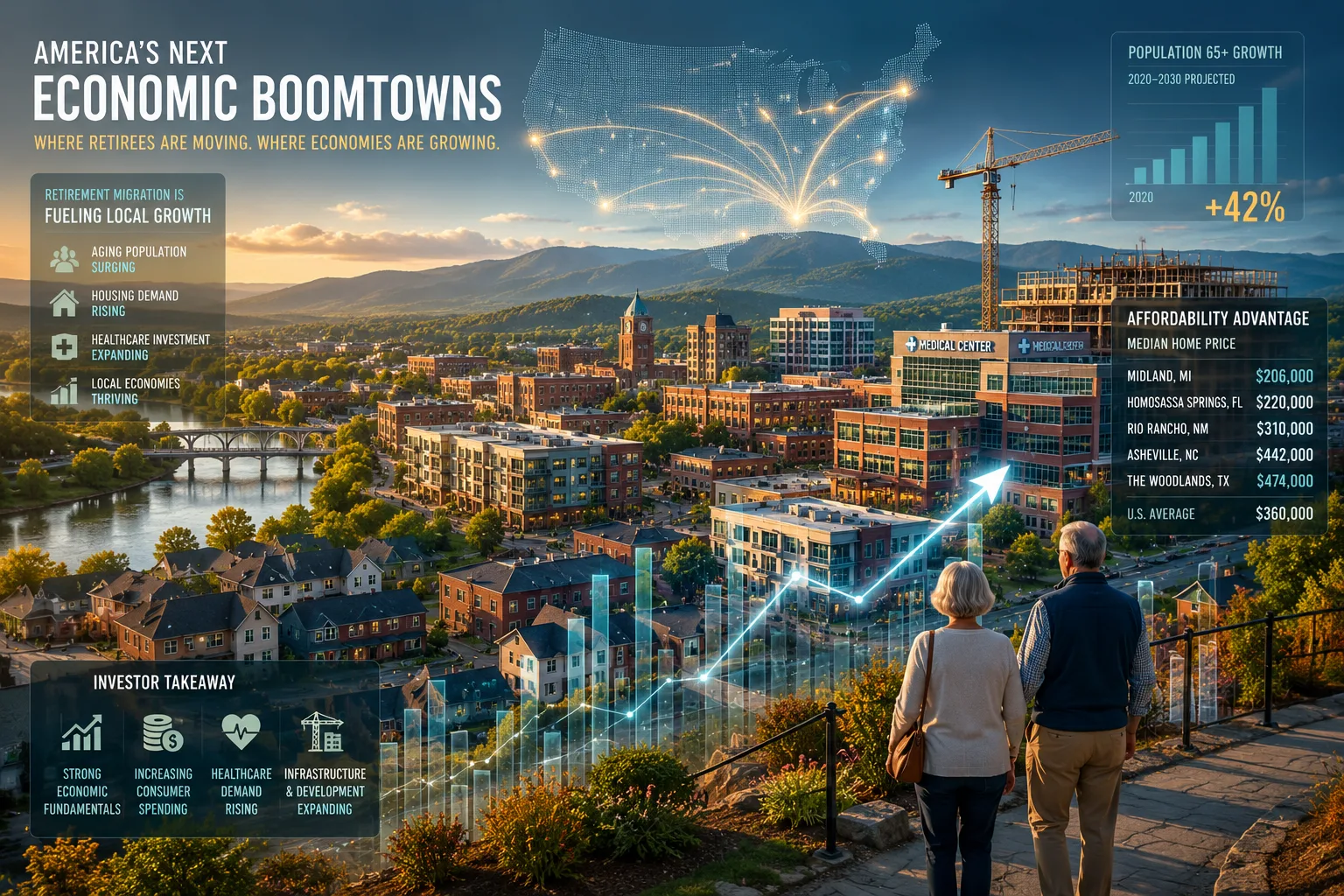
Americans planning to retire in 2026 are chasing more than sunshine and golf courses. They are quietly redrawing the map of future economic growth across the United States. From Midland to Asheville, retirees are increasingly prioritizing affordability, healthcare access, lower taxes, and quality of life over prestige zip codes or expensive coastal markets. That trend has major implications for housing, healthcare, regional banking, infrastructure, insurance, utilities, and local consumer spending.
The deeper story is not about retirement destinations. It is about capital migration. And investors paying attention early may uncover one of the next major demographic-driven investment cycles hiding in plain sight.
America’s Retirement Migration Is Accelerating
The latest analysis from GOBankingRates highlighted five cities that stand out as retirement sweet spots heading into 2026:
- Midland
- Homosassa Springs
- The Woodlands
- Rio Rancho
- Asheville
At first glance, the list looks fairly predictable. Lower taxes. Smaller cities. More affordable housing. Access to healthcare. Outdoor recreation.
That surface-level interpretation misses the larger macroeconomic shift underway.
The United States is entering the largest retirement wave in modern history. Roughly 11,000 Americans turn 65 every day. Tens of millions of Baby Boomers are entering a phase where they are no longer accumulating assets aggressively. They are reallocating them.
That distinction matters enormously.
For decades, investors viewed retirees mainly as consumers of healthcare products and income investments. Today’s retirees increasingly behave more like economic migrators. They relocate wealth, spending power, property tax bases, and investment capital from one region to another.
The result creates localized economic booms in areas many institutional investors largely ignored for years.
Mid-sized retirement markets are becoming economic power centers.
Why Midland, Michigan Quietly Topped the Rankings
The surprise on the list was Midland.
Most Americans instinctively associate retirement with warm-weather states like Florida or Arizona. Yet Midland ranked highest largely because it solves the biggest retirement threat facing middle-class Americans: housing inflation.
With median home prices around $206,000, retirees preserve far more of their nest egg compared to markets where housing consumes a disproportionate share of retirement savings.
This is where the retirement narrative becomes financially important for investors.
Retirees are increasingly prioritizing “retirement durability” over “retirement luxury.”
That means:
- Lower ongoing expenses
- Stable healthcare access
- Walkable communities
- Smaller tax burdens
- Lower insurance costs
- Less exposure to climate-related expenses
The old retirement dream centered on maximizing lifestyle. The emerging retirement strategy centers on minimizing financial fragility.
That shift changes which regions win economically over the next decade.
The Hidden Story Nobody Is Talking About
Most financial coverage treats retirement migration as a lifestyle trend.
It is actually a stress signal from the American middle class.
Retirees are responding to a financial environment shaped by:
- Persistent housing inflation
- Elevated insurance costs
- Healthcare uncertainty
- Higher property taxes
- Market volatility
- Rising longevity risks
The media often frames retirement planning around a single “magic number.” One report cited estimates ranging from roughly $735,000 needed in Oklahoma to over $1.1 million in Arizona.
That framing misses the key variable.
Retirement success increasingly depends less on portfolio size and more on geographic efficiency.
Two retirees with identical savings can experience completely different financial realities depending on where they live.
That is changing how wealth flows across America.
Large coastal metros that dominated economic growth for years are beginning to lose retirees with significant accumulated wealth. Meanwhile, secondary markets with lower costs are absorbing affluent aging populations that continue spending heavily on healthcare, restaurants, home improvement, financial services, leisure, and local experiences.
This creates an overlooked economic multiplier effect.
Retirees may stop working, but they do not stop spending.
The Retirement Capital Rotation Framework
Investors need a better framework for understanding what is happening.
Call it the “Retirement Capital Rotation.”
The model works in four stages:
Stage 1: Cost Pressure
Housing, taxes, healthcare, and insurance costs rise sharply in major metros.
Retirees begin reassessing whether remaining in expensive regions makes financial sense.
Stage 2: Wealth Relocation
Home equity accumulated over decades gets unlocked through downsizing or relocation.
A retiree selling a $900,000 home in a high-cost region and moving to a $250,000 market suddenly frees hundreds of thousands in deployable capital.
That money does not disappear.
It gets reinvested into:
- Dividend portfolios
- Municipal bonds
- REITs
- Local businesses
- Healthcare spending
- Consumer services
Stage 3: Secondary Market Expansion
Smaller cities experience:
- Rising healthcare investment
- Increased demand for local services
- Higher property values
- Expanded infrastructure needs
- Population stabilization
This is already happening across parts of Texas, North Carolina, Florida, and the Mountain West.
Stage 4: Investor Recognition
Wall Street eventually notices demographic tailwinds.
Capital floods into:
- Regional banks
- Healthcare providers
- Homebuilders
- Senior living operators
- Utility companies
- Infrastructure plays
By the time institutional capital fully arrives, much of the easy upside is already gone.
That is why understanding demographic shifts early matters.
The Florida Story Is Changing
Homosassa Springs made the list partly because Florida still offers attractive tax advantages and retirement-friendly policies.
Yet the broader Florida story is becoming more complicated.
Investors focusing only on migration inflows may overlook mounting pressures:
- Home insurance inflation
- Climate-related rebuilding costs
- Property tax increases
- Infrastructure strain
- Healthcare capacity issues
Some retirees continue moving to Florida enthusiastically. Others are beginning to reconsider whether the economics still work long term.
This creates divergence inside retirement markets themselves.
The winners going forward may not simply be warm-weather states.
The winners may be markets balancing:
- Affordability
- Climate resilience
- Healthcare access
- Tax efficiency
- Infrastructure quality
That is a narrower list than many investors assume.
Healthcare Is Becoming the Real Retirement Trade
Many investors still view retirement investing primarily through homebuilders or senior housing.
Healthcare infrastructure may become the more powerful long-term play.
Look closely at several cities on the list:
- The Woodlands benefits from proximity to Houston healthcare systems.
- Rio Rancho offers access to Albuquerque medical facilities.
- Asheville continues expanding healthcare services for aging populations.
This matters because retirees increasingly choose locations based on medical access before lifestyle amenities.
The aging population wave is likely to drive sustained demand for:
- Outpatient centers
- Medical office REITs
- Home healthcare
- Telehealth infrastructure
- Regional hospital systems
- Specialized pharmaceutical services
Healthcare may ultimately become the central economic engine of retirement migration.
That creates opportunities far beyond traditional retirement community stocks.
The Contrarian Insight Investors Should Consider
Many analysts assume retiring Baby Boomers will slow the economy because retirees spend less than younger workers.
That view is incomplete.
Retirees often redirect spending rather than reduce it entirely.
Instead of commuting costs and child expenses, spending shifts toward:
- Healthcare
- Travel
- Home remodeling
- Leisure
- Financial planning
- Wellness
- Local entertainment
- Service industries
In many smaller cities, affluent retirees inject stable recurring spending into local economies.
That can create unusually resilient regional growth patterns.
A town attracting thousands of financially secure retirees may experience steadier economic activity than regions heavily dependent on volatile industrial cycles.
This becomes especially important during recessions.
Retirement-driven economies sometimes hold up better because Social Security, pensions, investment income, and retirement distributions create relatively stable cash flows compared to employment-dependent markets.
That stability could make certain retirement-heavy regions surprisingly defensive investments during economic slowdowns.
Housing Investors Should Pay Close Attention
Retirement migration may also reshape housing demand in ways investors are underestimating.
Smaller cities increasingly face competing pressures:
- Retiree demand
- Limited inventory
- Local wage constraints
- Infrastructure expansion needs
That combination can gradually push housing prices higher even in historically affordable markets.
Investors should watch for:
- Regional homebuilders
- Manufactured housing operators
- Age-targeted housing developments
- Utility expansion projects
- Property management companies in retirement corridors
At the same time, investors should remain cautious about overheated retirement markets where insurance and climate risks could erode affordability faster than incomes can adjust.
The future retirement winners likely sit in a middle zone:
- Affordable
- Healthcare-accessible
- Tax-efficient
- Climate-manageable
- Infrastructure-ready
What Investors Should Monitor Over the Next 24 Months
Several forward-looking indicators could determine which retirement markets emerge as major economic winners:
Insurance Affordability
Insurance inflation may become one of the largest retirement migration variables in America.
Some traditionally attractive retirement regions could lose competitiveness quickly if insurance costs continue surging.
Healthcare Expansion
Watch where hospital systems and outpatient providers are investing aggressively.
Healthcare investment often signals where long-term demographic demand is heading.
Regional Banking Growth
Community and regional banks benefiting from rising deposits in retirement migration zones could see durable growth.
Infrastructure Spending
Roads, utilities, broadband, and water systems become increasingly important as population shifts accelerate.
Tax Policy Changes
States competing for retirees may continue adjusting tax structures to attract affluent older populations.
That competition could intensify significantly over the next decade.
The Bigger Picture Most Investors Still Miss
The retirement migration story is ultimately about the geographic redistribution of American wealth.
That shift affects:
- Real estate values
- Municipal finances
- Healthcare demand
- Consumer spending
- Banking deposits
- Local labor markets
- Infrastructure investment
It also changes political and economic influence across regions.
Investors focusing only on national averages may miss the massive regional divergence developing underneath the surface.
Some cities are quietly becoming retirement-era economic engines.
Others may struggle as aging populations leave behind shrinking tax bases and weaker consumer demand.
This is one of the clearest examples of demographics directly reshaping investment landscapes in real time.
Final Takeaway for Investors
The retirement sweet spot is no longer just about warm weather and low taxes.
It is becoming a competition between regions capable of delivering financial sustainability to aging Americans without sacrificing healthcare access, quality of life, or long-term affordability.
That shift creates investable trends across healthcare, housing, infrastructure, utilities, financial services, and regional consumer economies.
The smartest investors will not simply chase the hottest retirement destinations.
They will identify the regions quietly building durable demographic momentum before Wall Street fully prices it in.
About Author