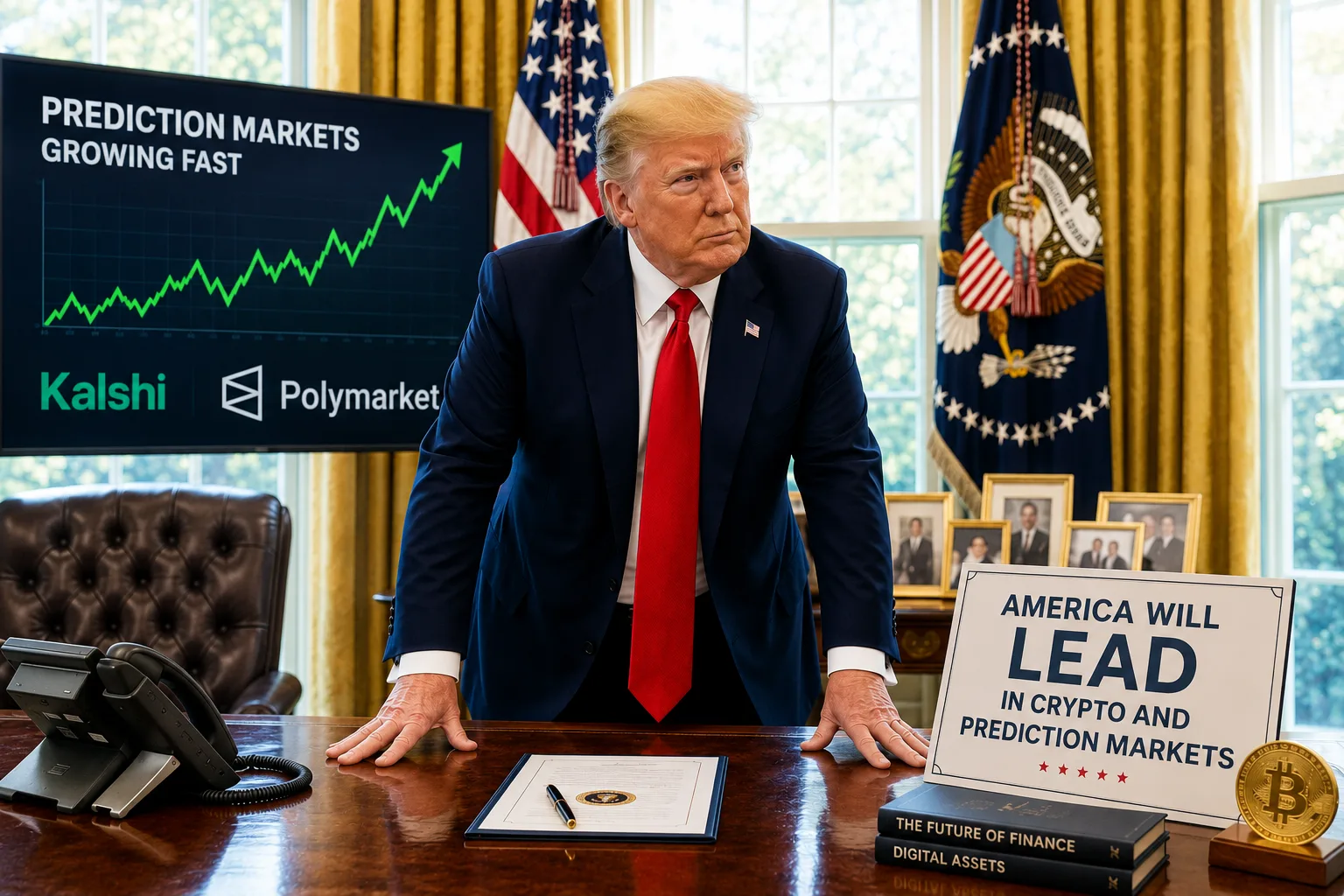
President Donald Trump is making it clear that his administration wants the United States to dominate not only cryptocurrency, but also the rapidly expanding world of prediction markets — a controversial financial sector now at the center of a major legal and political battle.
In a Truth Social post Tuesday, Trump declared that the federal government, specifically the Commodity Futures Trading Commission, should have “exclusive authority” over prediction markets. He also vowed to ensure the broader crypto industry continues to thrive under his leadership.
For investors, this is more than political rhetoric. It signals that the White House may be preparing for a major regulatory showdown involving crypto exchanges, event-contract betting platforms, state governments, and the future structure of digital financial markets in America.
The outcome could create enormous winners and losers across crypto, fintech, sports betting, and online trading.
Trump Doubles Down on Crypto and Prediction Markets
Trump framed both industries as strategic economic priorities for the United States.
“It is critically important that the CFTC’s exclusive authority over Prediction Markets is maintained, and that they will thrive,” Trump wrote.
He also argued that America must maintain its lead as the “Crypto Capital of the World,” warning that foreign countries are aggressively trying to overtake the U.S. in digital asset innovation.
That message aligns with a broader shift happening under Trump’s current administration. Since returning to office, Trump has increasingly positioned himself as one of the most pro-crypto presidents in modern U.S. history.
That is a remarkable evolution considering Trump once publicly criticized Bitcoin.
Now, his administration appears focused on:
- Reducing regulatory pressure on crypto firms
- Expanding institutional adoption
- Supporting stablecoin development
- Encouraging blockchain innovation
- Defending prediction market platforms from state crackdowns
For markets, this matters because regulatory clarity has become one of the single biggest drivers of crypto valuations.
What Are Prediction Markets?
Prediction markets allow users to place trades on the probability of future events.
These platforms can include contracts tied to:
- Elections
- Interest rate decisions
- Economic data
- Sports outcomes
- Geopolitical events
- Weather
- Corporate earnings
- Celebrity news
The industry has exploded in popularity over the past several years.
Two of the largest players are:
- Kalshi
- Polymarket
Supporters argue these markets provide valuable forecasting tools and improve price discovery.
Critics say they are essentially online gambling platforms disguised as financial products.
That distinction is now becoming one of the most important legal battles in fintech.
Why States Are Fighting Back
The core issue is jurisdiction.
The Trump administration and the CFTC argue prediction markets fall under federal commodities law.
But states increasingly disagree.
Governors and attorneys general from both parties argue that event-contract betting resembles sports gambling and should therefore fall under state gaming regulations.
That conflict escalated significantly after Tim Walz signed legislation banning prediction market sites in Minnesota.
The move marked the first state-level law directly targeting the industry.
The Trump administration responded aggressively by filing suit to defend federal oversight authority.
Meanwhile, Letitia James has also taken aim at the sector.
James recently pursued legal action involving crypto-related prediction market activity tied to firms including Coinbase and Gemini.
Her office argues some event-contract products effectively function as illegal gambling operations under New York law.
The companies dispute that characterization and argue they are federally regulated.
This legal conflict could ultimately head toward federal appellate courts or even the Supreme Court if states continue escalating restrictions.
The Hidden Story: Prediction Markets Could Become a Massive Financial Industry
Most investors still underestimate how large prediction markets could become.
Today, many people view them as niche political betting sites.
That may soon change.
If prediction markets receive full federal backing and broader institutional acceptance, they could evolve into an entirely new asset class.
Think about what already exists in traditional finance:
- Options markets
- Futures markets
- Commodity contracts
- Volatility indexes
- Sports betting
- Insurance derivatives
Prediction markets sit somewhere in between all of them.
In practice, they allow traders to monetize information asymmetry and probability forecasting.
That creates massive commercial potential.
Wall Street firms could eventually:
- Hedge political risks
- Trade geopolitical outcomes
- Price recession probabilities
- Bet on Fed decisions
- Manage election-related volatility
- Build structured products tied to event outcomes
In other words, prediction markets may eventually become deeply integrated into institutional finance.
That possibility is exactly why states are pushing back so hard.
If these markets remain federally regulated, states could lose billions in future gambling-related tax revenues and oversight power.
Trump Family Ties Raise Ethical Questions
The issue becomes even more politically sensitive because Trump and his family reportedly have financial ties to both crypto ventures and prediction market platforms.
The article references ties between Trump’s eldest son, Donald Trump Jr., and companies including Kalshi and Polymarket.
Trump and his family are also connected to World Liberty Financial, a crypto-focused business venture.
That overlap has fueled criticism from opponents who argue the administration could financially benefit from regulatory decisions.
Supporters counter that Trump is simply embracing innovation and defending America’s competitive position in emerging financial technology.
Either way, investors should understand that politics and crypto are now becoming deeply intertwined.
Why Crypto Investors Should Pay Close Attention
This fight matters far beyond prediction markets.
The broader message from Trump is that his administration intends to support digital financial infrastructure rather than suppress it.
That represents a major contrast from previous years when regulators frequently relied on enforcement actions instead of clear rules.
Markets generally hate uncertainty.
One reason crypto struggled for years institutionally was because firms could not determine:
- Which assets qualified as securities
- Which regulators had jurisdiction
- Whether products would suddenly face lawsuits
- How exchanges could legally operate
Trump’s approach appears designed to create a more permissive framework.
If successful, several areas could benefit:
- Bitcoin adoption
- Stablecoins
- Crypto exchanges
- Blockchain infrastructure companies
- Tokenization platforms
- Event-contract trading firms
- Fintech payment companies
This is partly why institutional capital has increasingly flowed back into crypto markets during Trump’s current presidency.
The Bigger Geopolitical Angle
Trump repeatedly emphasized international competition in his statement.
That was not accidental.
Countries around the world are racing to become leaders in digital finance.
The United States now faces mounting competition from:
- United Arab Emirates
- Singapore
- Hong Kong
- Switzerland
These jurisdictions have aggressively pursued crypto-friendly regulatory frameworks to attract capital, exchanges, startups, and blockchain developers.
If the U.S. becomes overly restrictive, firms can increasingly relocate overseas.
That risk is one reason many American policymakers have softened their stance toward crypto over the past two years.
The fear is no longer just consumer protection.
It is national competitiveness.
The Contrarian Insight Most Investors Are Missing
Many investors still frame crypto solely as a Bitcoin story.
That may be outdated thinking.
The larger opportunity could ultimately be the infrastructure surrounding digital finance itself.
Prediction markets represent one example.
Others include:
- Tokenized assets
- Blockchain settlement systems
- Digital identity infrastructure
- Stablecoin payment rails
- Real-world asset tokenization
- AI-integrated financial contracts
If prediction markets achieve mainstream legitimacy, they could become one of the first major examples of how blockchain-based finance expands beyond traditional crypto speculation.
That could attract an entirely new class of institutional investors.
What Investors Should Watch Next
Several major developments could determine where this story goes from here:
1. Federal Court Battles
The legal war between states and the federal government could define whether prediction markets remain nationally accessible.
2. CFTC Leadership Changes
Any further restructuring inside the CFTC could dramatically impact enforcement priorities.
3. Congressional Legislation
Congress may eventually attempt to formally define prediction market oversight authority.
4. Institutional Adoption
Large financial firms entering prediction markets would legitimize the industry almost overnight.
5. Crypto Market Reactions
If investors believe Trump’s administration will continue easing pressure on digital assets, crypto-related equities and tokens could benefit significantly.
Why This Matters for Investors
This story is ultimately about control over the future of financial markets.
Prediction markets sit at the intersection of:
- Gambling
- Finance
- Data markets
- Political forecasting
- Blockchain technology
- Regulatory power
Trump is signaling that his administration wants America to lead that transformation rather than restrict it.
Whether investors agree politically or not, the implications are substantial.
If federal regulators win this battle, prediction markets could become one of the fastest-growing financial sectors of the next decade.
If states succeed in shutting them down individually, the industry could fragment into a confusing patchwork of rules that slows growth dramatically.
Either outcome will create major investment consequences across crypto, fintech, gaming, and digital finance.
And for now, the White House appears fully prepared to fight for the industry’s future.
About Author