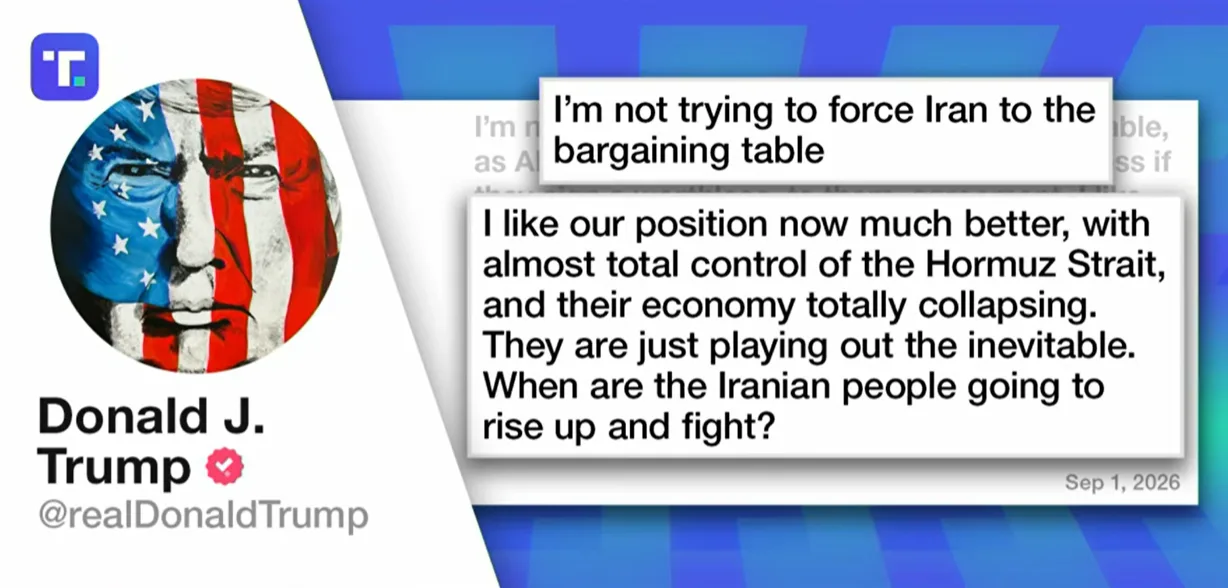
President Donald Trump announced Monday that the United States and Iran will return to the negotiating table Tuesday in Doha, Qatar, just days after both countries exchanged military strikes that threatened to unravel a fragile ceasefire.
The announcement marks the latest twist in one of the most volatile geopolitical stories of the year. After a weekend that saw U.S. strikes on Iranian military targets and renewed Iranian attacks on commercial shipping, both governments now appear willing to test whether diplomacy can prevent another escalation.
For investors, the outcome extends well beyond foreign policy. The talks could influence global oil prices, inflation expectations, shipping costs, defense stocks, and broader market sentiment.
Trump Says Iran Requested the Meeting
Trump revealed the planned negotiations in a post on Truth Social Monday morning.
“IRAN HAS REQUESTED A MEETING. IT WILL TAKE PLACE TOMORROW IN DOHA!”
As of Monday afternoon, Iranian officials had not publicly confirmed Trump’s statement.
According to White House Press Secretary Karoline Leavitt, U.S. special envoys Steve Witkoff and Jared Kushner will travel to Qatar for the discussions.
Leavitt emphasized that while negotiations are moving forward, the administration remains prepared to respond militarily if necessary.
“As far as we’re concerned, we’re holding up our end of the ceasefire. Violence will be met with violence.”
She added that discussions surrounding the memorandum of understanding between both countries would continue while the ceasefire remains in place.
Weekend Military Clashes Nearly Derailed Negotiations
The diplomatic breakthrough comes only days after both countries exchanged military attacks across the Persian Gulf.
The United States launched strikes against Iranian military infrastructure after Washington accused Tehran of targeting commercial vessels operating near the Strait of Hormuz.
Iran responded with additional attacks on regional shipping, prompting fears that months of diplomatic progress had collapsed.
On Sunday, Trump issued one of his strongest warnings yet toward Iran, saying that if diplomacy failed, the United States could complete the military campaign already underway.
Despite those threats, officials from both governments later agreed to temporarily pause hostilities while negotiations continued.
Oil Prices Continue Moving Lower
Interestingly, markets have largely welcomed the ceasefire despite the renewed military exchanges.
Trump highlighted the recent decline in oil and gasoline prices Monday, noting that U.S. crude has fallen back toward levels seen before fighting intensified earlier this year.
Lower energy prices could ease inflation pressures that have remained stubborn throughout much of 2026.
If negotiations in Doha produce additional confidence that shipping lanes will remain open, oil markets could continue stabilizing.
However, traders remain cautious.
Any renewed attack inside the Strait of Hormuz could quickly reverse those gains.
What Investors Should Watch Next
Tuesday’s meeting could become one of the most important geopolitical events of the week.
Several developments deserve close attention:
- Whether Iran officially confirms participation in the Doha negotiations.
- Any announcement expanding or formalizing the current ceasefire.
- New commitments regarding commercial shipping through the Strait of Hormuz.
- Additional details surrounding the memorandum of understanding under negotiation.
- Immediate reactions in crude oil, defense stocks, airline shares, and broader equity markets.
Even if the talks produce only incremental progress, avoiding another military escalation would likely be viewed positively by financial markets.
Why This Matters
Markets have repeatedly shown that geopolitical risks involving the Middle East can shift rapidly from headline risk to economic reality.
A stable agreement between Washington and Tehran could reduce pressure on global energy markets, ease inflation concerns, and remove one of the largest geopolitical uncertainties currently facing investors.
But after a weekend that included missile strikes, attacks on commercial shipping, and renewed military threats, Tuesday’s negotiations carry unusually high stakes.
For now, investors are watching Doha just as closely as Wall Street.
About Author