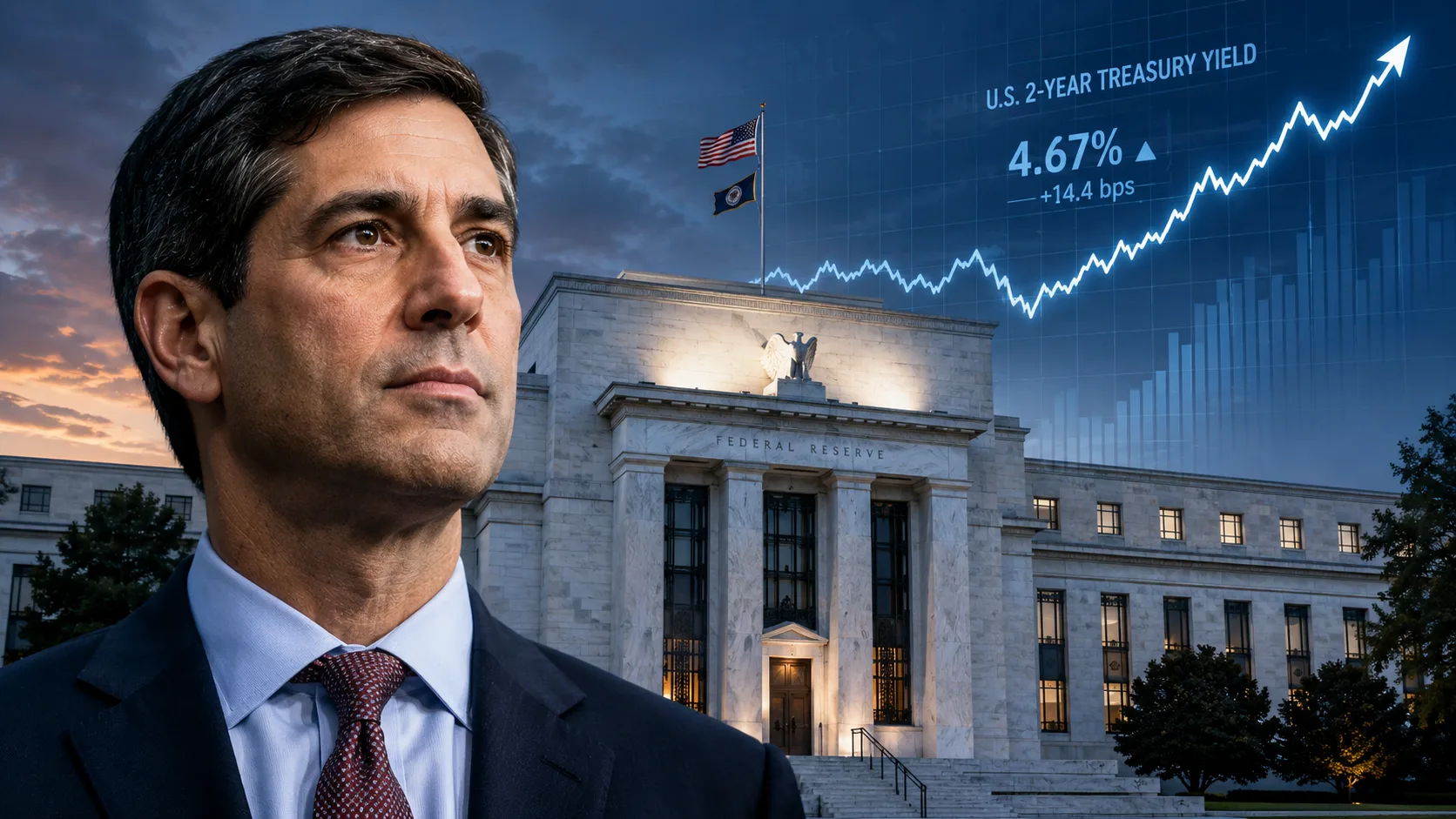
When investors want clues about where interest rates are headed, they typically parse every word from the Federal Reserve chair for hidden signals.
That strategy may no longer work.
New Federal Reserve Chair Kevin Warsh delivered a clear message Wednesday: stop trying to predict future Fed decisions based on central bank commentary and start paying closer attention to the actual economic data.
The remarks mark one of the biggest shifts in Federal Reserve communication strategy in years and could fundamentally change how investors interpret everything from inflation reports to employment data. Instead of relying on carefully crafted hints from policymakers, markets may now have to react directly to incoming economic numbers.
For investors, that means market volatility could increase as every major inflation report, jobs report, and GDP release carries even greater weight.
Why Wall Street’s Favorite Playbook Is No Longer Enough
Speaking at a gathering of global central bankers in Portugal, Warsh reiterated that the Federal Reserve is abandoning the practice known as “forward guidance,” where policymakers provide advance clues about the likely path of interest rates.
Previous Fed chairs frequently used speeches, interviews, and policy statements to prepare markets for future moves. The approach helped reduce surprises but also encouraged investors to focus more on Fed messaging than the underlying economy.
Warsh wants to reverse that.
His advice to Wall Street was straightforward: watch the data, not the speeches.
The shift represents a philosophical change that could make Federal Reserve meetings less predictable while placing greater importance on each major economic release.
The July Interest Rate Decision Remains a Mystery
Despite repeated questions, Warsh refused to offer any indication about what the Fed might do at its next policy meeting in July.
He also declined to say whether recent inflation pressures tied to the Middle East conflict would prove temporary.
“I am not going to make a judgment now,” Warsh said. “We meet again in four weeks.”
That refusal to telegraph future decisions is exactly the approach he has promised since taking over as Fed chair in May after being nominated by Donald Trump.
Unlike many of his predecessors, Warsh believes central bankers have become too vocal and, in some cases, have created more confusion than clarity for investors.
Inflation Remains the Fed’s Top Priority
While Warsh offered no guidance on future rate cuts, he did reinforce one point repeatedly: bringing inflation back under control remains the Federal Reserve’s primary objective.
Inflation has remained above the Fed’s 2% target for roughly five years, and Warsh emphasized that restoring price stability is non-negotiable.
“We are going to deliver on price stability in the U.S.,” he said.
That language suggests the Fed is unlikely to rush into cutting interest rates simply because financial markets expect it. Instead, policymakers appear prepared to wait until inflation convincingly moves toward their long-term goal.
For investors hoping for rapid rate cuts later this year, that could mean expectations need to be recalibrated.
Even President Trump Won’t Dictate Fed Policy
Before Warsh became Fed chair, President Trump repeatedly urged the Federal Reserve to lower interest rates.
Asked whether he would be willing to oppose the president if necessary, Warsh offered an unusually direct response.
“We are going to be an independent central bank at this moment and you are going to see no changes in that.”
The comment reinforces the Fed’s longstanding commitment to political independence, even as pressure from elected officials continues.
For financial markets, maintaining that independence is generally viewed as critical to preserving confidence in monetary policy.
Artificial Intelligence Could Change the Inflation Story
Warsh also highlighted another issue that could become increasingly important over the coming years: artificial intelligence.
According to Warsh, AI is already having meaningful effects on the economy.
In the short term, soaring demand for chips, memory, and other technology infrastructure is contributing to inflationary pressures. Over the longer term, however, AI could improve productivity enough to reduce inflation by helping businesses operate more efficiently.
“If the last four quarters are an indication … there is reason to be optimistic,” Warsh said.
That view aligns with a growing number of economists who believe productivity gains from AI could eventually offset some of today’s inflation pressures.
Why Every Economic Report Just Became More Important
Warsh’s new communication strategy could significantly alter how markets behave.
Without forward guidance, investors may place greater emphasis on:
- Monthly inflation reports
- Employment data
- Retail sales
- GDP growth
- Consumer spending
- Manufacturing activity
Each release now has greater potential to shift expectations for future interest-rate decisions because the Federal Reserve is signaling it will respond to incoming data rather than pre-committing to a policy path.
That could lead to sharper market reactions following major economic releases while reducing the importance of speeches from Fed officials.
What It Means for Investors
Kevin Warsh is attempting to reshape how markets interact with the Federal Reserve.
Instead of decoding every public comment from policymakers, investors are being encouraged to focus on the actual health of the U.S. economy.
If the strategy holds, future market moves may become increasingly driven by hard economic data rather than speculation over Fed messaging.
For long-term investors, that means paying closer attention to inflation trends, labor market strength, and economic growth could become more valuable than trying to predict the next headline from the central bank.
With the July Fed meeting approaching, every major economic report released over the coming weeks could play a much larger role in determining the direction of interest rates—and the markets that depend on them.
About Author