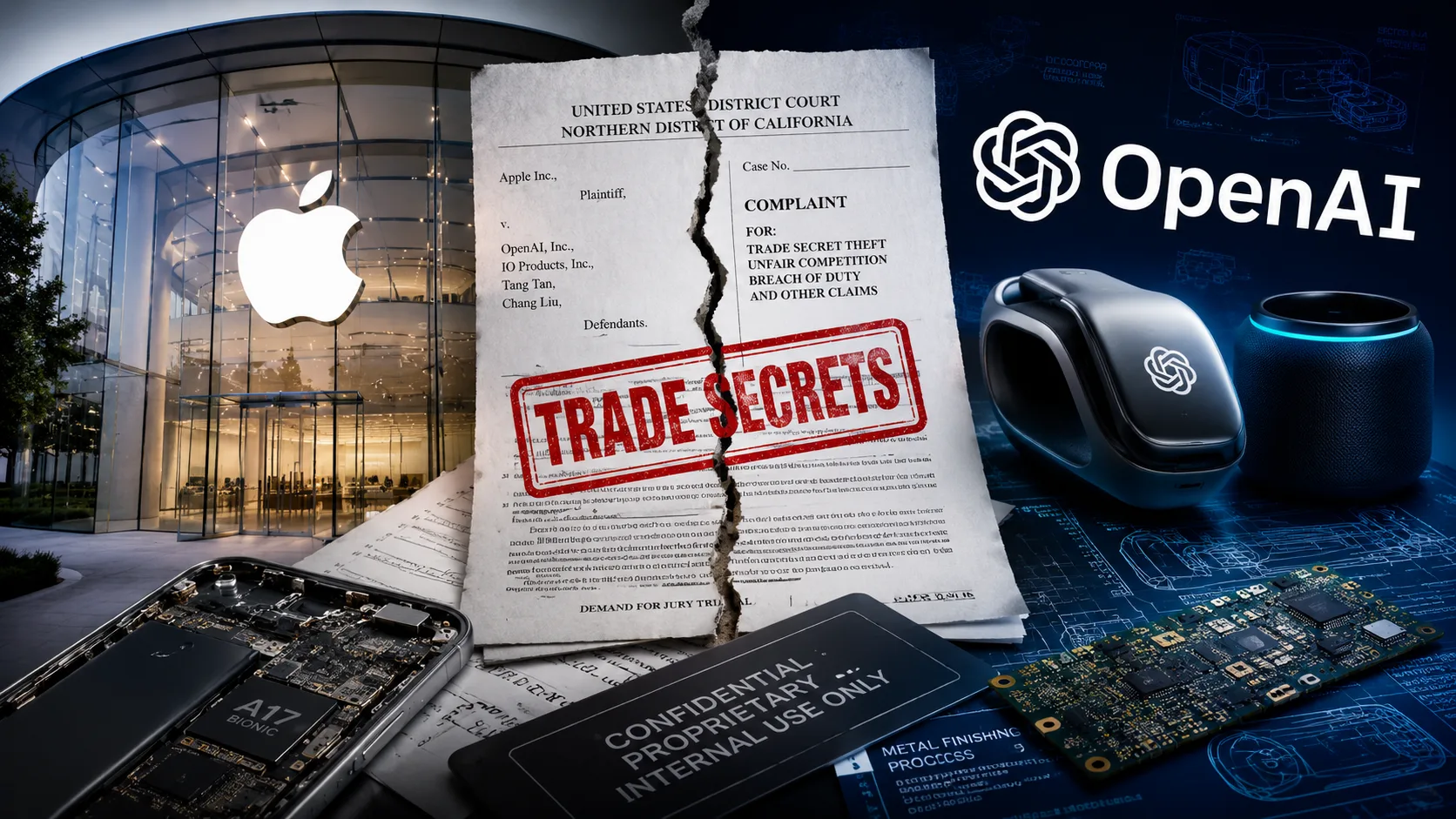
Apple and OpenAI, once celebrated partners in bringing artificial intelligence to the iPhone, are now locked in one of the technology industry’s most consequential legal battles.
Apple filed a federal lawsuit Friday in the U.S. District Court for the Northern District of California accusing OpenAI of systematically stealing trade secrets to accelerate its push into consumer hardware. The lawsuit alleges the effort extended from rank-and-file employees to senior executives and business partners, describing it as a coordinated campaign that operated “at every level.”
If Apple’s allegations are proven, the case could reshape competition in the rapidly expanding AI hardware market while adding another major legal challenge for OpenAI as it prepares for what many expect to be one of the largest IPOs in technology history.
Apple Claims OpenAI Ran a Coordinated Campaign to Obtain Trade Secrets
At the heart of Apple’s lawsuit is the accusation that OpenAI improperly acquired confidential information related to Apple’s unreleased products, manufacturing processes, and proprietary engineering techniques.
In the filing, Apple alleges that former employees who interviewed with or later joined OpenAI were encouraged to disclose confidential information that belonged to Apple.
“This much is clear, however: at every level, from members of its Technical Staff to its Chief Hardware Officer, and in coordination with business partners, OpenAI has been stealing Apple’s trade secrets and confidential information,” Apple stated in its complaint.
Apple says the alleged conduct went far beyond isolated incidents and instead represented an organized effort to gain an advantage in developing competing hardware products.
Former Apple Executive Named in the Lawsuit
One of the lawsuit’s primary defendants is Tang Tan, OpenAI’s Chief Hardware Officer and a former Apple vice president who spent years helping oversee iPhone development.
According to Apple, Tan instructed Apple employees interviewing at OpenAI to bring physical Apple components to interviews.
The lawsuit claims these “show and tell” sessions allowed OpenAI engineers to gather confidential information about Apple’s hardware and manufacturing methods.
Apple also alleges that Tan played a central role in recruiting Apple talent while encouraging the transfer of proprietary knowledge.
Apple Alleges Employees Took Hardware and Confidential Information
The complaint includes additional allegations against former Apple employee Chang Liu, who later joined OpenAI.
Apple claims Liu improperly took an Apple laptop when leaving the company and accuses OpenAI of coaching departing employees on how to avoid Apple’s security procedures during their exits.
The lawsuit further alleges that OpenAI attempted to recreate a specialized metal-finishing process that Apple developed for future hardware products.
According to Apple, OpenAI allegedly worked with manufacturing partners while leading them to believe Apple had approved the use of the proprietary process.
From Strategic Partners to Fierce Rivals
The lawsuit marks a dramatic reversal in the relationship between two companies that only recently appeared closely aligned.
In 2024, Apple announced a high-profile partnership with OpenAI that integrated ChatGPT into Apple Intelligence, bringing OpenAI’s chatbot directly to millions of iPhone users. OpenAI CEO Sam Altman even visited Apple’s headquarters during the launch.
But the relationship began to shift after OpenAI acquired former Apple design chief Jony Ive’s startup, IO Products, in a $6.4 billion deal.
The acquisition signaled OpenAI’s ambition to move beyond software and into consumer hardware, placing it on a direct collision course with Apple.
Apple has since chosen Google’s Gemini models to power the newest version of Siri, further highlighting the growing competitive divide.
OpenAI Denies the Allegations
OpenAI strongly rejected Apple’s claims.
“We have no interest in other companies’ trade secrets,” an OpenAI spokesperson said in a statement. “We remain focused on building innovative technology that empowers people everywhere.”
Apple, meanwhile, said recent evidence convinced the company that confidential information involving unreleased technologies and internal processes had been improperly taken.
Apple has not indicated whether the lawsuit will affect the companies’ existing ChatGPT integration inside Apple Intelligence.
The Lawsuit Arrives at a Critical Time for OpenAI
The legal battle comes as OpenAI faces increasing scrutiny from regulators, competitors, and former partners.
Just two months ago, OpenAI successfully defended itself in a closely watched lawsuit brought by Elon Musk, who accused the company of abandoning its nonprofit mission. A federal jury ruled in OpenAI’s favor, although Musk has said he plans to appeal.
Now, Apple is seeking financial damages, court injunctions, and an order requiring OpenAI to stop using any Apple trade secrets it may have obtained.
With OpenAI widely expected to pursue a historic public offering, the outcome of Apple’s lawsuit could influence investor confidence, product development timelines, and the broader competitive landscape for AI hardware.
Why Investors Should Watch This Case Closely
The lawsuit extends well beyond a dispute between two Silicon Valley giants.
If Apple succeeds, the case could slow OpenAI’s hardware ambitions, disrupt future AI device launches, and establish important legal precedent around employee recruiting, intellectual property protection, and trade secrets in the artificial intelligence industry.
For Apple, the lawsuit underscores how aggressively it intends to defend its technology as AI becomes the next major battleground in consumer electronics.
For OpenAI, it represents one of the highest-profile legal challenges in the company’s history at a moment when its business ambitions have never been larger.
About Author