President Donald Trump has turned Iran’s demand for war reparations back on Tehran, saying the United States should seek compensation for damage Iran has caused over the past 50 years.
The escalating dispute over who owes whom is adding another obstacle to negotiations over the Strait of Hormuz, where the United States and Iran remain fundamentally divided over the American military presence. Washington says its forces are keeping one of the world’s most important energy corridors accessible. Tehran says those same forces are the reason normal shipping cannot resume.
For energy markets, the stalemate is becoming increasingly difficult to ignore. Oil prices climbed Tuesday as traders weighed the prospect that the Strait of Hormuz could remain disrupted far longer than previously hoped.
Trump Turns Iran’s Reparations Demand Around
Trump told reporters in the Oval Office Monday that Iran’s demand for compensation had given him an idea of his own.
“They asked for reparations, you might say, or they asked for money for the damage that we’ve done, and I said that’s a good idea,” Trump said. “Well, we’re going to ask for money for the damage they’ve done over a 50-year period.”
Trump said any compensation from Iran could potentially be used to cover damages suffered by American military personnel killed or wounded in the Middle East. He also pointed to families of protesters killed during the Iranian government’s crackdown on mass unrest this year.
“If there’s damages to be paid, I think Iran should pay those damages,” Trump said.
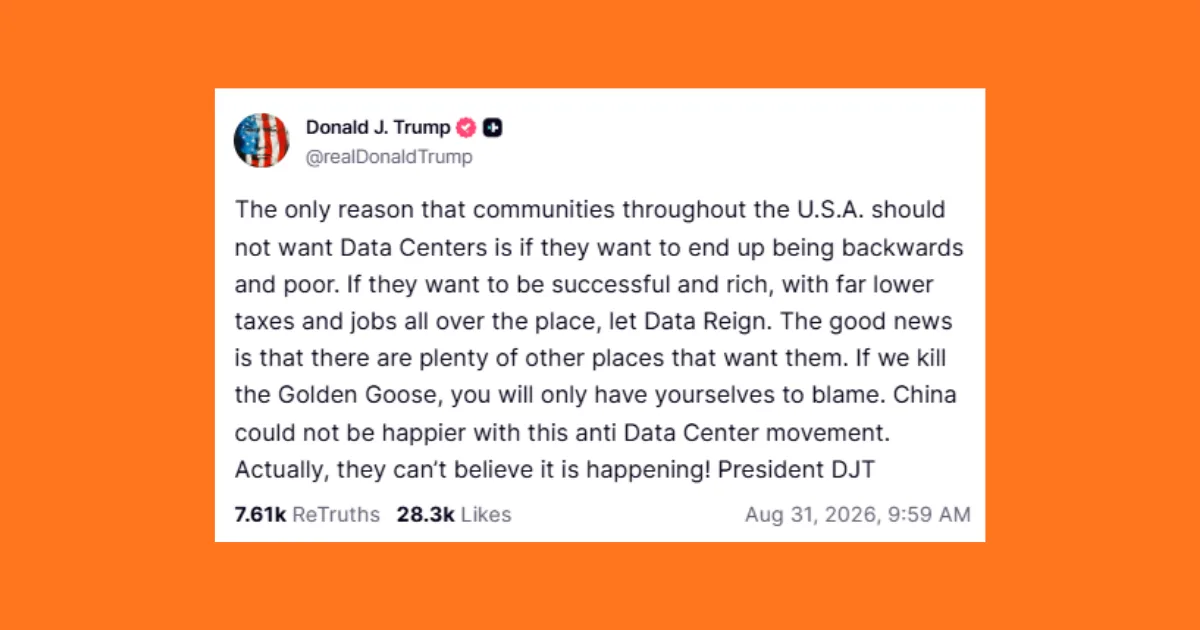
The president reinforced the demand in a Truth Social post Monday, saying he had instructed U.S. representatives to make compensation part of future negotiations with Tehran.
“It is an interesting idea because now I am likewise demanding compensation from Iran,” Trump wrote.
That could make an already difficult diplomatic negotiation considerably harder.
Iran Has Its Own List of Demands
The dispute comes just days after Iran presented sweeping conditions for fully reopening the Strait of Hormuz, the narrow waterway that carried roughly one-fifth of global oil supplies before the war disrupted normal shipping.
Mohammad Bagher Zolghadr, secretary of Iran’s Supreme National Security Council, said Saturday that Tehran would not reopen the strait until Washington lifts its naval blockade and sanctions, withdraws U.S. military forces from the region, pays Iran war reparations and releases frozen Iranian assets.
Iran also wants an end to U.S. attacks against its regional allies.
Those demands were already difficult for Washington to accept. Trump’s decision to counter with an American reparations demand introduces another major point of disagreement.
Instead of negotiating simply over the conditions necessary to restore shipping, the two countries are increasingly arguing over responsibility for decades of conflict, casualties and economic damage.
Iran’s foreign ministry also pushed back Tuesday against Treasury Secretary Scott Bessent’s assertion that U.S. sanctions were “suffocating” the Iranian economy.
Foreign Ministry spokesman Esmaeil Baqaei accused Washington of turning repeatedly to economic sanctions whenever diplomacy fails and escalating them when previous sanctions don’t produce the desired result. He described the strategy as less of a policy than a “compulsive addiction.”
Trump Says the U.S. Now Controls the Strait
Trump, meanwhile, is presenting the situation in dramatically different terms.
The president said Monday that the U.S. Navy had cleared mines from the Strait of Hormuz and that the United States now has “100%” control of the strategically vital waterway.
“It’s open now,” Trump told reporters at the White House, adding that the United States was “the only one that has control of the Strait of Hormuz right now.”
Iran disputes the broader implication that normal shipping has been restored. Tehran continues to insist that the strait will not fully reopen while the United States maintains its naval blockade and military presence.
Iran has also been discussing a potential shipping arrangement with Oman, but Iranian officials have said those talks should not be interpreted as an agreement to fully reopen the waterway.
That creates an unusual and potentially dangerous standoff: Washington considers its military presence essential to keeping Hormuz accessible, while Tehran considers that presence one of the main conditions preventing a return to normal traffic.
Another Maritime Incident Raises the Stakes
The risks surrounding the waterway were underscored again Tuesday.
The U.K. Maritime Trade Operations Centre said it had received a report involving a tanker and military forces in the Gulf of Oman near the Strait of Hormuz.
“Vessels are advised to consider the latest maritime security information and maintain awareness of the evolving operational environment,” UKMTO said, adding that authorities were investigating the incident.
Even without a major new confrontation, continued uncertainty can be enough to discourage commercial shipping companies and insurers from treating the route as normal.
That’s important because the Strait of Hormuz is one of the most consequential chokepoints in the global economy.
Before the conflict, roughly 20% of the world’s oil supply moved through the waterway connecting the Persian Gulf with the Gulf of Oman and Arabian Sea. Significant disruptions can therefore quickly ripple through crude prices, shipping costs, inflation expectations and financial markets around the world.
Oil Prices Jump as Traders See a Longer Standoff
Oil markets reacted Tuesday as hopes for a near-term diplomatic breakthrough weakened.
Global benchmark Brent crude futures climbed 2.5% to around $89.89 per barrel, while U.S. West Texas Intermediate futures rose approximately 2.9% to $84.49.
The move underscores how much geopolitical risk remains embedded in energy prices.
Lloyd Chan, senior currency analyst at MUFG Bank in Singapore, said energy supply disruptions remain a major market concern because tanker traffic through Hormuz continues to be subdued and Brent crude remains well above levels seen before the conflict.
A full-scale regional war is still not the base-case scenario, Chan said, but periodic flare-ups remain possible.
For markets, that distinction matters. Oil doesn’t necessarily need another major war to remain elevated. A prolonged period of restricted tanker traffic, higher insurance costs and uncertainty over whether Hormuz can operate normally could be enough to maintain upward pressure on energy prices.
The Two Sides Are Moving Further Apart
Trump has recently signaled that he is prepared to allow economic pressure to build on Iran rather than immediately launch another major round of military strikes. That strategy gives Washington time to see whether sanctions, the naval blockade and Iran’s domestic economic problems eventually force Tehran to soften its demands.
Iran, however, is showing little public willingness to retreat.
Tehran wants American forces out of the region, sanctions and the naval blockade lifted, frozen assets released and reparations paid. Washington is now responding that Iran should be the one paying compensation, while Trump insists the U.S. already controls the Strait of Hormuz.
That leaves the two countries arguing from almost opposite starting points.
The U.S. views its military presence as the mechanism protecting access to Hormuz. Iran views the American military presence as the obstacle preventing the waterway from returning to normal.
Unless one side changes its position, the prospects for a quick agreement appear increasingly remote.
For investors, that means the Strait of Hormuz could remain one of the biggest geopolitical variables hanging over markets. Continued disruption would threaten to keep oil prices elevated, raise transportation and shipping costs and complicate the inflation outlook just as investors are trying to determine the Federal Reserve’s next move.
The immediate question is no longer simply whether Washington and Tehran can negotiate a deal.
It’s whether either side is prepared to accept the other’s definition of what a deal would even look like.
About Author