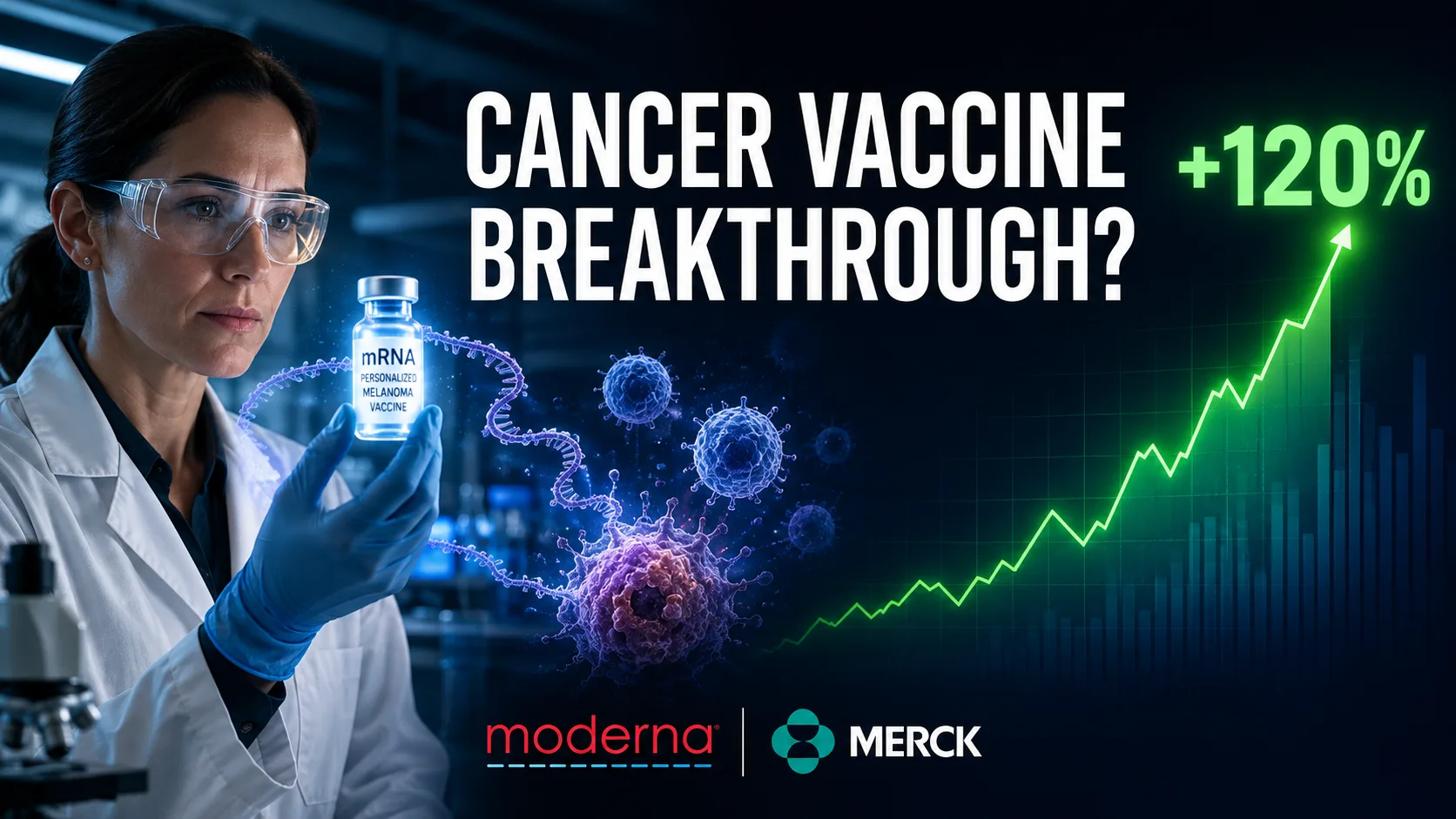
Moderna stock more than doubled Wednesday after the biotechnology company and Merck announced that their personalized mRNA cancer vaccine significantly delayed the return and spread of melanoma in a late-stage clinical trial. The breakthrough could give Moderna its most important commercial opportunity since COVID-19, strengthen Merck’s dominant Keytruda franchise and open the door to an entirely new class of individualized cancer treatments. However, investors should recognize that the companies have released only topline results, while detailed efficacy data, regulatory decisions, manufacturing economics and overall-survival results remain outstanding.
Moderna’s long-promised second act may finally be coming into focus.
Shares of Moderna jumped approximately 124% to nearly $141 by late Wednesday morning, after trading as high as $163. Merck stock gained roughly 11% to around $150. The rally followed the announcement that an experimental personalized cancer vaccine developed by the two companies met its primary and key secondary goals in a Phase 3 melanoma trial.
The market’s reaction was extraordinary, but the underlying development could be even more consequential.
According to Merck and Moderna’s announcement, the combination of Moderna’s personalized mRNA therapy, known as intismeran autogene, and Merck’s blockbuster immunotherapy Keytruda produced statistically significant and clinically meaningful improvements in patients whose high-risk melanoma had been surgically removed.
The treatment extended the period patients remained alive without their cancer returning. It also lowered the risk of melanoma spreading to distant areas of the body compared with Keytruda alone.
This is the first positive Phase 3 result for an individualized neoantigen therapy and the first successful late-stage study of an mRNA-based cancer treatment.
For patients, that could represent a new weapon against one of the deadliest skin cancers. For investors, it may validate billions of dollars in research spending and dramatically expand the long-term commercial possibilities of mRNA technology.
What did the Moderna-Merck cancer vaccine trial show?
The Phase 3 study, called INTerpath-001, enrolled 1,137 patients with stage IIB through stage IV cutaneous melanoma. Each participant’s visible cancer had been completely removed through surgery, and none had previously received systemic treatment.
Patients were randomly assigned on a two-to-one basis to receive one of two regimens:
| Treatment group | Regimen |
|---|---|
| Combination group | Personalized intismeran vaccine plus Keytruda |
| Control group | Keytruda plus placebo |
Patients in the combination arm received up to nine doses of intismeran, administered every three weeks. They also received Keytruda every six weeks for up to nine cycles. Total treatment could last approximately one year.
At a prespecified interim analysis, the combination achieved both of the trial’s most closely watched objectives:
- Recurrence-free survival improved by a statistically significant and clinically meaningful amount.
- Distant metastasis-free survival also improved by a statistically significant and clinically meaningful amount.
Recurrence-free survival measures how long patients remain alive without their cancer returning. Distant metastasis-free survival measures the time before cancer spreads to another organ or distant part of the body—or before the patient dies.
The companies also reported that the safety profile was consistent with earlier studies and that investigators observed no new safety signals.
That combination of efficacy and tolerability is encouraging. But it is important to understand what investors do not yet know.
Merck and Moderna have not disclosed the Phase 3 hazard ratios, absolute recurrence rates, duration of follow-up, detailed adverse-event rates or subgroup results. The companies plan to present the full findings at an upcoming international medical meeting.
The trial will also continue to evaluate overall survival, which measures whether patients receiving the combination ultimately live longer. An improvement in overall survival would further strengthen the clinical and commercial case, but that result is not yet available.
How does Moderna’s personalized cancer vaccine work?
Intismeran autogene—previously known as V940 or mRNA-4157—is not a preventive vaccine like a flu or COVID-19 shot. It is a therapeutic treatment created individually for a patient after cancer has developed.
Every tumor carries mutations that distinguish its cancer cells from healthy cells. Some of those mutations produce abnormal proteins, known as neoantigens, that can potentially be recognized by the immune system.
The treatment process begins with a sample of the patient’s surgically removed tumor. Scientists analyze its genetic profile, identify mutations believed to be important and then manufacture an mRNA therapy specifically for that individual.
Each dose can encode as many as 34 tumor-specific neoantigens.
After the therapy is administered, the mRNA provides instructions that help the immune system recognize those molecular targets. The objective is to prepare T cells to identify and destroy any remaining cancer cells carrying the same mutations.
Keytruda complements that process.
Keytruda blocks the PD-1 pathway, a biological checkpoint that tumors can exploit to hide from the immune system. By removing that brake, Keytruda helps immune cells attack cancer more effectively.
The personalized vaccine effectively gives the immune system a list of targets. Keytruda helps release the immune system to pursue them.
That two-part approach may explain why the combination performed better than Keytruda alone.
“For many years, the idea of creating an mRNA treatment designed specifically for an individual patient’s cancer was aspirational,” Moderna CEO Stéphane Bancel said in the companies’ announcement. “We are now helping turn that vision into a reality.”
Why melanoma is an important first proving ground
Melanoma represents only a small portion of all skin cancer cases, but it causes the majority of skin cancer deaths.
Merck estimates that approximately 112,000 new melanoma cases will be diagnosed in the United States in 2026, resulting in more than 8,500 deaths. Globally, more than 330,000 new cases were diagnosed in 2022.
The American Cancer Society notes that melanoma is substantially more dangerous once it grows deeper into the skin or spreads elsewhere in the body.
That makes preventing recurrence critically important.
Patients included in INTerpath-001 had no detectable cancer remaining after surgery. However, microscopic cancer cells can survive, eventually causing the disease to return locally or spread to distant organs.
This is why doctors use adjuvant therapy: additional treatment administered after surgery to destroy remaining cancer cells and reduce recurrence risk.
Keytruda is already an established adjuvant treatment for certain patients with surgically removed melanoma. The Moderna-Merck results indicate that adding a vaccine built around each patient’s tumor could improve upon that standard.
The National Cancer Institute lists immune-checkpoint inhibitors such as pembrolizumab—the scientific name for Keytruda—among the important systemic treatment options used in melanoma.
If regulators approve intismeran, physicians could gain a new treatment capable of making the existing standard more effective rather than replacing it entirely.
Earlier results gave investors reason for optimism
The Phase 3 success did not emerge from nowhere.
In an earlier Phase 2b melanoma trial, the intismeran-Keytruda combination produced durable benefits through five years of follow-up.
Compared with Keytruda alone, the combination was associated with:
| Phase 2b finding | Reported risk reduction |
|---|---|
| Recurrence or death | 49% |
| Distant metastasis or death | 59% |
Those findings were supported by hazard ratios of 0.51 for recurrence or death and 0.411 for distant metastasis or death.
Still, Phase 2 trials are smaller and can sometimes produce results that fail to hold up in larger studies. The successful Phase 3 interim analysis therefore removes one of the largest clinical uncertainties surrounding the program.
The late-stage trial was randomized, double-blind and controlled by both placebo and active comparator. Its enrollment of more than 1,100 patients makes the results considerably more persuasive than the earlier study.
The fact that the trial met its efficacy threshold at an interim analysis may also suggest that the benefit was sufficiently strong to become statistically evident before the final analysis. That is an inference, however, and investors will need the complete data before determining the true magnitude of benefit.
Why Moderna stock more than doubled
The dramatic move in Moderna stock reflects both the importance of the clinical result and the uncertainty investors had previously assigned to the company’s cancer program.
Before Wednesday’s rally, Moderna’s market capitalization was approximately $25 billion. Merck’s was around $333 billion.
Because Moderna entered the announcement with a much smaller valuation, the same clinical breakthrough had a far greater percentage impact on its shares.
More importantly, Moderna has spent years trying to prove that its mRNA platform can become a diversified medical technology rather than a company defined primarily by one pandemic-era vaccine.
COVID-19 vaccine sales generated enormous revenue and cash flow for Moderna, but demand declined sharply after the emergency phase of the pandemic. That exposed the company to falling revenue, losses, restructuring pressure and persistent questions about whether its platform could repeatedly produce commercially successful medicines.
The personalized cancer vaccine directly addresses that concern.
A Phase 3 success does not guarantee regulatory approval or commercial profitability. But it provides powerful evidence that Moderna’s mRNA platform may work in oncology, one of the pharmaceutical industry’s largest and most valuable markets.
It also changes the investment narrative.
Moderna is no longer being valued solely on its respiratory-vaccine portfolio, cash balance and development-stage pipeline. Investors can now assign a much higher probability to a potential oncology franchise.
That explains why the market added tens of billions of dollars to Moderna’s valuation in a single session.
What the trial means for Merck investors
Moderna may have delivered the larger stock gain, but the news is strategically important for Merck as well.
Keytruda is one of the world’s most commercially successful cancer drugs and the foundation of Merck’s oncology business. Its success, however, has also created a concentration risk for shareholders.
Merck must prepare for eventual patent expiration and biosimilar competition. One way to protect the franchise is to develop new formulations, expand Keytruda into additional cancer settings and build combinations that improve patient outcomes.
Intismeran could support all three strategic objectives.
If the personalized vaccine is approved as part of a Keytruda-based regimen, Merck could reinforce Keytruda’s position as the backbone of cancer immunotherapy. The combination might also encourage continued use of Keytruda in earlier-stage melanoma, when treatment is intended to prevent recurrence after surgery.
Merck and Moderna have a partnership under which the companies jointly develop and commercialize intismeran. The collaboration therefore gives Merck direct exposure to the vaccine’s potential economics while also increasing demand for its existing drug.
For conservative investors, Merck may represent the steadier way to gain exposure to the breakthrough. It has a broader drug portfolio, substantial revenue and established commercial infrastructure.
The trade-off is that intismeran would have a smaller proportional effect on Merck’s enormous business than on Moderna’s.
The opportunity could extend far beyond melanoma
The biggest long-term question is whether this platform can work across multiple cancers.
Merck and Moderna currently have nine Phase 2 and Phase 3 studies evaluating intismeran across different tumor types and disease settings. Those programs include:
- Non-small cell lung cancer
- Bladder cancer
- Renal cell carcinoma
- Pancreatic ductal adenocarcinoma
- Gastric cancer
- Additional melanoma settings
The Phase 3 melanoma result does not prove that the therapy will work in those diseases. Different tumors have different biological characteristics, mutation profiles and immune environments.
Nevertheless, melanoma has historically been an important testing ground for immunotherapy because it tends to carry many mutations and may be more visible to the immune system.
A successful personalized therapy in melanoma establishes clinical proof of concept. If similar benefits emerge in more common cancers such as non-small cell lung cancer, the commercial opportunity could expand dramatically.
This platform effect is likely a major reason investors reacted so forcefully. The market is not simply pricing a potential melanoma product. It is beginning to price the possibility of an individualized oncology franchise.
The risks investors should not ignore
A stock rally of more than 100% can create a fear of missing out, especially when the catalyst involves both lifesaving medicine and potentially disruptive technology. Investors should separate the quality of the scientific news from the attractiveness of the stock at its new valuation.
Several uncertainties remain.
1. Detailed Phase 3 data have not been released
The companies described the improvements as statistically significant and clinically meaningful, but investors do not yet know the numerical size of the benefit.
The eventual presentation should reveal hazard ratios, confidence intervals, follow-up time, absolute event rates and results across patient subgroups.
2. Overall survival remains unknown
Preventing or delaying recurrence is extremely valuable, but regulators, physicians and insurers will also want to know whether the combination helps patients live longer.
Overall-survival data can take years to mature, particularly in an adjuvant trial where patients begin treatment without detectable cancer.
3. Regulatory approval is not guaranteed
Merck and Moderna plan to share the findings with regulators and discuss potential filing submissions. The U.S. Food and Drug Administration must still review the efficacy, safety, manufacturing process and benefit-risk profile.
4. Personalized manufacturing is complex
This is not a single standardized product manufactured in huge batches and distributed identically to every patient.
Each therapy must be designed using an individual tumor sample and produced on schedule. Turnaround time, quality control, manufacturing capacity and cost will affect commercial adoption.
Patients recovering from surgery cannot necessarily wait indefinitely for a personalized dose.
5. Pricing and reimbursement could become contentious
An individually manufactured cancer treatment paired with an already expensive immunotherapy may carry a substantial total cost.
Insurers will examine the size and durability of the clinical benefit closely. Strong efficacy could support premium pricing, but weak cost-effectiveness could constrain access.
6. Moderna shares may remain extremely volatile
A one-day gain of more than 100% suggests that expectations changed almost instantly. It also means new investors are entering after a large amount of potential future value has already been added to the stock.
Even encouraging detailed data could trigger profit-taking if it falls short of the market’s newly elevated expectations.
What should investors watch next?
Investors considering Moderna or Merck should focus on a short list of upcoming catalysts:
| Catalyst | Why it matters |
|---|---|
| Full Phase 3 presentation | Reveals the actual size and consistency of the treatment benefit |
| FDA discussions | Clarifies the possible filing and approval timeline |
| Overall-survival follow-up | Could strengthen the clinical case |
| Manufacturing disclosures | Helps determine whether personalized production can scale profitably |
| Pricing and reimbursement strategy | Influences adoption and commercial margins |
| Results in other cancers | Determines whether this is a melanoma product or a broader platform |
| Partnership economics | Shows how future profits and costs may be divided |
The most important near-term event will be the full Phase 3 data presentation. Investors should pay particular attention to the absolute difference in recurrence rates—not just relative risk reductions.
A large relative improvement can appear less impressive if the absolute number of prevented events is small. Conversely, a meaningful absolute benefit combined with manageable side effects could encourage rapid physician adoption.
Moderna or Merck: Which stock offers the better opportunity?
The answer depends largely on an investor’s tolerance for risk.
Moderna offers greater upside if personalized cancer vaccines succeed across multiple tumors. Its smaller valuation means a successful oncology franchise could transform the entire company.
But Moderna also carries greater clinical, commercial and valuation risk. The stock’s enormous rally demonstrates how dependent its market value is on expectations surrounding the pipeline.
Merck offers more diversified exposure. Keytruda is already commercially established, and Merck has the infrastructure to navigate global regulatory reviews, manufacturing and physician adoption.
However, a successful vaccine would move Merck’s overall financial results less dramatically because the company is so much larger.
For investors focused on wealth preservation, the prudent response may be to avoid chasing Moderna after a historic one-day surge. Waiting for the detailed Phase 3 presentation could sacrifice some upside, but it would provide substantially more information about efficacy and risk.
More aggressive investors may view a pullback as an opportunity to gain exposure to a potentially transformational oncology platform. Even then, position sizing matters. A breakthrough biotech investment should not become large enough to threaten an investor’s broader retirement or income strategy.
The Bottom Line
The successful INTerpath-001 trial is a major milestone for Moderna, Merck and the field of personalized cancer medicine.
The combination of intismeran and Keytruda significantly improved recurrence-free and distant metastasis-free survival in patients with surgically removed high-risk melanoma. It also became the first individualized neoantigen therapy and mRNA cancer treatment to deliver a positive Phase 3 result.
For Moderna, the announcement offers its clearest evidence yet that mRNA technology can power a valuable business beyond COVID-19 vaccines. For Merck, the combination may reinforce Keytruda’s position at the center of modern cancer treatment.
But investors should resist treating the initial announcement as the end of the story.
The detailed Phase 3 numbers, overall-survival data, regulatory timeline, manufacturing process and commercial economics will determine whether this scientific victory becomes a durable investment success.
For now, the result deserves to be viewed as a genuine breakthrough—and Moderna’s massive stock rally shows just how badly Wall Street had been waiting for one.
About Author