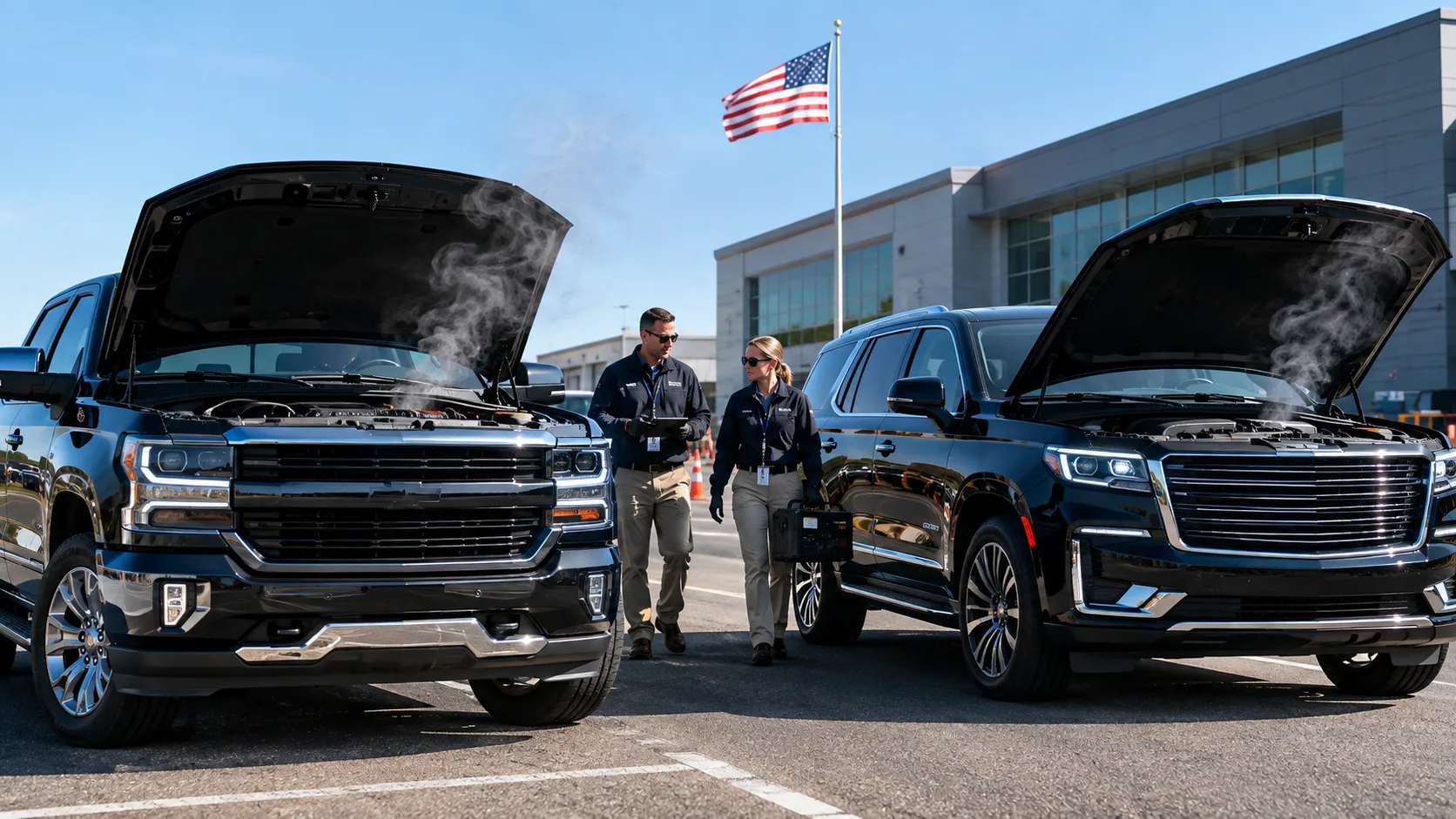
General Motors is facing a widening federal safety investigation after hundreds of owners reported engine failures in trucks and SUVs that had already received the company’s recall remedy. The probe now reaches nearly one million vehicles and puts some of GM’s most valuable products under fresh scrutiny.
The Investigation Just Became Much More Serious
The National Highway Traffic Safety Administration has opened an engineering analysis covering 997,743 GM vehicles equipped with the company’s 6.2-liter L87 V-8 engine.
The investigation includes 2021 through 2026 model-year vehicles across several of GM’s most important nameplates:
- Chevrolet Silverado 1500
- Chevrolet Tahoe
- Chevrolet Suburban
- GMC Sierra 1500
- GMC Yukon
- GMC Yukon XL
- Cadillac Escalade
- Cadillac Escalade ESV
This is a major escalation from the recall query NHTSA opened in January. That initial review focused on whether GM’s previous recall had adequately addressed the engine problem. Regulators have now expanded their work to include newer engines manufactured after the original recall period.
That distinction matters.
NHTSA is examining two separate concerns: engines that failed after receiving GM’s approved repair and newer engines that were manufactured outside the population GM originally identified as defective.
Both questions strike at the credibility of the company’s earlier explanation.
The Original Recall Covered Nearly 600,000 Vehicles
GM recalled nearly 600,000 vehicles in 2025 after determining that connecting rods and crankshaft components in certain L87 engines could contain manufacturing defects.
Those defects could cause severe engine damage, a sudden loss of propulsion and an increased risk of a crash.
GM attributed the problem to supplier manufacturing and quality issues affecting engines produced between March 1, 2021, and May 31, 2024.
The repair depended on the results of an engine inspection. Engines that failed the diagnostic test could be repaired or replaced. Vehicles that passed received higher-viscosity 0W-40 oil, a new oil filter, a replacement oil-fill cap and an owner’s manual insert.
The approach allowed GM to avoid replacing every engine in the recall population. Full engine replacements are expensive and labor-intensive, while changing the oil is faster and considerably cheaper.
That solution is now at the center of the investigation.
NHTSA says it has received 499 complaints alleging engine failure after the recall remedy was completed. Of those complaints, 473 involved vehicles that received the oil-viscosity change. Another 26 involved engines that had already been replaced.
The failures following oil changes raise questions about whether the inspection process reliably identified vulnerable engines. Reports involving replacement engines create an additional concern about the parts or manufacturing processes used in those repairs.
GM Reported Nearly 7,000 Complaints
The headline number most investors may overlook is buried inside NHTSA’s investigation document.
GM reported receiving 6,953 complaints involving engine failures after the recall remedy. NHTSA’s summary lists more than 6,000 incidents after eliminating duplicates.
That is substantially larger than the nearly 500 complaints submitted directly to the agency.
The gap does not prove that thousands of engines contain the same defect. Complaints can include incomplete reports, duplicate cases and failures caused by unrelated mechanical problems. Still, the volume gives regulators a large pool of evidence to examine.
NHTSA has also received 191 reports of L87 engine failures in vehicles produced after the manufacturing period included in the recall. The agency’s records include one crash, one injury and no reported fatalities.
Those newer-vehicle failures could become the most financially significant part of the investigation. If regulators determine that the underlying problem continued beyond May 2024, GM could face a broader recall covering additional model years.
That would challenge the company’s claim that the defect was isolated to a defined supplier and production window.
The Problem Has Already Cost GM About $500 Million
GM executives previously said the L87 engine issue created approximately $500 million in incremental expenses.
That figure provides investors with a useful starting point, though it should not be treated as a ceiling.
The eventual financial impact will depend on three factors:
1. The Size of Any Expanded Recall
The current investigation covers almost 998,000 vehicles, significantly more than the original recall population.
An investigation does not automatically lead to a recall. NHTSA could conclude that GM’s existing remedy is adequate, recommend changes to the inspection process or demand a larger field action.
If the agency determines that additional vehicles require inspection, the cost could rise quickly. If it concludes that engines must be replaced more broadly, the expense would become much more substantial.
2. The Required Repair
An oil change, filter and replacement cap carry a relatively modest cost. An engine replacement requires parts, skilled labor, transportation support and extended dealership capacity.
GM’s recall bulletin estimates more than 18 hours of labor for certain engine replacements, depending on the vehicle configuration. That does not include every associated cost, such as replacement transportation, administrative work, parts distribution or customer reimbursement.
The difference between expanding the current inspection program and replacing a large number of engines could amount to hundreds of millions of dollars.
3. The Duration of the Problem
GM provides additional protection for qualifying engine failures for up to 10 years or 150,000 miles from the vehicle’s original in-service date.
That extended coverage can spread costs across several years. It also means the company may continue recording warranty expenses long after the immediate investigation ends.
Investors should watch GM’s warranty reserves and recall-related charges in future filings. Those disclosures may offer an earlier financial signal than the final regulatory decision.
The Vehicles Involved Are Central to GM’s Business
The investigation is especially important because it affects GM’s most valuable internal-combustion vehicles.
In 2025, GM sold approximately 940,000 full-size pickups in the United States, its strongest combined Chevrolet and GMC result in 20 years. The company also maintained its leadership in full-size SUVs.
Silverado, Sierra, Tahoe, Suburban, Yukon and Escalade are central to GM’s North American earnings power. These vehicles generally command higher prices and provide stronger profit contributions than smaller cars and crossovers.
GM itself identifies the success of its full-size pickups and SUVs as a major business dependency in its investor risk disclosures.
That creates a direct transmission path from the investigation to GM’s financial performance:
- A broader recall increases warranty and repair expenses.
- Limited engine availability could lengthen repair times.
- Customer dissatisfaction could pressure brand loyalty and resale values.
- Dealer service departments could face capacity constraints.
- Incentives may need to rise if buyers become more cautious.
- Lower pricing power would put pressure on margins.
The immediate accounting charge could prove manageable for a company of GM’s size. Damage to confidence in its most profitable product families would carry a wider financial impact.
GM’s Strong Sales Could Help Contain the Damage
There is a credible case that the market will absorb this issue without a lasting hit to GM’s valuation.
GM entered 2026 with considerable momentum in the affected categories. The company reported its best combined full-size pickup sales in two decades, the best Silverado sales in five years and the strongest Escalade sales since 2007.
Truck buyers also tend to be loyal. Commercial customers, contractors and families often make purchasing decisions based on towing capacity, dealer relationships, service access and familiarity with a particular platform. One recall rarely destroys those advantages.
The company also has experience managing large recalls through an extensive dealership network. If GM can demonstrate that the failures are limited, provide a more reliable diagnostic process and repair affected vehicles quickly, the financial damage may remain contained.
The larger danger is uncertainty. Investors can estimate the cost of a defined recall. They have a harder time pricing an unresolved defect that could span multiple production years and several premium models.
The Three Signals That Will Define the Financial Risk
Investors can evaluate the investigation through a simple framework: scope, remedy and sales behavior.
Scope
Watch whether NHTSA links newer engine failures to the same connecting-rod or crankshaft defects covered by the earlier recall.
A finding that the post-May 2024 failures have a different cause would limit the potential expansion. Evidence of the same defect across later production would increase the likelihood of a broader recall.
Remedy
The most favorable outcome for GM would involve a refined inspection procedure or a limited group of engine replacements.
The highest-cost outcome would be a determination that the oil remedy failed to provide adequate protection and that a large portion of the affected engines require replacement.
The performance of replacement engines also needs to be explained. Twenty-six post-remedy complaints involved vehicles that had already received a new engine.
Sales Behavior
Monthly Silverado, Sierra, Tahoe, Yukon and Escalade sales will show whether the issue is changing customer behavior.
Stable sales and disciplined incentives would suggest buyers view the investigation as manageable. Slower retail demand, rising discounts or growing dealer inventory would indicate that the safety concern is beginning to affect GM’s pricing power.
Management Credibility Is Now Part of the Story
Earlier this year, GM Chief Financial Officer Paul Jacobson reportedly told analysts that the company did not believe additional vehicles would need to be recalled.
NHTSA’s decision to expand the investigation does not establish that management’s assessment was wrong. It does increase the importance of GM’s next explanation.
Investors should listen closely for changes in language around the affected population, supplier responsibility and anticipated recall costs. A shift from confident containment to broader uncertainty would be meaningful.
The company also needs to explain why thousands of complaints were recorded after the remedy and why failures have reportedly occurred in newer engines.
GM said it continues to cooperate with NHTSA and described customer safety and satisfaction as top priorities. The market will want more than reassurance. It will want a technically credible account of what failed, how the company knows the next solution will work and how much that solution will cost.
What Investors Should Watch Next
Several developments will determine whether this remains a manageable warranty issue or becomes a more serious earnings risk.
- NHTSA’s defect analysis: Confirmation that newer engines share the original manufacturing defect would increase the chance of an expanded recall.
- Changes to the recall remedy: A move away from oil changes toward additional engine replacements would materially increase costs.
- GM’s warranty reserves: Higher reserves or a new recall charge could reveal management’s evolving estimate of the financial exposure.
- Supplier recovery: GM may be able to recover part of the expense from the supplier linked to the original defect, though timing and reimbursement levels remain uncertain.
- Dealer repair times: Long delays could increase rental-vehicle costs and damage customer satisfaction.
- Truck and SUV incentives: Rising discounts on affected models would suggest the investigation is beginning to influence demand.
- Customer litigation: A wider group of owners could pursue claims involving lost vehicle value, repair delays or alleged inadequacy of the original remedy.
The Investor Takeaway
GM’s first L87 recall was already expensive. The new investigation raises the possibility that the company underestimated either the size of the defective population or the effectiveness of its repair.
Nearly one million vehicles are now within the scope of NHTSA’s engineering analysis. More than 6,000 post-remedy incidents appear in the regulator’s summary after duplicates were removed, and failures have been reported in engines produced beyond the original recall period.
The investigation does not guarantee another large recall. GM could still show that the remaining failures are isolated, that the revised repair process is effective and that newer-engine complaints have different causes.
Until then, investors should treat the L87 problem as an open financial liability attached to GM’s most important profit engines. The next meaningful development will be the remedy regulators demand, because that decision will determine whether the cost remains manageable or grows well beyond the $500 million GM has already absorbed.
Sources
https://static.nhtsa.gov/odi/inv/2026/INOA-EA26005-17015.pdf
https://static.nhtsa.gov/odi/inv/2026/INRD-RQ26001-10719P1.pdf
https://static.nhtsa.gov/odi/rcl/2025/RCRIT-25V274-6343.pdf
https://investor.gm.com/static-files/bd576095-7337-4596-bfd2-cb7b3b5b336a
About Author