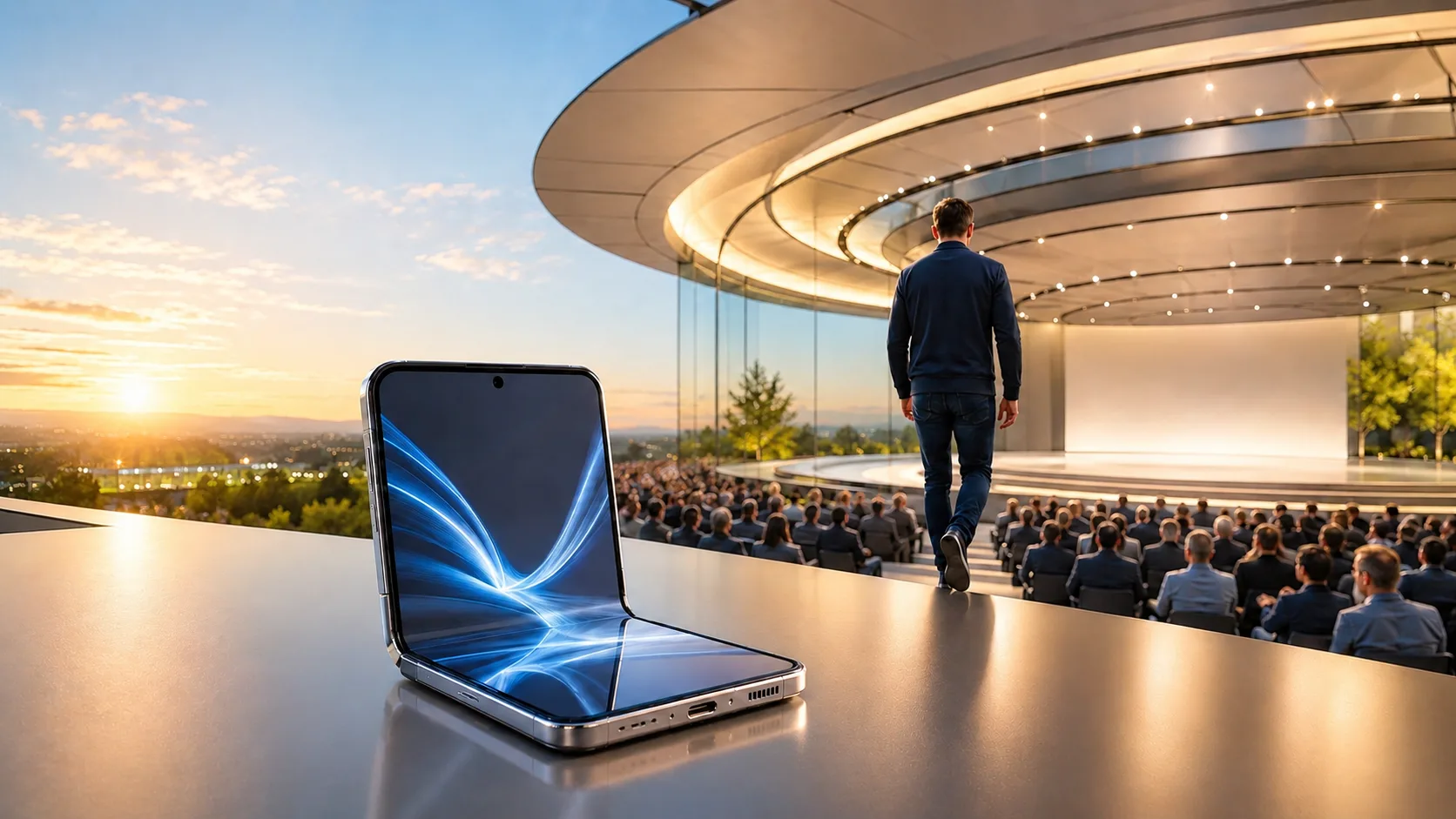
Apple’s Sept. 9 product launch could introduce its first foldable iPhone and a dramatically upgraded Siri, giving incoming CEO John Ternus an immediate opportunity to prove that the world’s most valuable consumer technology company can open a new growth chapter.
Apple Sets the Stage for a High-Stakes Launch
Apple has scheduled a product event at its Cupertino, California, headquarters for Sept. 9 at 10 a.m. Pacific time. The invitation features a glowing Apple logo and the tagline “Surprise and shine.”
Apple has not disclosed which products it plans to reveal. Analysts expect the event to feature new iPhones, updated Apple Watches and potentially the company’s first folding phone. Apple is also expected to showcase Siri AI, its rebuilt digital assistant powered by large language model technology.
The timing gives the event added significance.
John Ternus becomes Apple’s CEO on Sept. 1, replacing Tim Cook, who will move into the role of executive chairman. Eight days later, Ternus will preside over the most closely watched product launch on Apple’s annual calendar.
That makes Sept. 9 much more than another iPhone presentation. It will offer investors their first look at how Ternus intends to position Apple as the company navigates artificial intelligence, a mature smartphone market and the pressure to develop its next major product category.
Apple Could Be Preparing Its Biggest iPhone Change in Years
Annual iPhone launches typically emphasize better cameras, faster processors, longer battery life and modest design changes. These improvements help sustain Apple’s enormous upgrade cycle, although they rarely establish an entirely new market.
A foldable iPhone would represent a more consequential move.
Samsung, Google and several Chinese manufacturers already sell folding smartphones. Apple’s absence has allowed rivals to refine the category, identify weak points and test consumer demand while Apple remained on the sidelines.
Apple has historically entered emerging categories after competitors. It then attempts to deliver a more polished combination of hardware, software and services. That approach helped the company reshape markets for digital music players, smartphones, tablets, smartwatches and wireless earbuds.
A folding iPhone could follow the same strategy. Apple would be arriving late enough to learn from existing products, yet early enough to expand the category if it can solve the durability, battery life, weight and software problems that have limited mainstream adoption.
Analyst expectations should still be treated cautiously. Apple’s event invitation confirms the date and location, although it does not confirm a foldable device. The gap between anticipation and an official product announcement creates considerable event risk for Apple shares.
The Real Story Is Apple’s Next Upgrade Cycle
The most important question for investors is whether Apple can create a compelling reason for hundreds of millions of customers to replace devices they already own.
Modern smartphones last longer, and year-to-year improvements have become less dramatic. Consumers can often keep an iPhone for several years without sacrificing essential functionality. That makes every major design change increasingly important to Apple’s ability to accelerate upgrades.
A foldable device could help in three ways.
First, it could create a premium price tier above Apple’s existing Pro models. Folding phones commonly sell at substantially higher prices than traditional smartphones, giving Apple an opportunity to increase average selling prices even if unit growth remains modest.
Second, a new form factor could encourage affluent customers to upgrade sooner. Apple does not need every iPhone user to purchase a folding model. A relatively small group of high-value early adopters could still generate meaningful revenue.
Third, a foldable iPhone could strengthen the broader Apple ecosystem. A customer purchasing a premium device may also spend more on accessories, storage, applications, subscriptions and protection plans.
Apple’s fiscal third-quarter results show why the upgrade cycle matters. The company generated $54.25 billion in iPhone revenue during the quarter ended June 27, 2026, up from $44.58 billion a year earlier. The iPhone contributed almost half of Apple’s total quarterly revenue of $109.42 billion.
Services generated another $30.74 billion. That means hardware adoption continues to feed Apple’s increasingly valuable stream of recurring, higher-margin revenue.
Siri AI May Matter More Than the Folding Phone
The foldable iPhone would likely dominate headlines because it offers an obvious visual change. Siri AI could carry greater long-term financial importance.
Apple has presented Siri AI as a more capable and personalized assistant that can understand context and work across applications. The technology is expected to interact with services such as messaging and calendars, moving Siri closer to an operating layer that can complete tasks instead of simply answering basic questions.
That transition could reshape how customers use Apple devices.
If Siri AI can reliably organize schedules, summarize communications, find information and execute actions across apps, it could make Apple’s ecosystem significantly harder to leave. Customers would become accustomed to an assistant that understands their preferences, routines and digital history.
That creates several potential financial benefits:
A Stronger Upgrade Incentive
Apple can use advanced AI features to differentiate new devices from older models. If the best Siri AI experience requires newer processors, customers may have another reason to replace aging iPhones, iPads and Macs.
Greater Ecosystem Loyalty
An assistant that works across iPhone, Mac, Apple Watch and other Apple products could raise switching costs. The more useful Siri becomes across multiple devices, the more difficult it may be for customers to move to a competing platform.
New Services Opportunities
Apple could eventually connect AI capabilities to paid storage, premium productivity tools, health features or other subscriptions. Even if the first version is included with the operating system, it could support future services revenue.
Higher Investment Requirements
AI also brings costs. Apple must fund model development, computing infrastructure, acquisitions and partnerships while protecting its reputation for privacy. A successful launch could strengthen the company’s competitive position, while weak performance could reinforce concerns that Apple remains behind other technology companies in generative AI.
Ternus Faces an Unusually Visible First Test
Ternus brings a hardware engineering background to the CEO position. He joined Apple in 2001 and has overseen engineering across the company’s major product categories, including the iPhone, Mac, iPad, Apple Watch and AirPods.
That experience makes a hardware-heavy September event a natural setting for his debut. It also raises expectations.
Investors will be watching for clues about whether Ternus plans to preserve Apple’s established product strategy or pursue more aggressive changes. The rumored foldable iPhone and Siri AI rollout could allow him to emphasize both sides of Apple’s identity: premium hardware and deeply integrated software.
Tim Cook will remain influential as executive chairman, particularly in areas that include engagement with policymakers. That continuity reduces some succession risk. It could also make it harder to determine where Cook’s strategy ends and Ternus’s begins.
The Sept. 9 event will largely feature products developed before Ternus officially became CEO. Investors should therefore view it as a test of execution and communication rather than a complete expression of his long-term strategy.
His more consequential decisions will emerge over the following quarters through capital allocation, AI spending, product priorities, acquisitions and management appointments.
The Three-Part Ternus Test
Investors can evaluate the launch using three signals:
1. Product Surprise
Does Apple reveal a genuinely new product category or another incremental iPhone update?
A folding phone would demonstrate greater hardware ambition. A conventional lineup could still perform well financially, although it may do less to change perceptions about Apple’s innovation pipeline.
2. AI Utility
Can Siri AI perform useful tasks reliably across Apple’s ecosystem?
Demonstrations will matter, but real-world performance will matter more. Investors should look for clear availability dates, supported devices, geographic limitations and examples that extend beyond carefully controlled presentations.
3. Commercial Leverage
Can the new products increase revenue per customer?
Pricing, upgrade eligibility and premium model availability will show whether Apple can turn innovation into higher average selling prices and additional services spending.
A strong event should deliver progress across all three areas. Product excitement without broad availability may have limited near-term financial impact. Strong specifications without meaningful AI improvements could leave Apple vulnerable to competitors. Useful AI without a clear device upgrade cycle may take longer to influence earnings.
The Foldable iPhone Could Be a Deliberate Niche Product
The obvious assumption is that Apple needs a folding phone to become a mass-market success. A smaller outcome could still work in the company’s favor.
Apple may initially treat the device as an ultra-premium product aimed at enthusiasts, professionals and affluent early adopters. Limited volumes could reduce supply-chain risk while allowing the company to test durability, software design and consumer behavior.
This approach could protect the traditional iPhone lineup while creating a higher-priced halo product. The Apple Watch Ultra and Vision Pro demonstrate Apple’s willingness to use expensive devices to develop technology, shape its brand and explore future markets without depending on immediate mass adoption.
Investors should therefore avoid judging a foldable iPhone solely by early unit sales. Pricing power, customer interest, margins and the device’s influence on future iPhone designs may be more informative.
Key Signals to Watch on Sept. 9
- Foldable confirmation: An official announcement would give Apple access to a new premium smartphone segment and could create a stronger upgrade catalyst.
- Pricing: A high starting price could lift average selling prices, although it may restrict demand during the first generation.
- Shipping dates: A long delay between the announcement and availability could indicate production or component challenges.
- Siri AI compatibility: Support limited to newer devices would strengthen the upgrade case but could frustrate existing customers.
- AI demonstrations: Investors should focus on tasks completed across multiple apps, response reliability and privacy protections.
- Ternus’s message: His presentation could reveal how he balances product innovation, ecosystem expansion and Cook-era continuity.
- Supplier implications: A foldable device could benefit companies providing displays, hinges, batteries, processors and specialized materials, although Apple rarely provides a complete supplier list.
- Early demand indicators: Preorder wait times and shipping delays may offer an initial view of consumer interest, but supply limitations can distort those signals.
The Investor Takeaway
Apple enters its Sept. 9 event from a position of considerable financial strength. Its latest quarter produced $109.42 billion in revenue, $29.79 billion in net income and nearly $117 billion in operating cash flow during the first nine months of the fiscal year.
That strength gives Ternus room to invest, but it also creates an extraordinarily high bar. Apple’s size means that even successful products must generate enormous sales to materially change the company’s growth rate.
A foldable iPhone could raise prices and energize the upgrade cycle. Siri AI could deepen customer loyalty and expand the economic value of Apple’s installed base. Together, they could provide the strongest evidence yet that Apple has found a credible bridge from the Cook era to its next phase.
The Sept. 9 event will not define the entire Ternus era. It will define investors’ first impression of it.
About Author