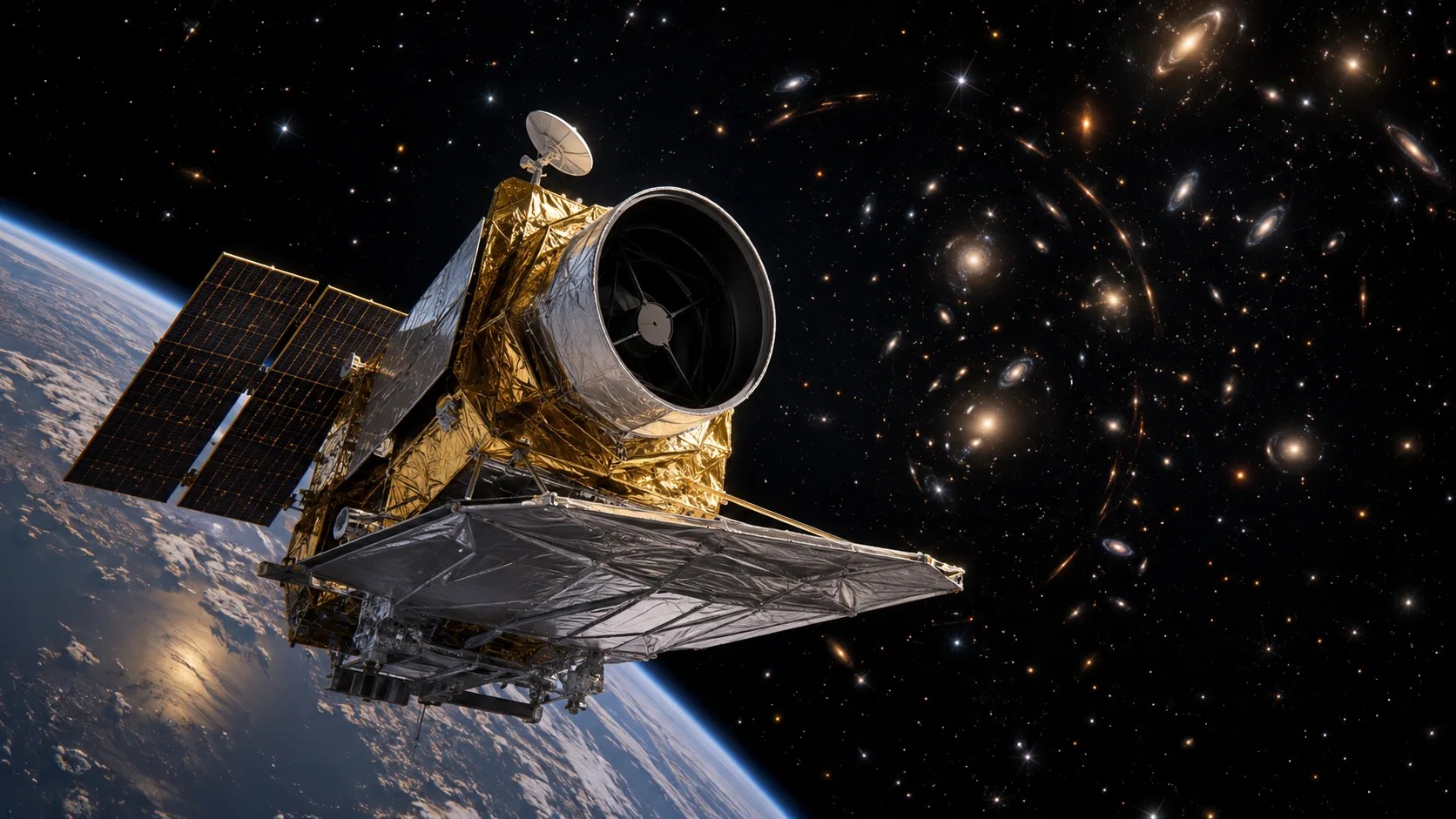
NASA’s Nancy Grace Roman Space Telescope has launched on a historic mission to study dark energy, discover distant planets and survey billions of galaxies. Its unprecedented speed could transform astronomy while creating new opportunities across aerospace, advanced imaging and artificial intelligence.
NASA’s Newest Observatory Begins Its Million-Mile Journey
The $4.3 billion Nancy Grace Roman Space Telescope lifted off from NASA’s Kennedy Space Center in Florida at 7:26 a.m. EDT on Sunday aboard a SpaceX Falcon Heavy rocket.
After separating successfully from the rocket, Roman began a three-month journey toward the second Sun-Earth Lagrange point, known as L2. Located roughly 1 million miles from Earth, L2 also hosts NASA’s James Webb Space Telescope.
The mission’s early milestones went according to plan. Ground controllers received telemetry seven minutes after launch, and the spacecraft separated from the Falcon Heavy approximately 31 minutes into the flight. Roman’s solar panels and lower instrument sunshade were deployed shortly afterward.
Roman will undergo an extensive commissioning process while traveling to L2. NASA expects to release the telescope’s first images in early 2027.
The launch carries unusual significance for an agency frequently criticized for delays and cost overruns. Roman reached the launchpad nearly a year ahead of its original schedule and remained within its approved budget.
NASA Administrator Jared Isaacman called the mission an example of what can happen when ambitious science is paired with disciplined execution.
Who Was Nancy Grace Roman?
The telescope is named after Nancy Grace Roman, NASA’s first chief astronomer and one of the most influential figures in modern space science.
Roman joined the newly created NASA in 1959 and spent decades arguing that telescopes placed above Earth’s atmosphere could see deeper into space with far greater clarity than ground-based observatories.
Her work helped establish the scientific and institutional foundation for the Hubble Space Telescope. That contribution eventually earned her the nickname “Mother of Hubble.”
Roman died in 2018 at age 93. The telescope bearing her name is NASA’s first flagship space telescope named after a woman.
The tribute is especially fitting because the Nancy Grace Roman Space Telescope takes the original Hubble concept and scales it dramatically. Roman’s primary mirror is nearly 8 feet in diameter, approximately the same size as Hubble’s. Its field of view, however, is at least 100 times wider.
A month of observations conducted by Roman could require Hubble roughly a century to complete.
That speed represents the telescope’s defining advantage.
Roman Is Built to Discover What Scientists Do Not Know Exists
Hubble and Webb are exceptionally powerful when astronomers know where to look. Their narrow fields of view allow them to study selected galaxies, stars and planets in extraordinary detail.
Roman will operate differently.
Its 300-megapixel Wide Field Instrument contains 18 advanced detectors and is designed to scan enormous portions of the infrared sky. NASA estimates Roman will survey the universe up to 1,000 times faster than Hubble while preserving similar sensitivity and image resolution.
The mission is expected to observe billions of galaxies, tens of billions of stars, thousands of supernovae and tens of thousands of planets outside our solar system.
That scale gives scientists a way to identify rare objects that smaller surveys could easily miss.
“Roman’s vast reach will allow us to find the weird, the rare and the unusual,” senior project scientist Julie McEnery said before the launch. “We’ll redefine what it means to find a needle in a haystack.”
This creates a complementary relationship among NASA’s major observatories. Roman can locate unusual objects across vast areas of space, while Webb can examine the most compelling discoveries in greater detail.
The European Space Agency’s Euclid mission and the Vera C. Rubin Observatory in Chile will add further data, creating an interconnected system for studying the universe across multiple wavelengths and time periods.
The Real Breakthrough Could Be Roman’s Data Factory
The telescope’s optical capabilities will attract most of the attention. Its larger impact could come from the volume and structure of the information it produces.
Roman is expected to transmit approximately 1.4 terabytes of data each day, the highest daily data rate of any NASA astrophysics mission to date.
Researchers will need machine learning, artificial intelligence and automated detection systems to identify patterns inside that flow. Citizen scientists may also help classify objects and flag unusual observations.
That makes the Nancy Grace Roman mission an important demonstration of AI-assisted science.
For decades, the limiting factor in astronomy was the amount of data scientists could collect. Roman could reverse that equation. Astronomers may soon receive information faster than conventional research teams can process it.
The challenge then moves from observation to computation.
This same shift is occurring in biotechnology, defense, climate science and industrial research. Sensors are generating increasingly large datasets, placing greater value on the software, computing infrastructure and AI models capable of turning raw information into usable discoveries.
What the Nancy Grace Roman Mission Means for Investors
Aerospace Contractors Gain a Valuable Proof Point
Roman was developed through a network of government facilities, research institutions and private contractors. NASA identifies BAE Systems, L3Harris Technologies and Teledyne Scientific & Imaging as the mission’s primary industrial partners.
L3Harris Technologies and Teledyne Technologies are publicly traded in the United States, while BAE Systems trades in London.
Investors should view Roman as a long-term validation of these companies’ capabilities in precision optics, sensors, spacecraft systems and advanced imaging. A single mission is unlikely to materially transform the earnings outlook of a large defense or aerospace contractor. Successful performance can still strengthen a company’s credentials when competing for future NASA, intelligence and national-security programs.
Space missions create unusually demanding operating conditions. Equipment must survive launch vibrations, extreme temperature changes and years of operation without conventional maintenance. Technology proven in that environment can carry substantial credibility.
SpaceX Demonstrates Falcon Heavy’s Strategic Value
SpaceX remains privately held, so public-market investors cannot purchase its shares directly. Roman’s successful deployment still matters to the wider launch market.
Falcon Heavy carried one of NASA’s most valuable scientific assets and executed the mission while returning its two side boosters to Cape Canaveral for potential reuse.
The launch reinforces the broader commercial-space model built around reusable rockets, higher launch frequency and lower costs. Public companies exposed to satellite components, communications equipment and space infrastructure may benefit if falling launch costs continue expanding the addressable market.
The largest opportunity may emerge from the economic activity enabled by cheaper access to orbit rather than from launch services alone.
Imaging and Sensor Technology Remain Strategic Assets
Roman’s Wide Field Instrument combines high-resolution infrared imaging with enormous survey capacity. Its experimental Coronagraph Instrument will block starlight so the telescope can directly image faint planets orbiting nearby stars.
The coronagraph is a technology demonstration for future missions that may eventually search for Earth-like worlds and signs of life.
From an investment perspective, the mission highlights the strategic importance of detectors, optical systems, radiation-resistant electronics and precision manufacturing. These capabilities serve civil space programs, military satellites, medical imaging and industrial automation.
Companies capable of producing highly specialized components often occupy attractive positions within aerospace supply chains because qualification barriers are high and replacement suppliers are limited.
AI Infrastructure Enters the Scientific Workflow
Roman’s daily data output will require automated analysis at a scale rarely seen in astronomy.
This provides a practical example of where AI can create measurable value. Machine-learning systems will help detect transient events, classify galaxies, identify gravitational lensing and find planetary signals buried inside massive datasets.
The financial impact will extend well beyond this mission. Government agencies and research institutions are becoming important customers for cloud computing, high-performance processors, storage systems and AI software.
Roman may help accelerate that spending by showing that advanced observatories can only reach their full potential when paired with equally advanced computational infrastructure.
Dark Energy Could Be Roman’s Most Valuable Discovery
Roman’s search for new planets offers an easy story for the public to understand. Its investigation of dark energy may have greater scientific importance.
Dark matter and dark energy are believed to account for most of the universe, yet their true nature remains unknown. Scientists infer their existence through the way galaxies move, light bends and the universe expands.
Roman will map galaxies across vast distances and measure thousands of exploding stars. These observations could reveal how cosmic expansion has changed over time.
A major discovery involving dark energy would have few immediate implications for corporate earnings. Fundamental science frequently creates value through paths that are impossible to forecast at the time of discovery.
Quantum mechanics began as an attempt to understand matter at microscopic scales. It later enabled semiconductors, lasers and modern computing. Einstein’s theories of relativity eventually became necessary for accurate GPS navigation.
Roman’s economic legacy may follow a similar pattern. The mission’s greatest discoveries could initially appear abstract before generating technologies, methods or industries with commercial importance.
The Biggest Winner May Be NASA’s Procurement Model
Roman’s launch is being celebrated as a scientific achievement, but its ahead-of-schedule, within-budget delivery may have broader consequences in Washington.
NASA and other federal agencies face constant pressure to control spending. A flagship mission that avoids major cost escalation gives supporters of large scientific programs a stronger argument for continued funding.
It also highlights a shift toward combining government research with commercial launch providers and specialized private contractors.
If Roman performs successfully, policymakers may see the mission as evidence that complex government programs can deliver both technical ambition and financial discipline. That could influence funding decisions for future telescopes, planetary missions and national-security space systems.
Roman’s refueling-compatible design adds another dimension. If a robotic servicing spacecraft becomes available during the next decade, NASA could potentially extend the telescope’s useful life.
Successful servicing would strengthen the case for an emerging orbital economy built around inspection, repair, refueling and life-extension services.
The Final Take
The Nancy Grace Roman Space Telescope gives NASA something it has never had: Hubble-quality vision combined with the ability to survey huge portions of the universe at extraordinary speed.
For investors, Roman is best understood as a platform rather than a single $4.3 billion project. It validates advanced aerospace suppliers, increases demand for scientific computing and demonstrates how artificial intelligence can turn overwhelming volumes of data into valuable discoveries.
Nancy Grace Roman spent her career arguing that humanity could see farther by placing observatories above Earth’s atmosphere. The telescope carrying her name is prepared to take that vision much further, mapping parts of the universe that have remained hidden and potentially uncovering phenomena scientists have yet to imagine.
About Author