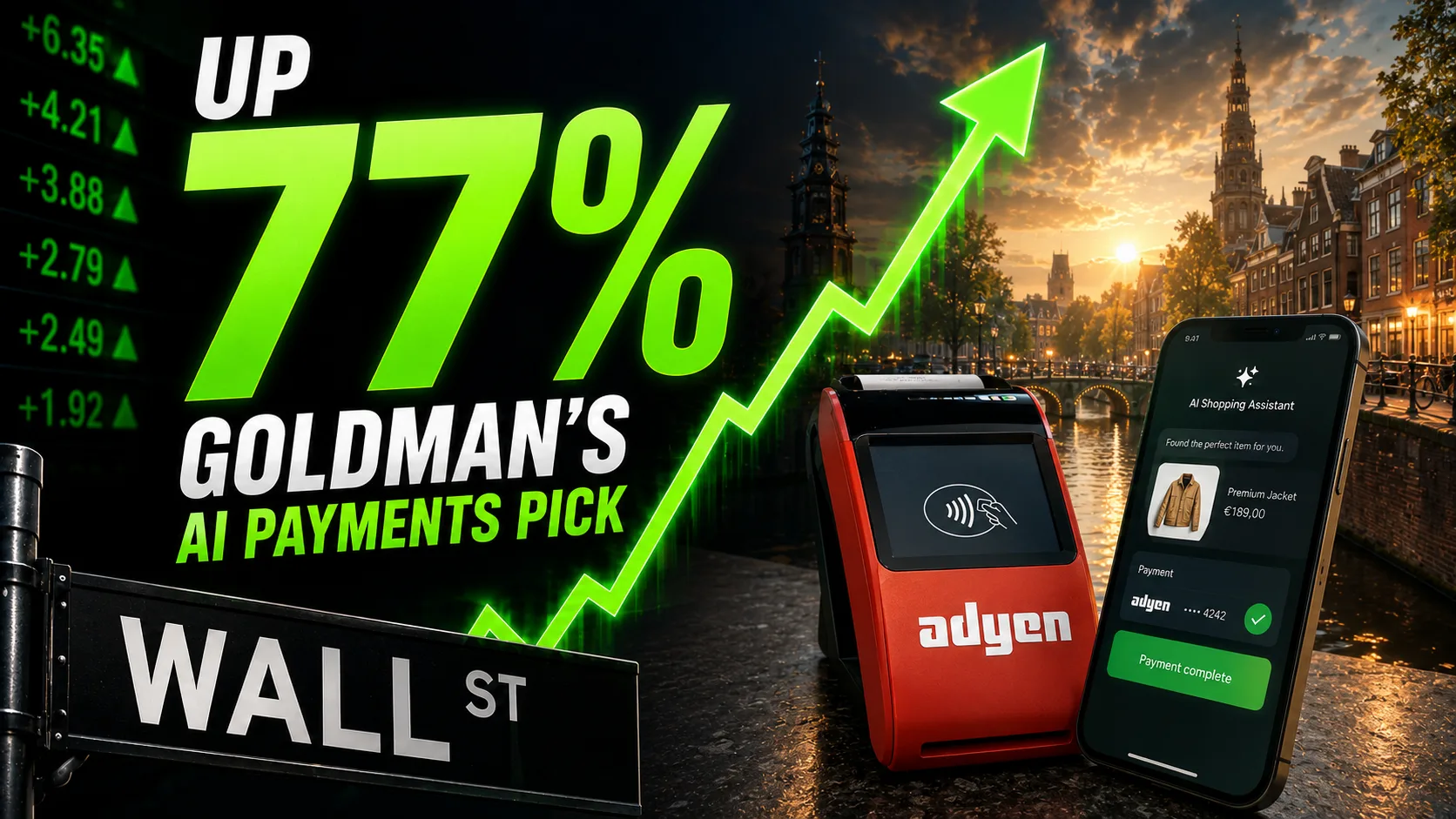
Goldman Sachs has added Adyen, RWE and Talanx to its closely watched list of top European stock ideas, with the bank projecting 77% upside for one beaten-down payments company positioned at the intersection of artificial intelligence and global commerce.
Goldman Refreshes Its Highest-Conviction European Picks
The three companies join Goldman’s European “Conviction List: Directors’ Cut” for September, a collection of buy-rated stocks that the investment bank believes offer especially attractive risk-reward opportunities.
Goldman removed Enel, Wise, Hannover Re and Zalando as part of the monthly update.
The new additions span three very different industries:
- Adyen, a Dutch payments technology company
- RWE, a German energy and electricity infrastructure company
- Talanx, a German insurance group
Goldman assigned Adyen the largest upside potential among the new additions. The bank believes the shares could climb 77%, supported by new enterprise customers, international expansion and the emerging market for payments initiated by AI agents.
RWE received a €75 price target, implying approximately 28% upside from its recent trading level.
Talanx received a €141 target, representing roughly 13% upside.
The headline numbers vary widely, yet the three selections appear to share a common investment theme: each company controls infrastructure that could become more valuable as technology, electricity demand and global financial activity grow.
Adyen: Goldman’s 77% Upside Bet
Adyen provides payment-processing technology to large companies through a single global platform. Its customers can use the system to accept online, mobile and in-store payments while managing fraud, authorization and transaction data within the same infrastructure.
Goldman analyst Mohammed Moawalla sees that integrated architecture as an important competitive advantage.
The bullish case rests partly on new customers and partnerships beginning to contribute more meaningful transaction volume. Goldman highlighted Adyen’s U.S. relationship with restaurant technology company Toast and Shopify’s expansion across Europe.
The larger opportunity could come from agentic commerce.
Agentic commerce refers to transactions in which an AI assistant searches for a product, compares options and completes a purchase on a consumer’s behalf. If that model becomes widely adopted, payment processors will need to distinguish legitimate AI agents from fraudulent bots, authenticate transactions and determine which party carries liability when something goes wrong.
Adyen has been working with technology companies including OpenAI, Google and Microsoft as this new payment architecture develops.
That gives Adyen a chance to become part of the transaction layer supporting AI commerce. Every AI-assisted purchase still needs authorization, fraud screening, settlement and reconciliation. Companies that provide that plumbing could generate recurring revenue regardless of which consumer-facing AI assistant ultimately dominates.
Adyen has also expanded its capabilities through acquisitions. The company’s additions of loyalty technology specialist Talon.One and billing platform Orb could help it offer merchants more services surrounding the core payment transaction.
The opportunity is substantial, although the 77% target also signals that Goldman sees a wide gap between the company’s potential and the market’s current expectations. Adyen shares entered September roughly 37% below their 52-week high and down close to 28% for 2026.
That discount creates the upside in Goldman’s forecast. It also tells investors that the market remains uncertain about growth, competition and execution.
RWE: The Power Infrastructure Behind the AI Boom
RWE represents a different route into the technology investment cycle.
The German company has been shifting from a traditional electricity producer toward a broader energy platform combining renewable generation, flexible power assets, electricity networks, batteries and LNG operations.
Goldman believes that transformation could justify a higher valuation.
One of the most important developments is RWE’s increased ownership of Amprion, one of Germany’s four transmission system operators. RWE raised its effective stake to 55%, adding regulated electricity infrastructure to its existing businesses in renewables and flexible generation.
Regulated power networks typically produce steadier earnings than electricity generation because returns are tied to an approved asset base rather than daily fluctuations in wholesale power prices.
Goldman expects networks to account for roughly one-third of RWE’s profits by 2029, compared with 23% in 2025. A larger contribution from predictable grid earnings could lower the company’s perceived risk and, in turn, reduce its cost of capital.
RWE plans to invest €6.5 billion through 2031 to support Amprion’s grid expansion. The company has also reaffirmed a separate €35 billion investment program covering renewable energy, battery storage and flexible generation.
AI data centers add another potential source of demand.
Data centers require large quantities of dependable electricity, often around the clock. Renewable generation alone cannot always provide that consistency, creating demand for transmission capacity, battery storage, natural gas generation and other flexible power resources.
RWE operates across several of those categories. That gives the company multiple ways to participate in rising electricity demand without relying on a single technology.
Goldman also sees potential benefits from U.S. renewable projects, LNG trading and emerging capacity-payment programs in Central Europe. Those government-backed programs compensate generators for keeping reliable power available, even when their plants are not actively producing electricity.
According to the bank’s analysis, capacity payments could add between €300 million and €400 million in pre-tax profit by 2032 or 2033.
Talanx: The Quiet Compounder of the Group
Talanx carries the smallest projected upside of the three additions, but it may offer the most defensive earnings profile.
The company operates across retail insurance, corporate insurance and reinsurance. Goldman’s thesis focuses heavily on its Retail International division, which accounts for approximately 23% of group profits.
That business has exposure to faster-growing and less-penetrated insurance markets, particularly Poland and Latin America.
Goldman analyst Andrew Baker expects the division’s gross written premiums to expand between 8% and 10% annually from 2026 through 2030. That compares with estimated growth of roughly 3% to 6% for insurers concentrated in developed markets.
Insurance penetration generally rises as household income, vehicle ownership, property values and commercial activity increase. That can produce a long runway for insurers operating in developing markets, although currency movements, regulation and local economic conditions remain important risks.
Talanx strengthened its Latin American position through the acquisition of Liberty Mutual operations in Brazil, Chile, Colombia and Ecuador. The transaction increased the company’s scale and diversification across the region.
Goldman also highlighted Talanx’s lean cost structure, approximately €6 billion in resilience reserves and at least €5 billion in potential acquisition capacity.
Possible inclusion in Germany’s benchmark DAX index provides another catalyst. Index admission can create incremental demand from funds that track the benchmark, although inclusion alone does not change a company’s underlying earnings power.
Goldman Is Looking Beyond the Obvious AI Winners
The most revealing part of Goldman’s update is the location of the expected growth.
Adyen and RWE both offer indirect exposure to artificial intelligence without requiring investors to buy another semiconductor manufacturer or cloud-computing giant.
Adyen could benefit when AI systems begin completing purchases. RWE could benefit from the enormous power requirements created by AI infrastructure. One sits at the digital checkout, while the other helps keep the servers running.
Talanx plays a different role. Its international insurance growth and reserve strength could provide steadier earnings if technology valuations become volatile or economic growth slows.
Together, the three companies resemble a deliberately balanced portfolio:
- Adyen offers the greatest potential upside and the greatest execution sensitivity.
- RWE combines growth spending with increasingly regulated earnings.
- Talanx offers a more defensive route to international expansion.
This suggests Goldman is looking for companies that can convert structural trends into cash flow while maintaining some protection against economic or market volatility.
The Picks-and-Shovels Test for AI Stocks
Investors evaluating indirect AI beneficiaries can use a simple three-part test.
Transaction Exposure
Does the company earn revenue when AI produces real economic activity?
Adyen could benefit if AI assistants generate actual purchases rather than merely answering questions. Payment volume would provide measurable evidence that AI adoption is turning into commerce.
Infrastructure Scarcity
Does the company own something that is difficult, expensive or slow to reproduce?
RWE’s grids, generation assets, storage projects and LNG operations cannot be replicated with software. Permitting, financing and construction timelines create barriers that may strengthen the value of existing infrastructure.
Earnings Durability
Can the company continue producing acceptable earnings if excitement around AI cools?
Talanx’s insurance operations have limited dependence on AI adoption. RWE’s regulated networks and broader energy portfolio also provide earnings sources beyond data centers. Adyen faces greater sensitivity to transaction growth and competitive execution.
Companies that score well across all three categories may offer more durable exposure than businesses whose valuations depend mainly on future AI expectations.
The Stock With the Lowest Upside May Carry the Cleanest Setup
Adyen’s 77% upside estimate will attract most of the attention, but the largest target does not automatically represent the easiest return.
A projected gain that large often reflects a depressed share price, uncertain investor expectations or a thesis requiring several developments to go right. Adyen must convert partnerships into volume, protect its margins and establish a meaningful role in agentic commerce.
RWE already reflects some optimism after a strong 2026 performance. Its grid strategy can improve earnings visibility, though heavy capital spending, regulatory decisions and project execution remain significant variables.
Talanx offers only 13% upside to Goldman’s target, yet its international premium growth, reserve position and acquisition capacity could make that forecast less dependent on an emerging technology.
The most aggressive opportunity is Adyen. The potentially steadier compounder is Talanx. RWE occupies the middle, combining infrastructure growth with regulated earnings.
Investors should therefore compare the path required to reach each target, rather than focusing solely on the percentage upside.
About Author