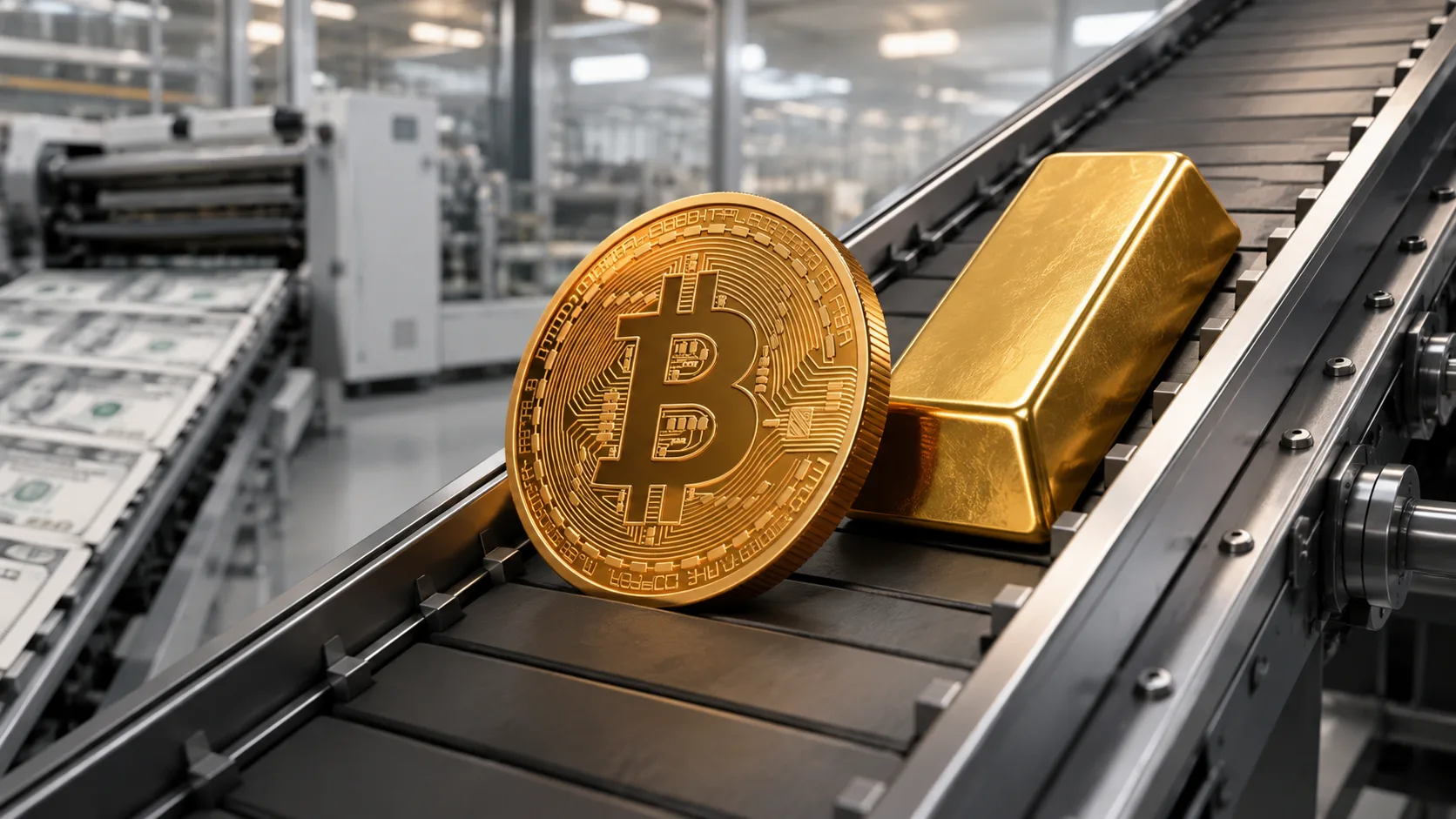
Gold’s recent pullback may be creating another opportunity. If the Federal Reserve keeps interest rates unchanged before the midterm elections, concerns about inflation, political influence and America’s $40 trillion debt burden could reignite the debasement trade.
Warsh Sounds Hawkish, but He Left Himself an Escape Route
Federal Reserve Chairman Kevin Warsh delivered a clear warning at the Jackson Hole Economic Policy Symposium: Inflation remains too high, financial conditions are showing few signs of restraint and the central bank must be prepared to act.
The Fed’s preferred inflation measure has increased 3.7% over the past 12 months, according to Warsh. He also said the labor market remains consistent with full employment, consumer spending is healthy and corporate credit conditions are relatively easy.
That combination would normally strengthen the case for raising interest rates.
Warsh stopped short of committing to a specific move, however. He emphasized that policymakers must study trends instead of reacting to isolated data points, and he described himself as “committed to a discipline, not to a decision.”
That distinction matters.
The Federal Open Market Committee will conclude its next meeting on Sept. 16. It will meet again on Oct. 28, less than a week before the Nov. 3 midterm elections. Its final scheduled decision of the year will arrive on Dec. 9.
Warsh therefore has two opportunities to raise rates before voters determine control of Congress. He also has ample room to argue that uncertainty surrounding trade, geopolitics, supply chains or incoming economic data warrants more patience.
The Real Trade Is About Federal Reserve Credibility
The immediate question is whether the Fed raises rates in September or October. The deeper issue is what investors conclude if it declines to act.
President Donald Trump has repeatedly favored lower interest rates, and the midterm elections could determine how much of his economic agenda survives the next two years. A rate increase shortly before Election Day could lift borrowing costs, pressure stocks and create an unwanted political complication.
There is no public evidence that Warsh intends to delay a rate increase for political reasons. The chairman also does not control policy by himself. Interest-rate decisions are made by the full Federal Open Market Committee.
Markets may still interpret an extended pause through a political lens, especially if inflation remains well above the Fed’s 2% target.
That perception could be enough to move money.
Gold frequently benefits when investors lose confidence in the ability or willingness of governments and central banks to protect the purchasing power of money. The metal does not require proof of political interference. It only requires a growing number of investors to believe that fiscal and political considerations are beginning to influence monetary policy.
This is why the next phase of the gold trade could be driven by credibility rather than conventional rate forecasting.
Why Gold Could Resume Its Rally
A Fed Pause Could Pressure Real Yields
Gold produces no income, so rising inflation-adjusted interest rates increase the opportunity cost of owning it.
A rate increase accompanied by hawkish guidance could push real yields higher and strengthen the dollar. Both developments would ordinarily create pressure on gold.
If the Fed holds rates steady while inflation remains elevated, the opposite reaction becomes possible. Investors could conclude that policymakers are falling behind the inflation curve. Inflation expectations could rise, reducing real yields even if nominal Treasury yields remain high.
That would make gold more competitive against bonds and cash.
The Debt Problem Is Becoming Harder to Ignore
U.S. government debt has surpassed $40 trillion, adding another structural argument for owning assets outside the traditional currency system.
Large deficits do not automatically produce a gold rally. They become especially important when investors believe monetary policy will eventually be constrained by the government’s rising interest expense.
Higher rates increase the cost of refinancing federal debt. Lower rates can support government finances, yet they also risk sustaining inflation and weakening confidence in the dollar.
Gold sits directly in the middle of that tension.
The larger the debt burden becomes, the harder it is for policymakers to simultaneously deliver low inflation, affordable government financing and strong economic growth. Investors may increasingly use gold as protection against the possibility that one of those objectives must be sacrificed.
Central Banks Are Providing Structural Demand
Private investors are only one part of the gold market.
Central banks have accumulated an average of approximately 1,000 metric tons of gold annually over the past four years, according to the World Gold Council. That compares with an average of roughly 500 tons during the preceding decade.
In the organization’s 2026 survey, 89% of responding central banks expected global official gold reserves to increase over the following 12 months. A record 45% expected their own institution’s reserves to rise.
Reserve diversification, inflation protection and geopolitical risk were among the primary reasons.
This demand matters because central banks generally operate with longer time horizons than hedge funds and retail traders. Their purchases can create an underlying source of support even when momentum investors take profits.
The GLD Call Spread to Watch
SPDR Gold Shares, which trades under the ticker GLD, is designed to track the price of gold bullion before expenses. It is also one of the most liquid vehicles available to investors seeking exposure to gold.
GLD closed at $396.75 on Sept. 1 and traded near $401 the following day. That left the fund below its August peak after an unusually strong monthly advance.
Investors expecting a renewed rally could consider an illustrative November bull call spread:
- Buy one November $410 call.
- Sell one November $440 call with the same expiration.
Using the option premiums cited with the original trade, the spread would cost approximately $8.15 per share, or $815 for one standard options contract covering 100 shares.
The position’s expiration economics would be:
- Maximum loss: $815 if GLD finishes at or below $410.
- Break-even point: $418.15.
- Maximum profit: $2,185 if GLD finishes at or above $440.
- Maximum return on capital at risk: Approximately 268%, excluding commissions and fees.
Between $410 and $418.15, the position would recover part of its cost while still producing a net loss. Between $418.15 and $440, profit would increase as GLD rises. Gains would be capped above $440 because the short call offsets additional appreciation in the long call.
Option prices change throughout the trading day, so the original $8.15 cost may no longer be available. Investors would need to recalculate the break-even point, maximum loss and maximum profit using current premiums.
The strategy also requires GLD to move quickly enough. Even if the bullish gold thesis proves correct over the longer term, the spread could expire worthless if the move occurs after the November expiration.
A Fed Pause Does Not Guarantee a Gold Rally
The political-pressure thesis has an important weakness.
If the Fed leaves rates unchanged while inflation remains high, bond investors could push long-term yields sharply higher. Rising real yields might then overwhelm the benefits gold receives from political uncertainty.
The World Gold Council has already identified elevated real yields as a potential headwind for North American gold ETF demand. A stronger dollar could add further pressure.
Gold could also struggle if Warsh convinces investors that a September pause merely delays an October increase. Markets trade the expected path of policy, so the absence of an immediate hike may have little impact if traders remain confident that tighter policy is coming.
The strongest bullish scenario requires more than an unchanged rate. Investors must begin questioning whether the Fed will act forcefully enough to contain inflation.
That is the line separating a routine policy pause from a renewed debasement trade.
About Author