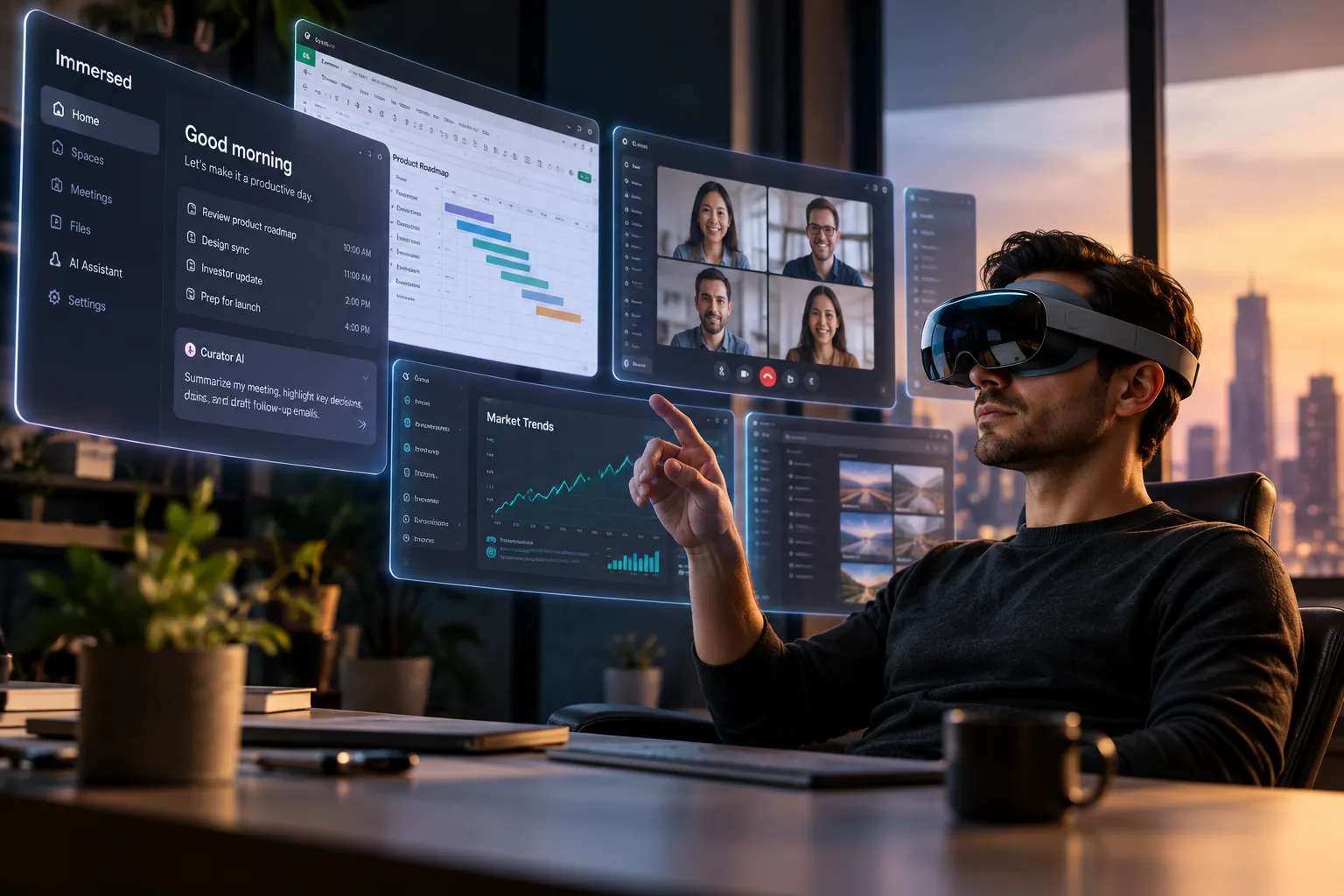
Immersed already has 1.5 million users. Now it is betting that a combination of spatial computing, artificial intelligence and a new lightweight headset could change how millions of people work.
For decades, the basic office setup has barely changed.
You sit in front of a laptop or desktop computer, add a monitor or two, and spend the day moving between email, spreadsheets, video calls, browsers and dozens of open tabs.
Immersed believes that setup is approaching its expiration date.
The privately held technology company is developing what it describes as a full-stack spatial computing platform built around three pieces: its established virtual-workspace software, a lightweight headset called Visor and an artificial intelligence assistant called Curator.
The long-term idea is ambitious: replace the traditional desk full of screens with a wearable computing environment that can go virtually anywhere.
For investors, there is another reason the company is attracting attention.
Immersed says it has already raised more than $40 million, attracted more than 10,000 investors and reserved the NASDAQ ticker $IMRS as it considers an eventual public listing. The company currently remains private, meaning investors interested in owning shares have an opportunity to participate before any potential IPO. Reserving a ticker, however, does not guarantee that an IPO will occur.
Immersed Already Has Something Many Startups Don’t: Users
One of the biggest risks with emerging technology companies is simple: they often spend years developing a product before discovering whether anyone actually wants it.
Immersed is approaching the market from a different position.
Its existing software allows users wearing compatible headsets to work with multiple virtual monitors rather than relying on physical displays. The company says the platform has attracted more than 1.5 million unique users since launching in 2020.
Immersed describes it as the world’s most-used XR work software, with professionals using the platform across Apple and Meta headsets.
That installed user base could become increasingly important as the company expands beyond software.
Instead of simply building another virtual-reality headset and hoping people find something useful to do with it, Immersed is developing hardware specifically around a use case its customers are already embracing: work.
Visor Could Be the Company’s Biggest Bet Yet
The centerpiece of Immersed’s next phase is Visor, a headset being designed specifically for productivity.
The company says Visor will offer 4K resolution per eye while being substantially lighter and less expensive than Apple’s Vision Pro. Immersed describes it as approximately 70% lighter and 70% less expensive, while offering higher display resolution.
That distinction matters.
The broader virtual- and augmented-reality industry has spent years trying to convince consumers to wear bulky headsets for gaming and entertainment. Immersed is taking a narrower approach: create something comfortable enough that professionals could potentially wear it for much of the working day.
Imagine traveling with a laptop but opening several enormous virtual monitors once you sit down. Or working from a small home office without needing three physical screens occupying the desk.
That is the problem Immersed wants Visor to solve.
And unlike many early-stage hardware companies, Immersed already has an existing software ecosystem into which the device can fit.
Then Comes Artificial Intelligence
Hardware and software are only two pieces of the strategy.
The third is Curator, Immersed’s AI assistant.
Currently in beta, Curator is being developed to summarize meetings, organize a user’s workday, surface information and eventually help automate tasks within the computing environment.
This could ultimately be the more interesting part of the company’s strategy.
Most AI assistants today still live inside a browser window or smartphone application. Immersed wants AI operating directly inside the environment where someone is already working.
In theory, that could allow the AI to move beyond simply answering questions.
Instead, it could understand what a user is working on, summarize information as it appears, organize follow-up tasks and help control applications without forcing the user to constantly switch between programs.
Immersed sees the combination of software + hardware + AI as the foundation of an entirely new computing platform.
The Numbers Are Starting to Get Investors’ Attention
Immersed’s investment campaign highlights several figures that help explain the excitement surrounding the company.
According to Immersed, it has:
- More than 1.5 million unique software users
- Raised approximately $40.8 million
- Generated roughly $7 million in revenue to date
- Attracted more than 10,000 investors
- Projected $71 million in revenue
- Reserved the potential NASDAQ ticker $IMRS
Immersed is also promoting roughly 4,000% growth in connection with its investment campaign. Investors should recognize that company-promoted growth figures and future revenue projections should not be interpreted as guaranteed future investment returns.
Still, the company has attracted some notable supporters.
Immersed says former Intel CEO Pat Gelsinger and Tim Tebow are among its investors, while executives and entrepreneurs with experience across major technology companies have also backed or advised the business.
That doesn’t eliminate the risks associated with investing in a private company, but it adds another layer of credibility to a business attempting something extremely ambitious.
The Bigger Opportunity May Extend Beyond Remote Work
Immersed’s immediate business is focused on productivity.
Its longer-term vision goes much further.
The company believes workers using its headset could eventually generate valuable human-movement data that may help train physical artificial intelligence and robotics systems.
That puts Immersed at the intersection of three major technology trends:
Artificial intelligence. Spatial computing. Robotics.
If those markets converge the way companies like Meta, Apple, Nvidia and Tesla expect, the device replacing today’s computer monitor could become an important platform.
Immersed wants to own that platform rather than simply build software for somebody else’s hardware.
That’s a much larger opportunity — and also a much more difficult goal.
Why the Pre-IPO Timing Matters
Most individual investors don’t encounter rapidly growing technology companies until after they become publicly traded.
By then, institutional investors, venture-capital firms and early insiders may have owned shares for years.
Immersed is taking a different route by allowing individual investors to participate while the company is still privately held.
The attraction is straightforward.
If Immersed successfully launches Visor, expands its user base, grows revenue and eventually completes an IPO, today’s investors would already own shares.
But the opposite outcome is also possible.
Private-company investments are speculative and illiquid. There is no guarantee Immersed will successfully commercialize Visor, achieve its revenue projections, complete an IPO or provide investors with an opportunity to sell their shares.
The company itself warns that investors could lose their entire investment and that an exit through an acquisition or public offering could take years — or never happen at all.
The Investment Case Comes Down to One Question
The smartphone transformed computing because it made technology dramatically more portable.
Immersed believes the next transition could remove the screen altogether.
Instead of carrying monitors from place to place, your entire workspace could eventually exist inside a lightweight pair of glasses or a headset, with AI helping manage everything happening around you.
Immersed already has something most companies pursuing that vision would love to have: more than a million people using its software.
Now comes the harder part.
Can the company turn those users into a much larger hardware, software and AI ecosystem?
If it can, investors getting involved before a potential public listing could be participating unusually early in the development of a new computing platform.
And that is ultimately the Immersed investment thesis.
[Learn More About Investing in Immersed Before a Potential IPO →]
Sponsored content. This article is for informational purposes only and should not be considered investment advice. Private and early-stage investments involve substantial risk, including the possible loss of your entire investment. Any potential NASDAQ listing or IPO is subject to regulatory approval and is not guaranteed.
About Author