
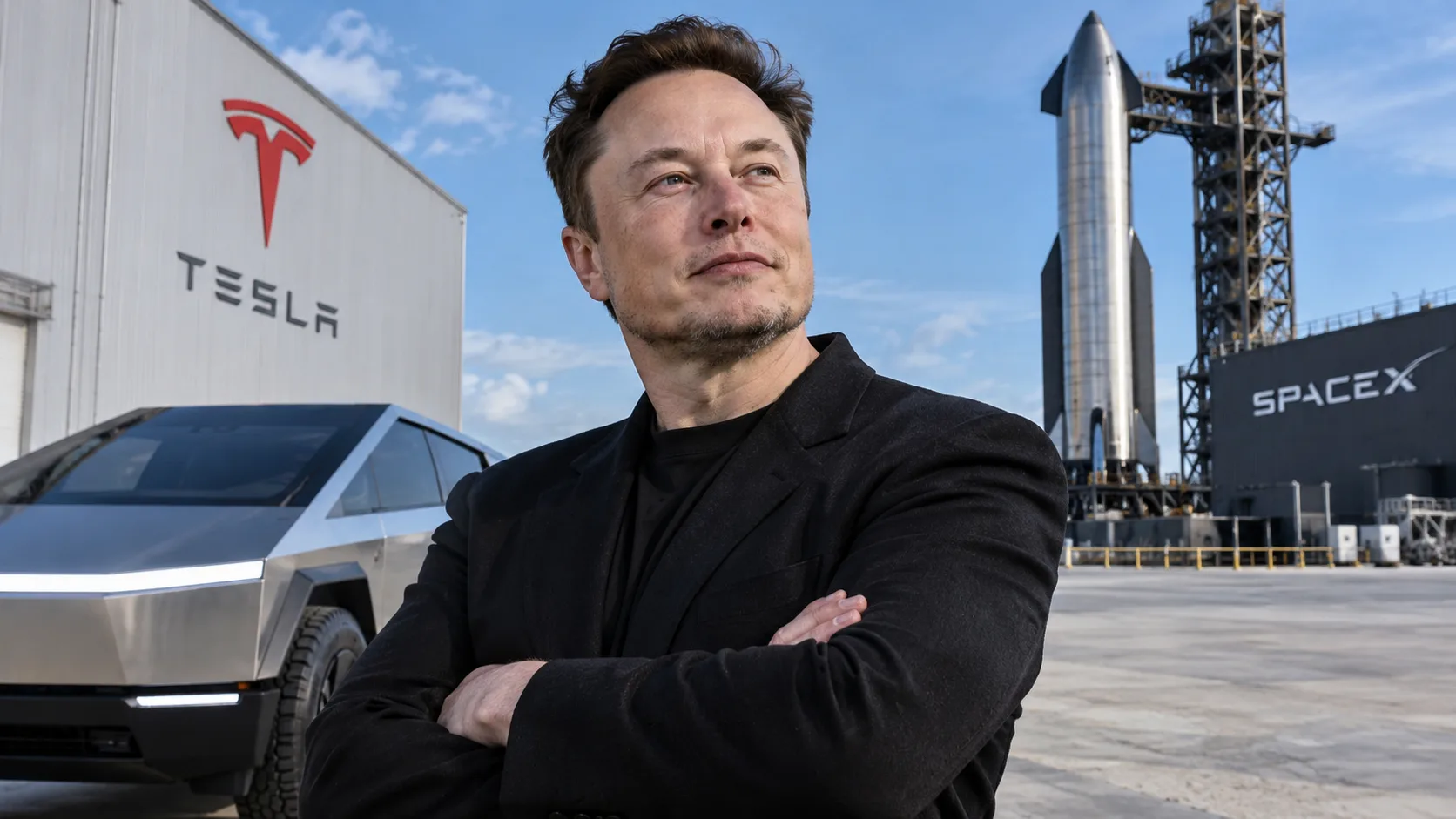
A potential $3.5 trillion combination of Elon Musk’s two largest companies is moving closer, with negotiations advancing and a major Tesla shareholder meeting just weeks away.
Tesla and SpaceX are reportedly making significant progress toward a merger that could become the largest corporate transaction in history. According to Bloomberg, the companies are working through the terms of a potential combination, with an announcement possible as early as December.
The timing is attracting particular attention because Tesla is scheduled to hold its annual shareholder meeting on December 3, an event investors will be watching for clues about the company’s future. Musk has already publicly endorsed the idea of bringing the two businesses together, although the negotiations face substantial financial, regulatory and shareholder approval challenges.
Merger Negotiations Are Moving Forward
On November 12, Bloomberg reported that Tesla and SpaceX have made progress in their merger negotiations, citing people familiar with the private discussions. The companies’ boards and financial advisers are reportedly working through several major issues, including the transaction’s structure, ownership terms and governance of the combined organization.
A formal announcement could come as early as December 2026, although the companies have also discussed delaying an agreement until early 2027. Neither company has publicly announced a final merger agreement.
The development follows Musk’s October 20 confirmation that Tesla and SpaceX had formed special committees of independent directors to evaluate a potential combination. Those committees are particularly important because Musk serves as chief executive of both companies and holds substantial ownership stakes in each.
Any agreement must address the interests of shareholders on both sides, including how much of the combined company each group would own. Those negotiations will help determine whether the potential transaction can move forward and under what terms.
What Elon Musk Said About the Merger
Musk has made it clear that he sees significant advantages in combining Tesla and SpaceX. During SpaceX’s third-quarter earnings call on October 20, he acknowledged that both companies had established independent committees to consider the transaction.
Asked whether he personally supported a merger, Musk responded:
“Do I think it would be a good idea? Yes.”
He explained that bringing the companies together could accelerate development across several technologies, including artificial intelligence, semiconductor manufacturing, robotics and satellite communications. Musk specifically identified opportunities involving advanced AI software, chip design, the companies’ Terafab semiconductor project and technologies that could connect spacecraft with terrestrial systems.
However, Musk also cautioned investors against assuming an agreement was inevitable.
“I think some people out there assume that a SpaceX and Tesla merger is a certainty, and I think that would be overstating it.”
Musk said he cannot participate directly in the special committees’ negotiations because of his interests in both businesses. He also emphasized that a merger would require substantial shareholder support, particularly from Tesla investors.
At the time of his comments, the committees had not agreed on transaction terms. The November 12 reports suggest negotiations have advanced since then, although the companies have yet to disclose any binding agreement.
Why December 3 Has Become an Important Date
Tesla’s annual shareholder meeting is scheduled for Thursday, December 3, 2026, at 3 p.m. Central Time, or 4 p.m. Eastern. The meeting will take place at Tesla’s Gigafactory Texas in Austin, with online participation available for shareholders.
There are three principal items on the published agenda:
- Re-election of three directors, including Elon Musk, board chair Robyn Denholm and former Tesla technology executive JB Straubel.
- An advisory vote concerning executive compensation.
- Ratification of the company’s independent auditor.
A Tesla-SpaceX merger vote is not included in the published agenda. December 3 has nevertheless become a date to watch because merger negotiations are reportedly advancing around the same period as Tesla’s scheduled shareholder meeting.
Investors could receive additional information before or during the event. However, neither company has announced that December 3 will serve as a merger deadline or that shareholders will vote on a combination at the meeting.
A proposed merger would likely require a separate shareholder approval process after its terms are finalized and formally disclosed. For investors, the more immediate question is whether Musk or Tesla’s directors will provide any new information about the negotiations.
A Potential $3.5 Trillion Technology Giant
The scale of the proposed combination would be extraordinary. Based on market valuations cited in November 12 reporting, SpaceX is worth approximately $1.9 trillion following its public listing earlier this year, while Tesla is valued at roughly $1.55 trillion.
Together, the companies represent approximately $3.45 trillion in market value. That would place the combined enterprise among the world’s most valuable publicly traded companies, with operations spanning several major industries.
Tesla brings its electric vehicle business, energy storage operations, autonomous driving technology and Optimus humanoid robot program. SpaceX contributes rocket launches, satellite communications, Starlink, space-based infrastructure and a rapidly expanding artificial intelligence business.
A merger could create a company operating across transportation, energy, robotics, communications, computing and aerospace. Yet the combined market value alone does not determine whether the transaction would be attractive to shareholders.
The financial terms would decide how ownership, future earnings, liabilities and potential growth are divided. Those details could ultimately matter more to investors than the headline valuation of the combined business.
The Bigger Opportunity May Be Artificial Intelligence
Although Tesla is best known for electric vehicles and SpaceX for rockets, Musk’s merger argument centers increasingly on artificial intelligence. Both companies are investing heavily in technologies that require sophisticated software, computing infrastructure and specialized semiconductor capabilities.
Tesla’s autonomous driving and humanoid robotics ambitions depend on increasingly powerful AI systems. SpaceX is developing AI-related infrastructure and satellite systems that could expand the reach of computing and communications.
The companies have already established a semiconductor manufacturing initiative known as Terafab, designed to support their long-term computing requirements. During the October earnings call, Musk said the project could produce its first test chips around May or June 2027, with volume production targeted for the third quarter of 2028.
Bringing these efforts under one corporate structure could simplify decisions about capital investment, engineering resources and technology development. That is part of the strategic argument for a merger, particularly as the demand for advanced AI computing continues to grow.
The potential financial benefit would depend on whether deeper integration produces measurable improvements in productivity, revenue growth or operating costs. For investors, that distinction is critical because the companies can already collaborate on projects without completing a merger.
Any transaction would therefore need to demonstrate advantages beyond the cooperation already taking place.
What Would Happen to Tesla Shareholders?
For Tesla investors, one of the biggest unanswered questions concerns the structure of the transaction. Bloomberg reported that advisers have been discussing how many SpaceX shares Tesla investors would receive in a potential combination.
That raises the possibility of a share-exchange transaction in which Tesla shareholders would become owners of the larger combined company. The exchange ratio would determine how much ownership Tesla investors retain and how the value of the transaction is distributed.
For example, a transaction that assigns Tesla a higher valuation could give existing Tesla shareholders a greater percentage of the combined business. A lower valuation could have the opposite effect, potentially raising concerns among investors who believe Tesla’s long-term growth prospects deserve a premium.
The same calculation matters to SpaceX shareholders, whose ownership interests could be diluted depending on the final terms. Governance is another issue, particularly how voting rights would be structured and how much control Musk would exercise over the combined organization.
The eventual terms could have a meaningful influence on both stocks. A deal carrying a favorable exchange ratio could generate enthusiasm among one group of investors while raising concerns among the other.
For that reason, the headline valuation of a $3.5 trillion merger tells only part of the story. The precise ownership terms and financial structure will be essential to evaluating the transaction.
Two Major Obstacles Could Complicate the Deal
Despite the apparent progress, Tesla and SpaceX face significant challenges that could complicate or delay an agreement. Two issues stand out: Tesla’s extensive operations in China and the level of shareholder support required to approve the transaction.
Tesla’s China Operations
Tesla operates a major manufacturing business in China, including its Shanghai factory. SpaceX, meanwhile, maintains extensive relationships with the U.S. government, including sensitive national security and defense-related contracts.
Combining the companies could create complications involving foreign operations, government security requirements and access to sensitive technologies. Bloomberg reported that discussions include how Tesla’s Chinese operations could be separated or protected from sensitive SpaceX activities.
The exact solution remains unclear, and any proposed arrangement could face scrutiny from U.S. regulators and government agencies. These concerns could become especially important if the merger brings together sensitive aerospace technologies and operations with significant exposure to China.
Shareholder Approval
Musk has identified shareholder approval as another major obstacle. He said Tesla would need support from holders representing at least 50% of all outstanding shares, rather than simply a majority of shareholders participating in a vote.
That represents a demanding threshold, particularly for a transaction involving companies with complex valuations and substantial ownership interests. Even investors who favor the strategic idea may disagree over the exchange ratio, governance structure or potential risks.
Regulatory reviews and political scrutiny could also affect the transaction’s timing. The boards therefore face a complicated task: producing a deal that satisfies investors while addressing the operational and regulatory issues involved in combining two unusually large businesses.
Why Investors Should Pay Attention to the Deal’s Structure
The most important development may ultimately be the structure of the merger rather than its announcement date. A combined Tesla-SpaceX would give shareholders exposure to a broader range of businesses, including industries with very different financial characteristics.
Tesla’s vehicle operations are exposed to manufacturing costs, consumer demand and competition. SpaceX’s launch, satellite and AI infrastructure businesses operate under different revenue models, capital requirements and regulatory obligations.
Combining them could provide diversification and new opportunities to share resources. However, it could also make the resulting company more complicated to value, particularly if investors struggle to separate the financial performance of its different businesses.
Investors who currently own Tesla for its electric vehicle, robotics or energy businesses could find themselves holding shares in a much larger conglomerate. SpaceX investors would gain exposure to Tesla’s automotive operations and their associated risks.
One possibility is that a merger leads Wall Street to assign a higher valuation to the combined company’s technological capabilities. Another is that the additional complexity makes it harder for investors to determine what each business is worth.
Neither outcome is guaranteed. Ultimately, the financial merits depend on the transaction price, governance terms and whether integration produces tangible benefits that justify the merger.
A Historic Merger Could Be Weeks Away
Tesla and SpaceX have moved beyond casual speculation about combining their businesses. Musk has publicly endorsed the idea, independent directors are evaluating it, and recent reporting indicates negotiations over the structure and terms are progressing.
A December announcement remains possible, although no final agreement has been announced and substantial obstacles remain. The December 3 shareholder meeting creates an important near-term event for investors to monitor.
For Tesla and SpaceX shareholders, the biggest questions concern the valuation of each business, the ownership structure and whether a merger would produce financial benefits that justify its complexity.
With nearly $3.5 trillion in combined market value, the potential transaction could reshape the technology and aerospace sectors and create one of the most influential corporate enterprises in the world. The next few weeks could reveal whether Musk’s vision of bringing his largest businesses together becomes a formal deal.
About Author