China’s economy continues to send mixed signals. On the surface, exports remain strong, advanced manufacturing is expanding, and China maintains global leadership in areas such as electric vehicles, robotics, and artificial intelligence. Underneath that growth, however, a troubling dynamic is unfolding. Too much production is colliding with fragile domestic demand, pushing prices lower, compressing corporate profits, and weakening wage growth.
Economists increasingly warn that China may be sliding into a prolonged deflationary cycle that could resemble Japan’s lost decades, with serious consequences for global trade, commodity markets, multinational earnings, and geopolitical tensions.
The warning signs are visible not just in macro data, but on the ground across China’s retail and manufacturing economy.
Returns Pile Up as Consumer Spending Stalls
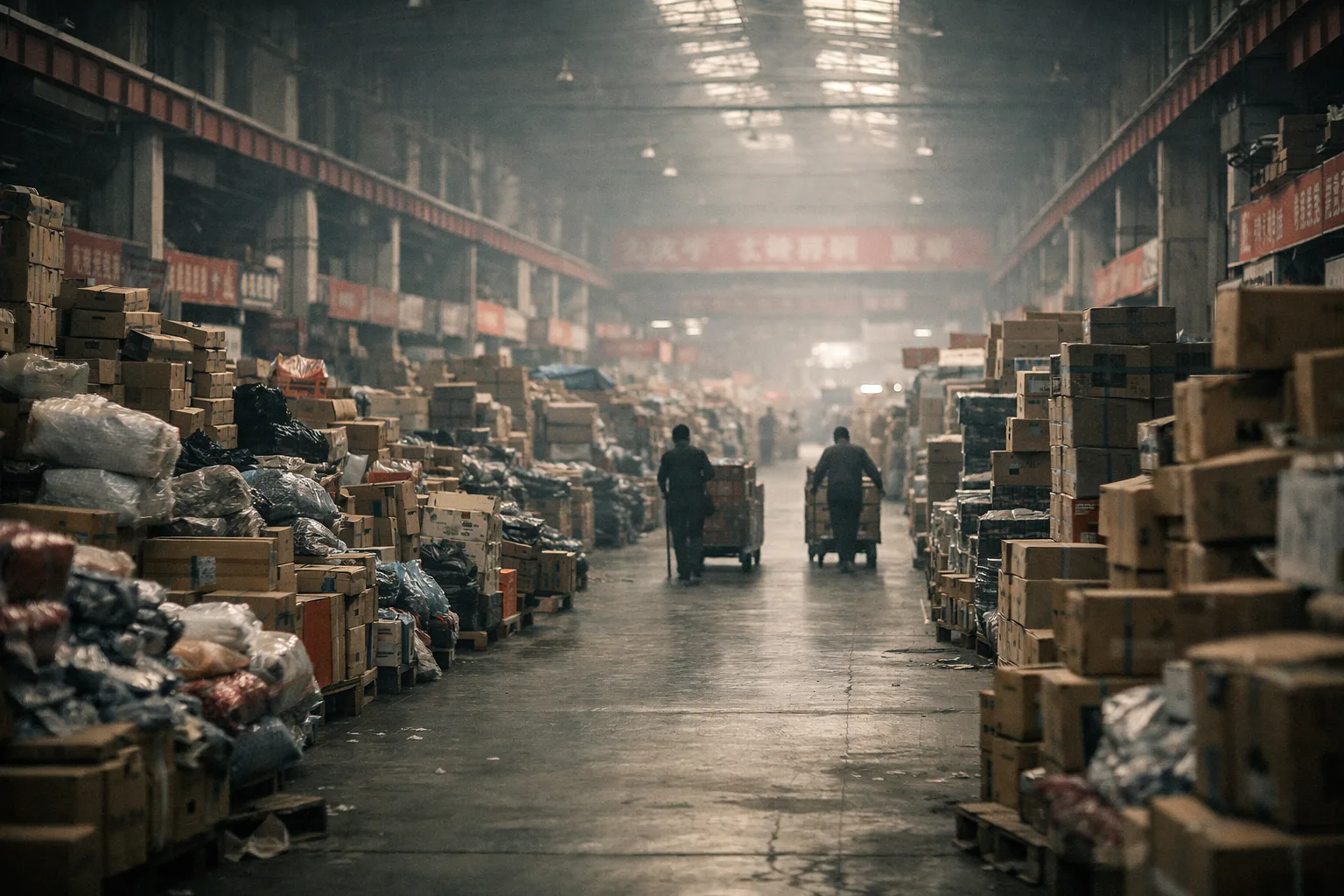
At Shanghai’s massive Qipu Road Wholesale Clothing Market, business activity appears busy but misleading. Vendors ship large volumes of sweaters, dresses, and pants to retail stores nationwide under a consignment model. Retailers pay only for what sells and return what does not.
Lately, vendors say little is selling.
Delivery workers regularly push carts stacked with returned clothing through the market’s narrow corridors. Merchants sort through unsold inventory, counting losses rather than profits.
Wang Jingjing, a womenswear wholesaler, estimates her 2025 revenue fell roughly 50 percent from the previous year. Before the pandemic she employed four workers. Today she has only one.
“Ordinary people have no money in their pockets, including us,” she said.
Her personal spending habits reflect the broader slowdown. Luxury purchases have disappeared, replaced by inexpensive takeout meals and strict budgeting.
This pattern is repeating across much of China’s consumer economy. Weak household spending combined with excess supply forces businesses to cut prices simply to move inventory. Lower prices reduce margins. Shrinking margins lead companies to freeze hiring, limit wage increases, or lay off workers. That in turn suppresses consumer spending even further.
Economists describe this as a deflationary feedback loop.
Economic Growth Masks Underlying Weakness
China reported roughly 5 percent GDP growth last year, driven primarily by export demand. Chinese factories continue to dominate global manufacturing in areas ranging from rare earth processing to shipbuilding and advanced electronics.
That export strength has helped offset weak domestic consumption, but it also creates imbalances. China’s GDP deflator, a broad measure of price changes across the economy, has remained negative since 2023. That signals insufficient demand inside the country.
Corporate earnings reinforce the message. Profit margins among publicly traded Chinese companies are now near their lowest levels since 2009, according to FactSet data covering roughly 5,000 mainland firms. Industries experiencing margin pressure include steel, cement, electric vehicles, robotics, consumer staples, and cosmetics.
Fixed asset investment also contracted in 2025 for the first time on record. That category includes spending on factories, infrastructure, and real estate, traditionally key drivers of China’s growth model.
The risk is that deflation becomes entrenched in expectations. Once businesses and consumers begin assuming prices will keep falling, spending decisions get delayed, worsening the slowdown.
Export Surpluses Are Creating Political Friction
Deflation at home is pushing manufacturers to seek growth abroad. China posted a record trade surplus of approximately $1.2 trillion in 2025, according to customs data. That surge has fueled rising political tensions as governments in the United States, Europe, and parts of Asia accuse China of flooding markets with artificially cheap goods.
The U.S. has already imposed higher tariffs on electric vehicles, batteries, solar equipment, and select industrial components. The European Union has launched anti-subsidy investigations into Chinese EV exports. Emerging markets worry their domestic manufacturers cannot compete with China’s pricing power.
For investors, this raises the risk of escalating trade barriers, retaliatory tariffs, and supply chain disruptions that could impact multinational earnings and inflation dynamics globally.
Beijing Prioritizes Production Over Consumption
Chinese policymakers publicly acknowledge the need to boost domestic demand and curb excessive competition, often referred to locally as “involution.” Officials have pledged to address price wars and overcapacity heading into 2026.
At the same time, China’s industrial strategy remains focused on technological self-sufficiency and manufacturing dominance. That emphasis reflects President Xi Jinping’s long-standing skepticism toward Western-style consumer-driven growth, which he has previously characterized as wasteful.
Draft guidance for China’s next five-year economic plan continues to prioritize advanced manufacturing, automation, and strategic industries. Consumer stimulus measures remain comparatively modest.
“Old habits die hard,” said Robin Xing, Morgan Stanley’s chief China economist, who expects deflationary pressures to persist through at least this year.
High Savings Rates Limit Consumer Spending
China’s household sector remains structurally cautious. Many families maintain limited health insurance coverage and small pensions, encouraging precautionary saving. Social safety net spending remains well below levels seen in developed economies.
On average, Chinese households save roughly one-third of their income. In contrast, U.S. households typically save less than 5 percent. Household consumption accounted for only about 40 percent of China’s GDP in 2024, compared with a global average near 55 percent and roughly 68 percent in the United States, according to World Bank data.
Song Tianying, a 20-year-old cellphone saleswoman in Beijing, earns around $1,000 per month and saves roughly $400. After her father fell ill and later passed away, her family took on medical debt. She now helps support her mother and brother while saving for a future home down payment.
“I want to save as much as I can,” Song said.
Such stories highlight why consumer confidence remains fragile.
Property Slump Continues to Weigh on Wealth
China’s multi-year real estate downturn remains another drag on household spending. Home prices in many cities have fallen between 20 percent and 40 percent from peak levels in 2021. Government efforts to stabilize the sector have so far produced only limited results.
Zou Zhimin, a jewelry wholesaler in Shanghai, purchased a two-bedroom apartment near the market peak. Since then, the value of his home has declined significantly.
“It feels like my total net worth has shrunk by 20%,” Zou said.
To maintain sales, he has been forced to discount jewelry by as much as 60 percent. Declining home values reduce household wealth, further discouraging discretionary spending.
Electric Vehicle Industry Shows Signs of Saturation
China’s electric vehicle sector illustrates the broader overcapacity problem. More than 100 EV manufacturers currently compete in the domestic market, many supported by local government subsidies and preferential financing.
Local governments remain reluctant to allow company failures because factories provide employment and tax revenue.
“The problem now is that the rate of closures is too slow,” said David Zhang, an independent auto analyst. “It isn’t a purely market-driven competition.”
Vehicle prices have declined for roughly three consecutive years. According to the China Automobile Dealers Association, only about 30 percent of car dealers were profitable in the first half of 2025. Nearly three-quarters sold at least some vehicles below cost.
Some dealers are shifting aggressively toward exports. At AVIC Lantian in Shanghai, management downsized imported vehicle operations while expanding export sales teams targeting the Middle East, Central Asia, and Africa.
General manager Zhang Leibin said vehicle prices were approximately 30 percent lower in 2025 than in 2024, while profits declined about 50 percent.
New Industries Risk Repeating Old Mistakes
Even emerging sectors are showing signs of excessive investment. China’s humanoid robotics industry now includes more than 150 companies. Last year, the country’s top economic planning agency warned about bubble risks.
Non-tech industries face similar struggles. China’s paper manufacturing sector continues to battle chronic overcapacity. In the first eleven months of 2025, profits among large paper producers declined roughly 11 percent year over year, according to government data.
Shandong Chenming Paper, one of the country’s largest producers, has accumulated more than $500 million in overdue debt and was forced to shut down production lines, according to company filings.
Pet products, food condiments, and consumer goods manufacturers are also battling margin compression as competitors slash prices to gain volume.
Food delivery platforms including Meituan, Alibaba, and JD.com have intensified discount wars to stimulate demand. Meituan recently reported a quarterly loss of approximately $2.6 billion, its first loss since 2022. Alibaba and JD.com saw profits decline sharply due to subsidy spending.
Chinese media dubbed the period the “summer of free lunch.”
Workers Face Longer Hours and Stagnant Wages
With profits under pressure, companies increasingly stretch existing staff rather than hiring. Wage growth has stalled, and surveys from the People’s Bank of China show elevated anxiety about job security.
Youth unemployment remains elevated, with the jobless rate for workers aged 16 to 24 hovering near 17 percent.
Tian Yi, a 24-year-old graphic designer in Beijing, now handles livestream sales in addition to design work as her employer struggles financially.
“I’m doing two jobs,” she said, while earning roughly $1,100 per month. “I’m so tired.”
Even higher-income professionals report rising caution. Lu You, an employee at a semiconductor firm in Shanghai, says peers discussing pay cuts create pressure to save aggressively even when personal income remains stable.
Government Stimulus Has Limited Impact
China introduced consumer trade-in subsidies in 2024 to encourage purchases of vehicles and appliances. While the program temporarily boosted retail activity, momentum has faded as eligible consumers already completed purchases.
Retail sales growth recently slipped to the slowest pace in several years.
Authorities have also launched an “anti-involution” campaign aimed at curbing destructive price competition. Guidelines encourage firms to avoid selling below cost and reduce redundant capacity. Critics argue these measures treat symptoms rather than root causes.
“It will cure the symptom but not the underlying disease,” said Fred Neumann, HSBC’s chief Asia economist. “The relentless pursuit and incentivization of investment ultimately creates a deflationary trap.”
Global Implications for Investors
China’s deflation problem matters far beyond its borders. Persistent price weakness can suppress global inflation, impact commodity demand, pressure multinational earnings, and intensify trade disputes.
For equity investors, margin pressure across Chinese industries raises risks for exporters, suppliers, and global manufacturers exposed to China’s pricing competition. Commodity investors should monitor how slowing domestic demand affects metals, energy, and shipping volumes.
Currency markets may also feel pressure if deflation encourages further monetary easing by the People’s Bank of China.
Perhaps most importantly, geopolitical tensions around trade protectionism could escalate as governments attempt to shield domestic industries from Chinese overcapacity.
A Mood of Caution on the Ground
Small business owners continue to face difficult choices. Huang Hai, who runs a toy shop in Shanghai, sells collectible blind boxes at steep discounts just to generate cash flow. Online competitors undercut his pricing further.
If business conditions deteriorate further, Huang says he may return to his hometown.
“If he can’t make a living there either, he said, ‘I’ll just have to live off my parents.’”
Wang Jingjing, the clothing wholesaler, reflects on how dramatically conditions have changed.
“I still quite long for that feeling from before,” she said. “Now there’s just a feeling of bleakness.”
Unless China finds a sustainable way to rebalance toward household consumption and market-driven capacity discipline, the deflation cycle may continue to tighten its grip on the world’s second-largest economy.
For investors globally, the consequences will extend well beyond China’s borders.
About Author