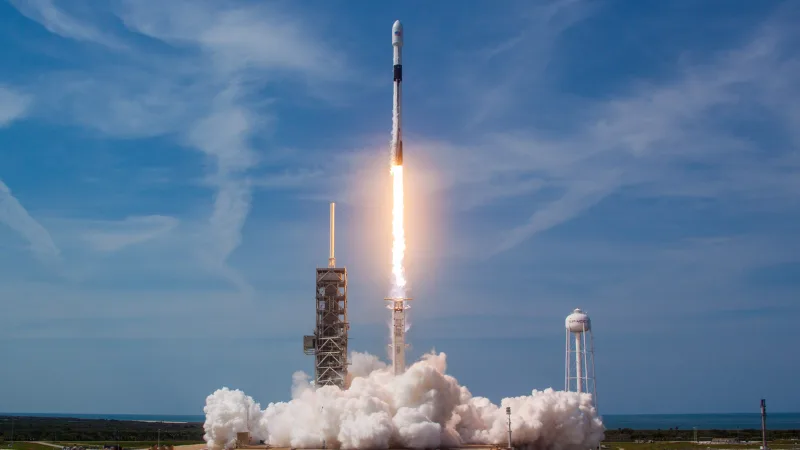
Starlink expands. Axiom-4 faces delays. And Elon Musk’s rocket empire shows no signs of slowing down. Here’s what investors need to know.
SpaceX just completed its 500th Falcon-family rocket launch, a milestone that puts the company in a league of its own. As of June 16, Elon Musk’s aerospace giant had sent another 26 Starlink V2 Mini satellites into orbit from Vandenberg Space Force Base in California. That brings the total number of operational Starlink satellites to a staggering 7,776, with nearly 9,000 launched to date.
But it’s not just about raw numbers. It’s about reliability, reusable tech, and expanding verticals. For investors watching the space economy or looking for clues about where next-gen infrastructure is headed—SpaceX is proving it’s not just a rocket company. It’s a tech platform.
The Business of Reuse: Falcon 9 and Its Economic Engine
The June 16 Starlink mission was powered by Falcon 9 booster B1081, which returned safely to the Pacific Ocean droneship, “Of Course I Still Love You.” This isn’t novelty—it’s routine. Falcon 9 first-stage boosters have now been reused in over 80% of recent missions, cutting launch costs and outpacing any national space agency in turnaround time.
Reusability is what gives SpaceX its edge—and potential long-term profitability.
“The launch cost savings from reusability are enormous. We’re seeing sub-$30 million launches now for commercial customers,” noted space industry analyst Arsène Dupont in a June 2025 Bloomberg interview.
Source
For context, NASA’s SLS (Space Launch System) costs nearly $2 billion per launch. That’s not even in the same universe.
Starlink’s Global Grab: From Internet to Infrastructure Backbone
With nearly 8,000 satellites in orbit, Starlink is now the largest satellite constellation ever built. And it’s no longer just serving remote broadband users in Alaska or cargo ships crossing the Pacific.
In 2025, Starlink began targeting:
- Mobile backhaul for telecoms in Asia and Africa
- Low-latency trading routes for financial firms (especially between Singapore and Tokyo)
- Defense contracts with the U.S. and allied militaries for encrypted, resilient communications
According to filings with the FCC and ITU, SpaceX is positioning Starlink as a low-earth-orbit replacement for legacy cable infrastructure in markets plagued by red tape and unreliable landlines.
A $30 Billion Revenue Engine?
Elon Musk has previously projected $30 billion annually in Starlink revenue. While some analysts have scoffed, recent momentum suggests he may not be far off.
What’s Holding Up the Axiom-4 Crew Launch?
Despite SpaceX’s commercial success, not everything is running smoothly. The much-anticipated Axiom-4 crew mission to the ISS—which includes Indian astronaut Shubhanshu Shukla—has been delayed twice in June.
Why the Hold?
- On June 10, a liquid oxygen leak during Falcon 9 hot-fire testing raised safety concerns.
- By June 12, a pressurization leak on the ISS’s Russian Zvezda module further postponed liftoff, now tentatively rescheduled for June 19.
This marks a rare double-delay for SpaceX, which prides itself on clockwork precision. However, the company and NASA have emphasized that crew safety is paramount—and the spacecraft remains flight-ready once issues are cleared.
Axiom Space, a private space station developer partnering with SpaceX, has already flown three successful missions and is betting on private orbital labs becoming revenue-generating platforms by the early 2030s.
What’s Next? More Starlink, More Risk, More Opportunity
Upcoming Launches to Watch:
- June 18: Starlink Group 10-3 (Cape Canaveral)
- June 20: Starlink Group 15-10 (Vandenberg)
- Late June: Transporter-14, a commercial rideshare flight that includes Earth observation satellites, IoT relays, and military payloads
SpaceX has already surpassed one launch every 3.2 days in 2025. With plans to ramp up to 150+ launches annually, it’s outpacing not just competitors—but entire countries.
And investors should pay close attention to Transporter missions—they reflect the growing “space-as-a-service” economy, where SpaceX gets paid like FedEx to deploy smallsat payloads for everyone from climate startups to NATO.
Why Investors Shouldn’t Ignore SpaceX (Even If It’s Private)
SpaceX is still private—but it has implications across multiple asset classes:
| Sector | Impact |
|---|---|
| Telecom | Starlink is disrupting traditional satellite providers like Viasat and Iridium. |
| Defense | Increasing reliance on LEO-based secure comms may shift contract flows from Lockheed/Raytheon toward agile players. |
| Semiconductors | Satellite and launch demand are pressuring supply chains—watch companies like Skyworks, STMicro, and Maxar. |
| Public Space ETFs | Funds like ARKX and UFO benefit indirectly via suppliers and SPAC-adjacent firms. |
| AI & Cloud | Starlink’s edge access supports low-latency data transmission for edge-AI and cloud platforms in remote areas. |
A future IPO would likely be one of the most anticipated in history. Elon Musk has hinted at spinning off Starlink as a public company once it achieves cash flow positivity—which some insiders estimate could happen as early as 2026.
SpaceX Isn’t Just a Rocket Company. It’s Infrastructure.
To the average observer, rockets are flashy. But to investors, SpaceX is infrastructure. It’s delivering:
- Global connectivity at speed
- Reusable delivery systems at scale
- Supply chain reshaping across multiple sectors
And with 500 successful Falcon launches behind them—and Starship on the horizon—SpaceX has not only built a durable monopoly on orbital transport, it’s creating a new class of investable opportunities in the space economy.
About Author