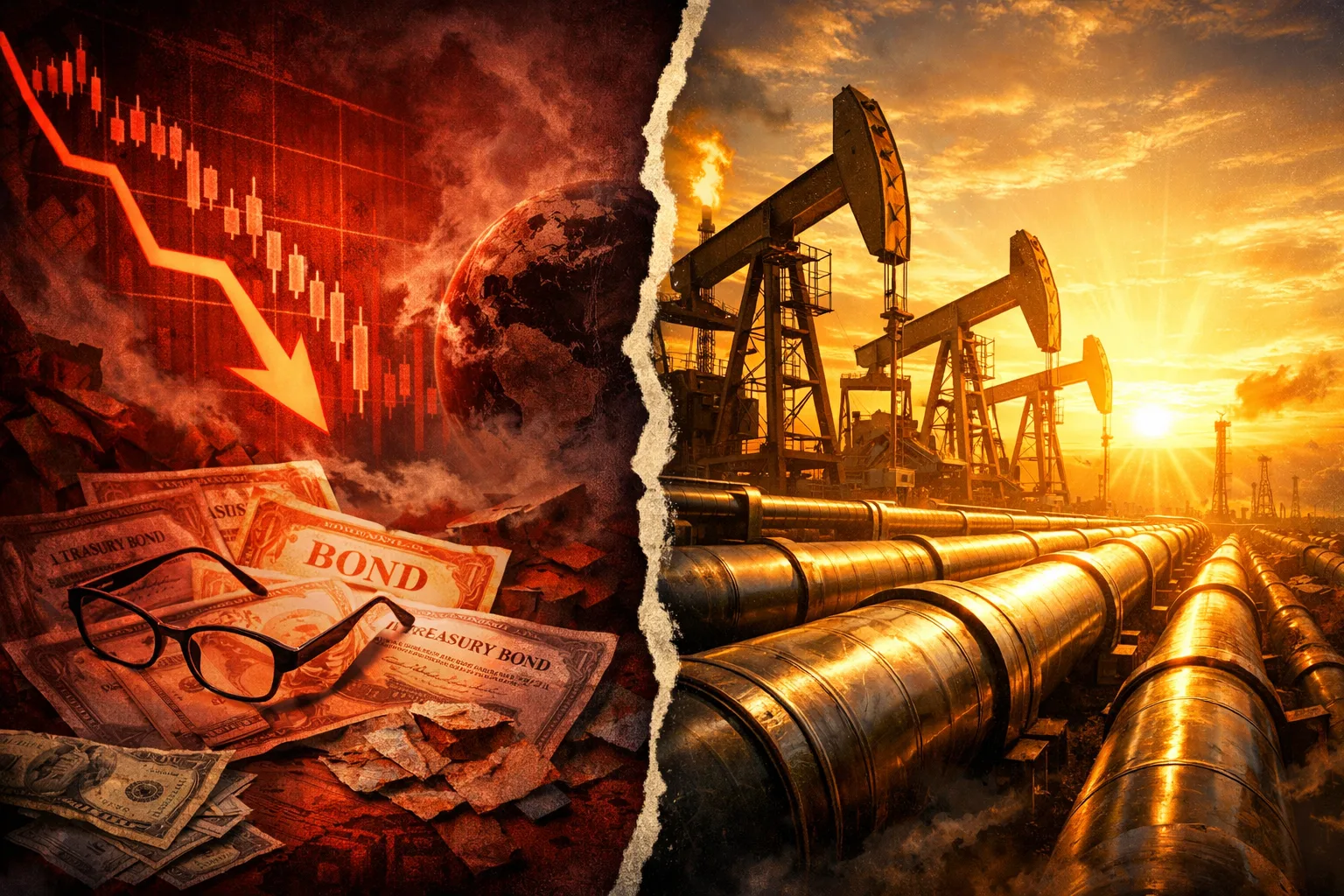
The sudden surge in oil prices has revived an uncomfortable economic word that many investors hoped would remain in the history books: stagflation.
Gasoline prices across the United States have jumped in recent weeks as tensions in the Middle East escalate following military strikes involving the United States, Israel, and Iran. Oil markets are now reacting to fears that the conflict could disrupt energy supplies flowing through the Persian Gulf, one of the most critical oil shipping routes in the world.
Those fears intensified after Qatar’s energy minister warned that oil prices could surge dramatically if the conflict spreads.
“When even the energy minister of Qatar warns that oil prices could double to $150 a barrel, crashing the global economy, you know that the financial and economic risks are enormous.”
For investors, the concern is not just higher gasoline prices. A major oil shock has historically created a dangerous combination of slower economic growth and rising inflation, a scenario known as stagflation.
And during periods like that, the traditional retirement portfolio that millions of Americans rely on can struggle.
But history suggests that one sector has often helped protect retirement portfolios during these moments: energy stocks.
Why Stagflation Is Dangerous for Traditional Portfolios
Most retirement portfolios follow a simple formula that financial advisors have promoted for decades.
The classic structure is the 60/40 portfolio, which holds roughly 60 percent stocks and 40 percent bonds.
The idea is simple. Stocks provide growth while bonds provide stability and income.
Normally, when stocks fall during economic downturns, bonds rise because investors seek safer assets.
But stagflation breaks that relationship.
When inflation rises rapidly, bonds lose value because their fixed payments become less attractive. At the same time, stocks often fall because economic growth slows and corporate profits come under pressure.
In other words, both sides of the traditional portfolio can decline at the same time.
History provides several examples.
During the 1970s oil crisis, when energy prices surged after geopolitical disruptions in the Middle East, the U.S. economy experienced years of slow growth combined with high inflation.
Research shows that the standard 60/40 portfolio lost about 10 percent in real inflation adjusted terms during that decade.
More recently, a similar dynamic occurred in 2022, when Russia invaded Ukraine and energy prices surged globally.
That year stocks and bonds both declined sharply.
The typical balanced portfolio lost roughly 22 percent after accounting for inflation, one of the worst combined performances for stocks and bonds in decades.
A New Oil Shock Is Emerging
Markets are once again facing the possibility of another energy driven inflation spike.
Oil prices have been climbing as geopolitical tensions intensify in the Middle East. Traders fear that a broader regional conflict could disrupt shipments through the Strait of Hormuz, the narrow waterway that carries roughly one fifth of the world’s oil supply.
Any interruption in that corridor could quickly push global crude prices higher.
Already, gasoline prices in the United States have risen sharply in response to tightening energy markets.
At the same time, new economic data is raising concerns that the economy may already be weakening.
The U.S. Bureau of Labor Statistics recently reported a surprise decline of 92,000 jobs in February, while the unemployment rate climbed to 4.4 percent.
Weak employment growth combined with rising energy costs is exactly the type of environment that historically produces stagflation.
For investors, that raises an uncomfortable question.
If stocks and bonds both struggle during stagflation, how can retirement portfolios be protected?
Energy Stocks Have Historically Acted as a Hedge
One potential answer lies in the same force that creates the problem: energy prices.
When oil and gas prices surge, energy companies often benefit because their revenues and profits increase.
That means energy stocks can rise even when the broader market is struggling.
Historically, this dynamic has provided an important hedge against inflation shocks.
Data tracked by Dartmouth College finance professor Kenneth French shows that energy stocks performed exceptionally well during the inflationary 1970s.
While many sectors of the stock market struggled and bonds lost value, energy producers generated strong real returns.
According to French’s historical data, energy stocks more than doubled investors’ purchasing power during that decade, even after adjusting for inflation.
That performance helped offset losses in other parts of the market.
Energy Has Already Outperformed in the Current Crisis
The same pattern appears to be emerging again today.
Energy stocks have significantly outperformed the broader market as oil prices rise.
One widely tracked benchmark is the Energy Select Sector SPDR Fund (XLE), an exchange traded fund that holds major U.S. oil companies including Exxon Mobil, Chevron, and Occidental Petroleum.
So far this year the fund has gained roughly 26 percent, while the broader stock market has delivered little or no return.
Major integrated oil companies have also rallied.
Companies like Exxon Mobil, Chevron, and Occidental Petroleum benefit directly from higher crude prices because their revenues are tied to energy production.
As energy prices rise, their cash flows and profits often increase.
For investors, that creates an important diversification benefit.
How Energy Stocks Help Stabilize Retirement Portfolios
Financial analysts often test investment strategies by modeling hypothetical portfolios.
One example shows how energy exposure can help during periods of market stress.
Consider a retirement portfolio invested entirely in a balanced fund that tracks the traditional 60 percent stock and 40 percent bond allocation.
In 2022 that type of portfolio lost about 17 percent, and more than 20 percent when inflation is included.
But if an investor had placed 20 percent of their portfolio into energy stocks, while keeping 80 percent in the balanced fund, the results would have looked very different.
The overall portfolio would have declined less than 1 percent.
The gains from energy companies would have offset much of the damage caused by falling stocks and bonds.
That illustrates the power of diversification during inflation shocks.
The Strategic Role of Energy in Retirement Accounts
None of this means investors should abandon traditional stock and bond portfolios.
Equities still provide long term growth and bonds still play a role in stabilizing income.
But many financial experts argue that adding a modest allocation to energy producers can improve resilience during periods of economic uncertainty.
A simple approach might involve allocating 10 percent to 20 percent of a portfolio to energy stocks or energy ETFs.
This allocation can serve two purposes.
First, it acts as a hedge if oil prices surge due to geopolitical crises or inflation.
Second, it creates an opportunity for investors to rebalance their portfolios.
If energy stocks outperform during market turmoil, investors can sell some of those gains and use the proceeds to buy beaten down stocks or bonds at lower prices.
This process helps maintain the long term balance of the portfolio while taking advantage of market volatility.
Why the Energy Sector Still Matters in a Changing Economy
Some investors have been hesitant to invest in fossil fuel companies because of the global push toward renewable energy.
But even as governments promote clean energy policies, the global economy still relies heavily on oil and natural gas.
The International Energy Agency estimates that fossil fuels still account for more than 80 percent of global energy consumption.
That means geopolitical disruptions in oil producing regions can still have enormous economic consequences.
The Middle East remains particularly important.
Several of the world’s largest oil producers are located there, and the region’s shipping lanes transport vast amounts of crude to global markets.
Any escalation of military conflict in the region could quickly affect energy supply.
What Investors Should Watch Next
Several factors will determine whether oil prices continue rising in the months ahead.
Investors should closely monitor developments in the Middle East, particularly any threats to oil infrastructure or shipping routes.
Another key variable will be global demand.
If the U.S. and global economies slow significantly, oil demand could weaken, limiting price increases.
At the same time, central bank policy will play an important role.
If inflation remains elevated because of rising energy prices, the Federal Reserve may be forced to keep interest rates higher for longer.
That would create additional pressure on both stocks and bonds.
For retirement investors, these crosscurrents make diversification more important than ever.
The Bottom Line for 401(k) Investors
Periods of geopolitical conflict and rising inflation create some of the most difficult environments for traditional portfolios.
When both stocks and bonds decline together, many retirement savers feel like they have nowhere to hide.
History suggests that energy stocks can provide a valuable buffer in those moments.
They often benefit from the same forces that cause broader market stress.
While no investment strategy eliminates risk, adding energy exposure can help stabilize portfolios during oil shocks and inflation spikes.
For long term investors managing their 401(k) or IRA accounts, that diversification may prove increasingly important if global tensions continue to rise.
Sources
https://fred.stlouisfed.org/series/DCOILWTICO
https://mba.tuck.dartmouth.edu/pages/faculty/ken.french/data_library.html
https://www.bls.gov/news.release/empsit.nr0.htm
https://www.eia.gov/energyexplained/oil-and-petroleum-products/imports-and-exports.php
https://www.iea.org/reports/world-energy-outlook-2024
About Author