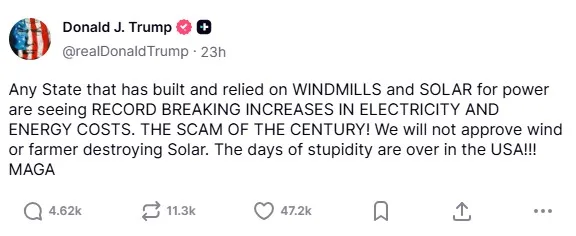
President Donald Trump has escalated his administration’s energy shift, declaring on Truth Social that the United States will no longer approve new wind or “farmer-destroying” solar projects. His blunt message—“The scam of the century… we will not approve wind or farmer destroying Solar. The days of stupidity are over in the USA!!!”—marks a sharp departure from the clean energy boom that defined much of the past decade.
But what does this mean for investors, utilities, and everyday Americans facing energy bills and inflationary pressures? Let’s break it down.
The Policy Shift: From Support to Crackdown
Trump’s statement is not an isolated outburst; it’s part of a broader set of policy moves that, taken together, amount to a systematic rollback of federal support for renewable energy.
- Treasury Guidance on Tax Credits – As of September 2, only projects with active construction will remain eligible for credits, with limited exceptions for solar projects under 1.5 MW. This effectively shuts down the “safe harbor” provision that developers used to lock in incentives.
- USDA Withdrawal – The Department of Agriculture recently ended programs supporting solar and wind on farmland, cutting off loan guarantees and imposing restrictions on equipment sourcing.
- Executive Order to End Subsidies – Trump signed the One Big Beautiful Bill Act, which phases out federal subsidies for renewables by 2027.
- Interior Department Roadblocks – Federal regulators have tightened environmental reviews and even revoked previously approved wind development zones, citing “capacity density” and land-use concerns.
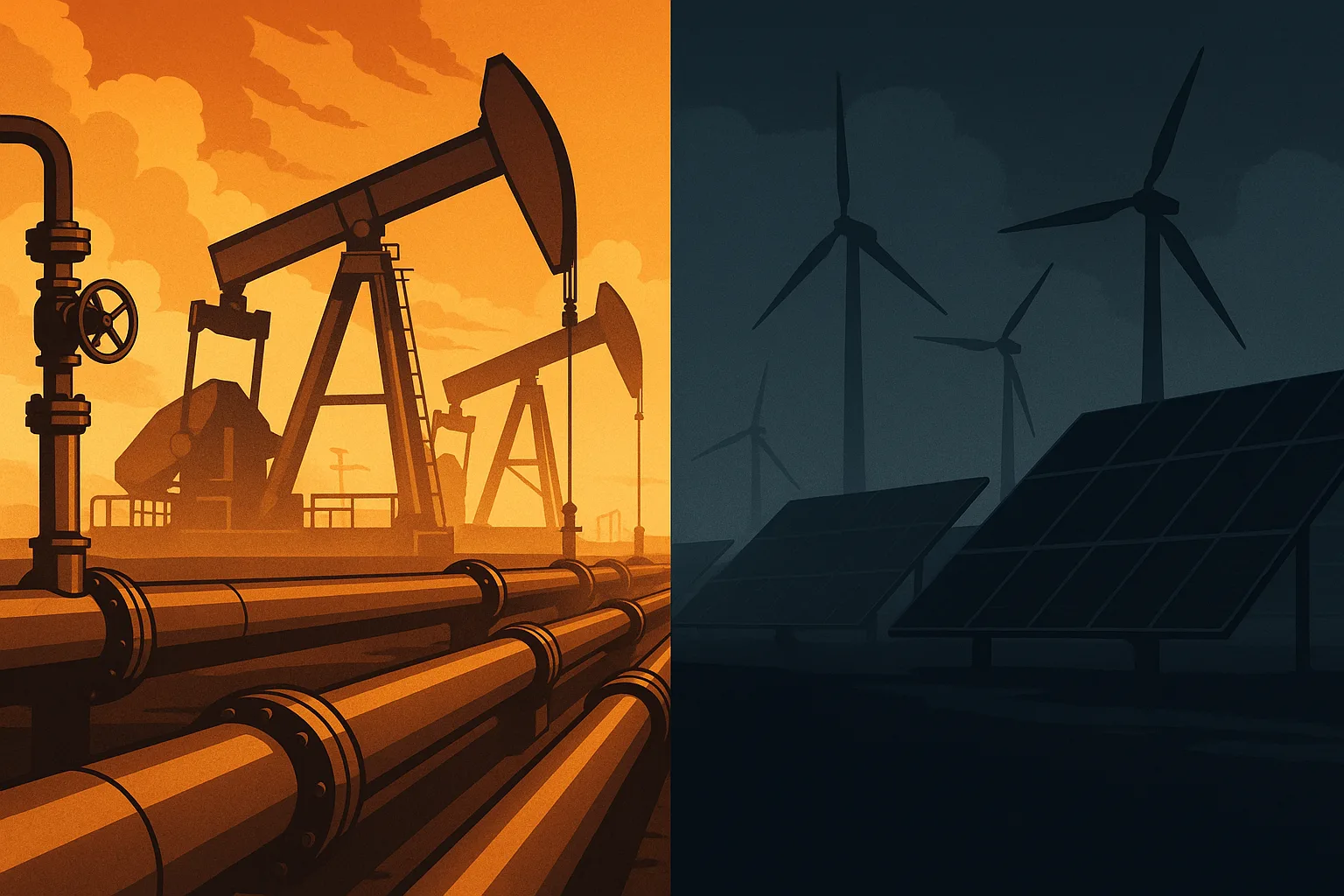
Taken together, these measures mean the U.S. clean energy industry faces an entirely new regulatory and financial environment—one tilted away from renewables and toward fossil fuels.
Why Trump Is Making the Move
Trump argues that renewables have driven up electricity costs, hurt farmers, and undermined grid reliability. He frames solar and wind as foreign-driven scams that exploit taxpayers while weakening U.S. energy independence.
This rhetoric appeals to parts of his base, especially in rural states where farmland use for solar panels has stirred controversy. It also dovetails with his long-standing push for oil, gas, and coal dominance.
But here’s the kicker: data paints a very different picture. According to the U.S. Department of Energy, utility-scale solar and wind were among the cheapest sources of new electricity in 2023 and 2024, beating out natural gas and coal on a cost-per-megawatt basis.
The Market Fallout
Solar and Wind Stocks Under Pressure
Investors immediately reacted. Solar ETFs and clean energy funds slid after Trump’s statement and related executive orders. The Invesco Solar ETF (TAN), for example, dropped after his July order slashed federal support.
Developers like NextEra Energy (NEE) and First Solar (FSLR) are particularly exposed. Both have billions in pipeline projects reliant on federal credits, and those projects are now in jeopardy.
Fossil Fuel Rally
Meanwhile, oil and gas producers stand to benefit. With renewable competition throttled, demand for natural gas in particular may rise as utilities scramble for dispatchable power sources. Companies like ExxonMobil (XOM) and Chevron (CVX) may see upside.
State-Level Clash
States heavily invested in renewables—like Texas, California, and Iowa—face stark consequences. A study in Texas estimates the phaseout of credits could kill 77 GW of planned capacity, raise household energy bills by $220 per year by 2030, and wipe out over 90,000 jobs.
This sets up an energy federalism battle—with blue and some red states potentially suing or legislating to keep clean energy expansion alive despite federal headwinds.
What It Means for Everyday Americans
For households, this pivot could translate into higher bills, more volatility, and less choice. By undermining renewables, the U.S. risks:
- Slower adoption of cheaper energy sources, keeping reliance on higher-cost fossil fuels.
- Greater exposure to oil price swings, especially if geopolitical tensions flare in the Middle East.
- Job losses in clean energy sectors, which have been among the fastest-growing in the country.
Ironically, Trump’s argument that renewables drive up bills could backfire, as the removal of subsidies and stalled investment slows cost reductions and grid innovation.
Investor Takeaways
1. Positioning for a Fossil Fuel Tilt
Expect short- to mid-term tailwinds for oil and gas equities. Energy companies producing natural gas, in particular, may benefit from reduced renewable competition and higher grid reliance.
2. Renewables: High Risk, Select Opportunity
While broad clean energy ETFs face headwinds, there may be contrarian opportunities in oversold names like First Solar if states or courts push back against Trump’s policies. Long-term demand for renewables globally remains robust, regardless of U.S. politics.
3. Utilities Caught in the Crossfire
Investors should watch utilities with large renewable buildout plans, such as Duke Energy (DUK) and Southern Company (SO). Regulatory delays may weigh on them, but natural gas-heavy utilities could benefit.
4. Inflation & Energy Costs
Energy is a key input across the economy. If policy leads to higher electricity costs, expect knock-on effects in consumer spending, inflation metrics, and Fed policy decisions. This is an underappreciated risk for broader equity markets.
The Bigger Picture: U.S. vs. Global Energy Trends
Even if Trump throttles domestic clean energy, the global market is moving in the opposite direction. China continues to dominate solar panel production and installation, Europe is doubling down on green energy post-Ukraine war, and India is scaling renewables rapidly.
For global investors, that means opportunities in non-U.S. renewable plays remain attractive, even as U.S. policy temporarily tilts backward.
A Major Shift
Trump’s vow to halt approvals for solar and wind is more than just rhetoric—it’s a structural shift in U.S. energy policy. With subsidies being phased out, approvals tightened, and farmland projects effectively blocked, the clean energy sector faces some of its toughest years in recent memory.
For investors, the key is not to get caught flat-footed. Fossil fuel equities may benefit in the short run, but long-term global energy trends still point to renewables. The tension between U.S. political cycles and global market forces will shape portfolios for years to come.
As always, energy is not just about powering homes—it’s about powering profits. And Trump’s latest declaration just made the game far more volatile.
Sources:
- OilPrice.com
- Politico
- Reuters
- Reuters – Subsidy Phaseout
- Grist
- Houston Chronicle
- Investopedia
- Wall Street Journal
About Author