President Donald Trump just injected even more volatility into an already fragile global market setup and traders should not dismiss it as social media theatrics.
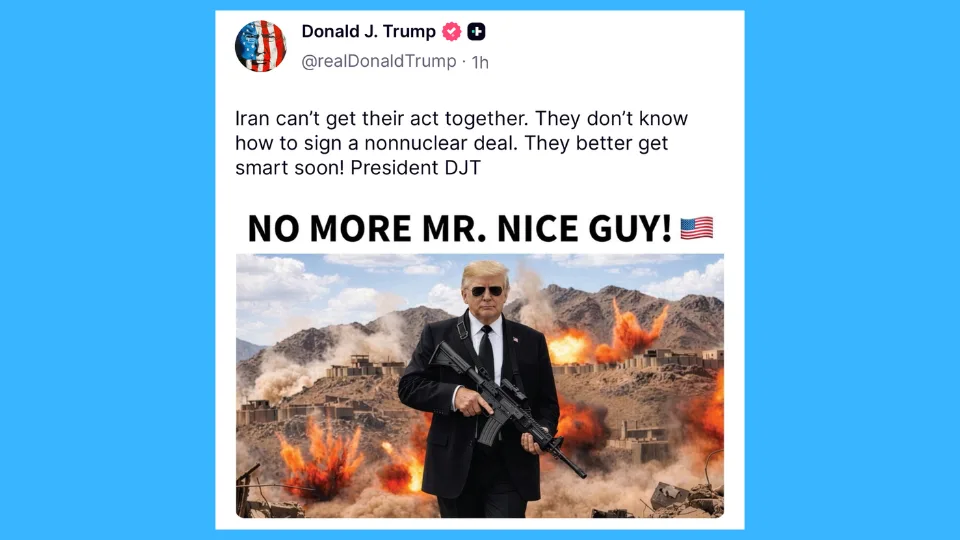
Early Wednesday morning, Trump posted an AI-generated image of himself holding a gun with explosions in the background alongside the phrase “NO MORE MR. NICE GUY!” and warned that Iran “better get smart soon!” The message landed as the Strait of Hormuz remains blocked, U.S.-Iran negotiations appear stalled, and global oil markets are already under pressure following the OPEC disruption caused by the United Arab Emirates announcing its departure from the cartel.
This is no longer just a geopolitical story. It is rapidly becoming an inflation story, a consumer story, and potentially a Federal Reserve story.
What Just Happened
Trump’s latest post came after a chaotic week of failed diplomacy.
U.S. negotiators were reportedly expected to head to Islamabad for talks over the weekend, but Trump canceled the trip. He later told Fox News: “We have all the cards.” He added that if Iran wants talks, “they can come to us, or they can call us.”
That appears to have shut down what little diplomatic momentum remained.
Iran had floated a proposal to reopen the Strait of Hormuz if the U.S. lifted its blockade of Iranian ports and agreed to pause broader tensions. That proposal reportedly delayed deeper discussions over Iran’s nuclear program.
Trump reportedly rejected the framework.
Markets responded immediately.
West Texas Intermediate surged above $102 per barrel. Brent Crude climbed above $114.
That move matters because roughly 20% of global oil supply moves through the Strait of Hormuz. When that chokepoint is disrupted, traders begin pricing in worst-case scenarios fast.
Why This Matters for Investors
The biggest risk here is inflation getting reaccelerated just as investors were hoping the Federal Reserve would eventually cut interest rates.
If oil remains above $100 for a prolonged period:
Airline stocks could face major pressure, including carriers like Delta Air Lines, American Airlines, and United Airlines.
Retailers could face margin compression as transportation costs rise.
Consumers may get hit with higher gasoline prices right as household budgets remain stretched.
The Fed could be forced to stay hawkish longer if energy inflation spills into broader inflation data.
That becomes particularly dangerous because investors were already digesting elevated borrowing costs and slowing economic momentum.
Meanwhile, defense stocks may continue seeing momentum. Companies like Lockheed Martin, Northrop Grumman, and RTX Corporation could remain beneficiaries if tensions continue escalating.
Energy producers may also benefit if oil remains structurally elevated, including Exxon Mobil, Chevron Corporation, and major shale producers.
About Author