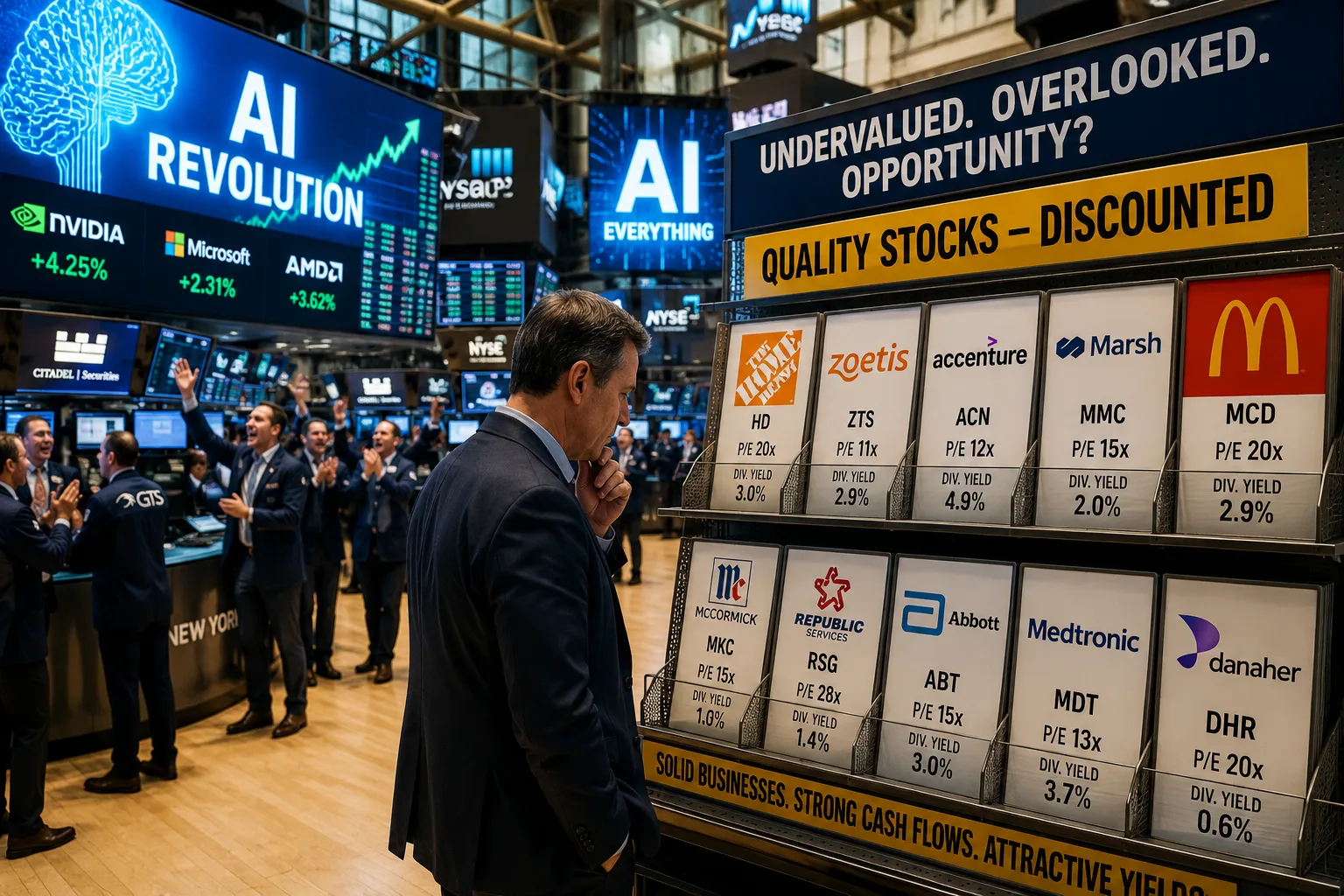
The market keeps making new highs, but underneath the surface, a completely different story is unfolding. A growing list of blue-chip stocks across healthcare, consumer staples, industrials, consulting, and retail are getting crushed while AI-linked tech names absorb nearly all investor attention.
That divergence matters.
When markets become this narrow, capital starts behaving irrationally. Investors chase momentum at any price while abandoning companies that still generate billions in cash flow, raise dividends, buy back stock, and dominate their industries. Some of the most beaten-down names in the market now trade at valuations usually reserved for companies in structural decline.
Many are nowhere near decline.
The Market Has Quietly Become a One-Sector Trade
The S&P 500 may be up roughly 10% this year, but the gains have become heavily concentrated inside a handful of mega-cap technology and AI-linked stocks. Healthcare, financials, consumer staples, and several defensive sectors have badly lagged.
That concentration risk is becoming harder to ignore.
“If you’re not a chip company or building data centers, you’re out of luck,” said Michael Jamison, managing partner at Griffin Asset Management.
That line captures the current market psychology perfectly.
The issue is not simply that AI stocks are rising. The issue is that investors have started pricing many non-AI businesses as if their future no longer matters. That creates opportunity.
Historically, periods of extreme market concentration eventually reverse. The “Nifty Fifty” era in the 1970s, the dot-com boom in 1999, and the post-pandemic growth frenzy all ended with investors rediscovering quality companies that had been left behind.
The current setup has echoes of those periods.
Why These Stocks Are Breaking Down
Many of the companies hitting 52-week lows are not collapsing because of balance-sheet disasters or existential threats. They are falling because Wall Street fears AI disruption, slowing consumer spending, higher rates, or temporary sector weakness.
That distinction matters.
Home Depot has struggled because elevated mortgage rates continue freezing housing turnover and remodeling activity. Yet the company still controls one of the most dominant retail ecosystems in America. Shares are down sharply over the past year and now trade near 20 times forward earnings with a roughly 3% dividend yield.
Housing activity eventually recovers. When it does, Home Depot likely rebounds long before the headlines turn positive.
Zoetis has become another casualty of changing sentiment. Investors suddenly fear slowing pet-care spending after years of explosive growth. The stock has been devastated, falling roughly 70% from its peak.
Yet the underlying business still owns a massive portfolio in animal health, generates strong margins, and continues producing earnings growth. Morgan Stanley analyst Erin Wright recently highlighted the “unmatched breadth” of the company’s portfolio.
The market currently values Zoetis like a permanently impaired business.
That may prove excessive.
AI Fear Is Starting to Distort Valuations
One of the biggest themes driving this selloff is growing fear that AI will destroy consulting, insurance brokerage, healthcare administration, and white-collar service firms.
Investors may be moving too fast.
Accenture has become a prime example. Shares have plunged nearly 40% this year as Wall Street worries AI tools could reduce demand for consulting work. OpenAI’s expanding enterprise initiatives intensified those concerns.
But there is another side to the story.
Large corporations still need implementation, cybersecurity integration, workflow redesign, compliance infrastructure, and enterprise-scale deployment. AI adoption may ultimately increase demand for companies capable of integrating these systems globally.
UBS analyst Kevin McVeigh argued Accenture still has the scale, “deployment capability,” and technical expertise that smaller AI challengers lack.
At under 12 times projected earnings with a 4% dividend yield, the stock now trades more like a melting business than a global consulting giant.
The same pattern is appearing inside insurance brokerage firms like Marsh. Investors suddenly fear AI could automate portions of the brokerage and consulting business.
That sounds logical in theory.
In reality, large corporate insurance programs remain extraordinarily complex. Fortune 500 companies are not handing billion-dollar liability decisions entirely to algorithms anytime soon. Marsh continues generating strong cash flow and now trades at a far lower multiple than investors were willing to pay just a year ago.
Consumer Weakness Is Separating Winners From Survivors
Several consumer-facing names on the list reveal something deeper happening inside the U.S. economy.
McDonald’s has faced pressure because lower-income consumers are increasingly strained by inflation, gasoline prices, and elevated borrowing costs. Wall Street fears spending fatigue is spreading.
That concern is legitimate.
But investors also understand something else about McDonald’s: during difficult economic periods, consumers often trade down toward value-oriented food options. That defensive positioning matters if economic growth weakens further.
UBS analyst Dennis Geiger recently said, “We believe risk/reward for MCD shares is attractive despite near-term pressures, given catalysts with potential to drive market share gains & strengthen U.S. sales growth, and defensive characteristics.”
McCormick tells a different story. Investors hated the company’s acquisition of Unilever’s food business, fearing excessive debt and dilution.
The market reaction has been brutal.
Still, McCormick now trades at roughly half the valuation investors awarded it just a few years ago. If management successfully integrates the acquisition and expands internationally, sentiment could reverse quickly.
This is how major bottoms often form. Good companies become temporarily untouchable.
Quiet Compounders Are Starting to Look Interesting Again
Some of the names hitting new lows are not broken businesses at all. They are simply no longer receiving the premium multiples investors once handed out freely.
Republic Services remains one of the strongest waste-management operators in the country, benefiting from scarce landfill assets, recurring revenue, and extremely high customer retention. The stock still trades at a premium valuation because garbage collection remains one of the steadiest businesses in the economy.
Even after weakness this year, investors continue paying up for predictability.
Healthcare names tell an even more interesting story.
Abbott Laboratories, Medtronic, and Danaher have all sold off aggressively despite remaining leaders in diagnostics, medical devices, and biotech infrastructure. Investors worry about slowing growth, reimbursement pressure, GLP-1 drug disruption, tariffs, and weak biotech spending.
Some fears are real.
Others may be overextended.
Medtronic, for example, has seen concerns emerge that GLP-1 drugs could reduce future knee and hip replacement demand by lowering obesity rates. Yet large portions of the company’s business focus on cardiology, neurology, and other areas relatively insulated from that dynamic.
Danaher’s weakness reflects another market frustration: investors no longer tolerate even temporary slowdowns in growth. First-quarter core sales growth of 1% triggered a major selloff despite management still targeting stronger long-term expansion.
That impatience creates openings.
When investors crowd into momentum trades, companies delivering merely “good” performance suddenly get punished as if they are failing.
The Bigger Market Message Investors Should Watch
The real story here is not just about 10 stocks hitting new lows.
It is about how distorted this market has become.
Right now, investors are paying enormous premiums for a small cluster of AI winners while simultaneously discounting large portions of the broader economy. That creates a dangerous imbalance if AI spending cools, earnings expectations reset, or interest rates remain elevated longer than expected.
Meanwhile, many traditional companies are quietly becoming cheaper, higher yielding, and increasingly attractive for long-term capital.
That does not mean these stocks bottom tomorrow.
Some could fall further if economic growth weakens or rates rise again.
But history shows that periods of extreme concentration eventually create fertile ground for value investors willing to move before sentiment changes.
Catalysts Investors Should Watch Next
- AI spending trends and whether enterprise budgets begin broadening beyond semiconductors and infrastructure
- Federal Reserve rate policy and its impact on housing-sensitive names like Home Depot
- Consumer spending data, especially among lower-income households
- Healthcare earnings revisions tied to GLP-1 adoption trends
- Buyback acceleration among depressed blue-chip companies
- Insider buying activity in beaten-down sectors
- Whether institutional investors begin rotating toward defensive dividend-paying stocks
What Wall Street May Be Missing
The market currently behaves as though only AI matters.
That mindset rarely lasts forever.
Many of the companies hitting new lows still generate enormous free cash flow, maintain dominant competitive positions, and return capital to shareholders through dividends and buybacks. Several now trade at valuations that already assume years of disappointment ahead.
If the AI trade keeps roaring, these stocks may continue lagging.
But if market leadership broadens even modestly, some of today’s most ignored blue chips could become tomorrow’s strongest rebound stories.
About Author