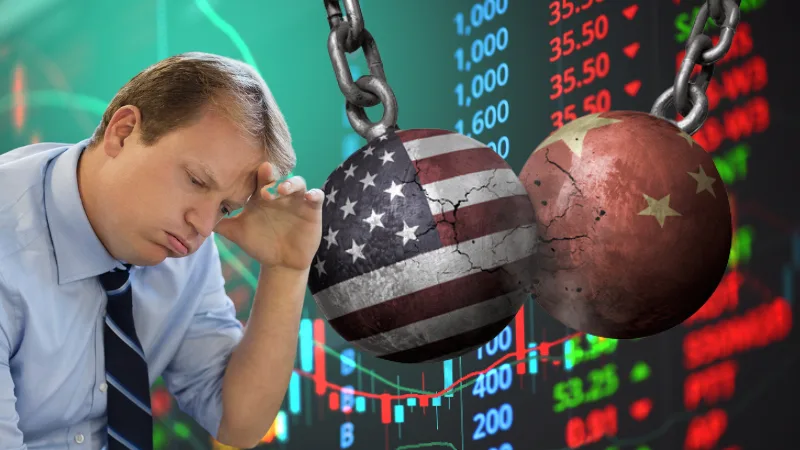
The first trading day of June opened with a sharp pullback in U.S. equities, signaling growing investor anxiety as tensions between the United States and China flared up once again. The selloff came in response to renewed trade hostilities between the world’s two largest economies, stoking fears of prolonged volatility in global markets.
China Counters Trump’s Accusations of Geneva Trade Deal Violations
China pushed back hard against U.S. allegations that it had breached a temporary trade agreement brokered earlier this year. In a firm statement, Beijing not only denied violating the pact but instead accused Washington of failing to uphold its own commitments.
The trade deal in question was forged as a temporary ceasefire in an escalating tariff war, following a high-level meeting between U.S. Treasury Secretary Scott Bessent and Chinese Vice Premier He Lifeng in Geneva. The agreement included a 90-day suspension of most new tariffs to allow both sides room for further negotiation. However, the fragile peace now appears to be unraveling.
China’s Ministry of Commerce issued a pointed response to the recent U.S. accusations, stating, “It is the United States that has failed to meet its obligations under the agreement, including reducing certain tariffs and removing regulatory barriers.” The ministry further claimed that China had fulfilled its commitment to increasing purchases of U.S. goods, a central pillar of the temporary deal.
Trade analysts believe that the breakdown in communication stems from unresolved structural issues, including intellectual property protections, forced technology transfers, and data localization policies — all of which remain sticking points for U.S. negotiators.
A Crucial Week for Diplomacy
The renewed tension comes at a particularly delicate moment. National Economic Council Director Kevin Hassett suggested over the weekend that President Donald Trump and Chinese President Xi Jinping could speak as early as this week in a bid to de-escalate the growing conflict.
“Conversations between Trump and Xi could prove critical to much needed clarity for the largest economies in the world,” said Jay Woods, Chief Global Strategist at Freedom Capital Markets. “If they get clarity, look for another leg higher in this market and talk of new all-time highs. If this back-and-forth goes on, then expect volatile markets to continue.”
The call, if it happens, would follow months of intermittent negotiations marked by optimism followed by deadlock. Investors are watching closely for signs that both sides are willing to compromise.
Markets React as Uncertainty Returns
All three major U.S. stock indices dropped on Monday as a wave of uncertainty rolled back into the markets:
- The S&P 500 fell more than 0.8%, snapping a four-day winning streak.
- The Nasdaq Composite, which had seen a robust May rally, declined 1.2%.
- The Dow Jones Industrial Average dropped about 250 points.
This retreat came despite a stellar performance in May. The S&P 500 notched a more than 6% monthly gain — its best since November 2023. The Nasdaq surged over 9%, driven by strong performance in AI and chip stocks, while the Dow climbed around 4%.
But not all market voices are convinced this momentum will continue. Chris Toomey, Managing Director at Morgan Stanley, warned that the market might already be pricing in overly optimistic outcomes.
“We’re probably still range-bound,” Toomey told CNBC’s Closing Bell. “The concern we’ve got is that while I think we’ve taken out the worst-case scenario with regards to the ‘liberation day’ [tariffs], we’re in a situation where the market’s right now probably pricing in the best-case scenario.”
Europe Also Caught in Crossfire
Simultaneously, U.S.-EU trade tensions are intensifying. President Trump announced plans to double tariffs on imported steel to 50%, citing national security and economic fairness. The European Union swiftly responded, calling the move an “unfriendly escalation.”
“This decision adds further uncertainty to the global economy and increases costs for consumers and businesses on both sides of the Atlantic,” an EU spokesperson said. The European Commission warned it may consider countermeasures if the tariffs take effect without further negotiation.
Broader Economic Implications
These multi-front trade tensions come as global economic growth remains fragile. In the U.S., inflation remains elevated, and interest rate uncertainty lingers. A prolonged trade war could add further pressure on supply chains, input costs, and consumer prices.
Meanwhile, China is facing its own economic hurdles. While Beijing’s economy has shown resilience, it is grappling with a struggling real estate sector, demographic headwinds, and weak consumer sentiment. Escalating trade disputes with the U.S. — its largest trading partner — only heighten the risks.
Investors are also bracing for potential disruptions to tech and semiconductor supply chains, many of which rely on cross-border cooperation. Any additional tariffs on electronic components or rare earth metals could send ripples across industries from smartphones to electric vehicles.
Investor Outlook: What to Watch
- Trump-Xi Phone Call: Markets will likely rally if this conversation results in a clear timeline for renewed negotiations or the restoration of the 90-day tariff suspension.
- Tariff Announcements: Any new tariffs from either side, particularly on high-tech goods, could trigger sell-offs in related sectors.
- China’s Countermoves: Investors will monitor whether Beijing responds with tariffs, currency adjustments, or export restrictions.
- EU Response: With U.S.-EU tensions rising, investors will also watch for retaliatory trade measures from Brussels.
- Corporate Earnings: Companies with large exposure to China — like Apple, Tesla, and major chipmakers — may revise forward guidance in response to trade volatility.
Conclusion: Entering a Period of Uncertainty
The breakdown in U.S.-China trade relations has added another layer of complexity to an already fragile global economy. While the market had been pricing in optimism, reality may now be forcing a reassessment. President Trump’s increasingly aggressive trade stance — whether toward Beijing or Brussels — is reshaping the calculus for multinational firms and investors alike.
If diplomatic efforts fail, expect this summer to bring heightened volatility, with significant downside risk in sectors sensitive to tariffs and global supply chain disruptions. On the other hand, a surprise breakthrough between Trump and Xi could reignite investor confidence and drive another leg up in equity markets.
For now, caution is warranted — and close attention to diplomatic developments is essential.
About Author