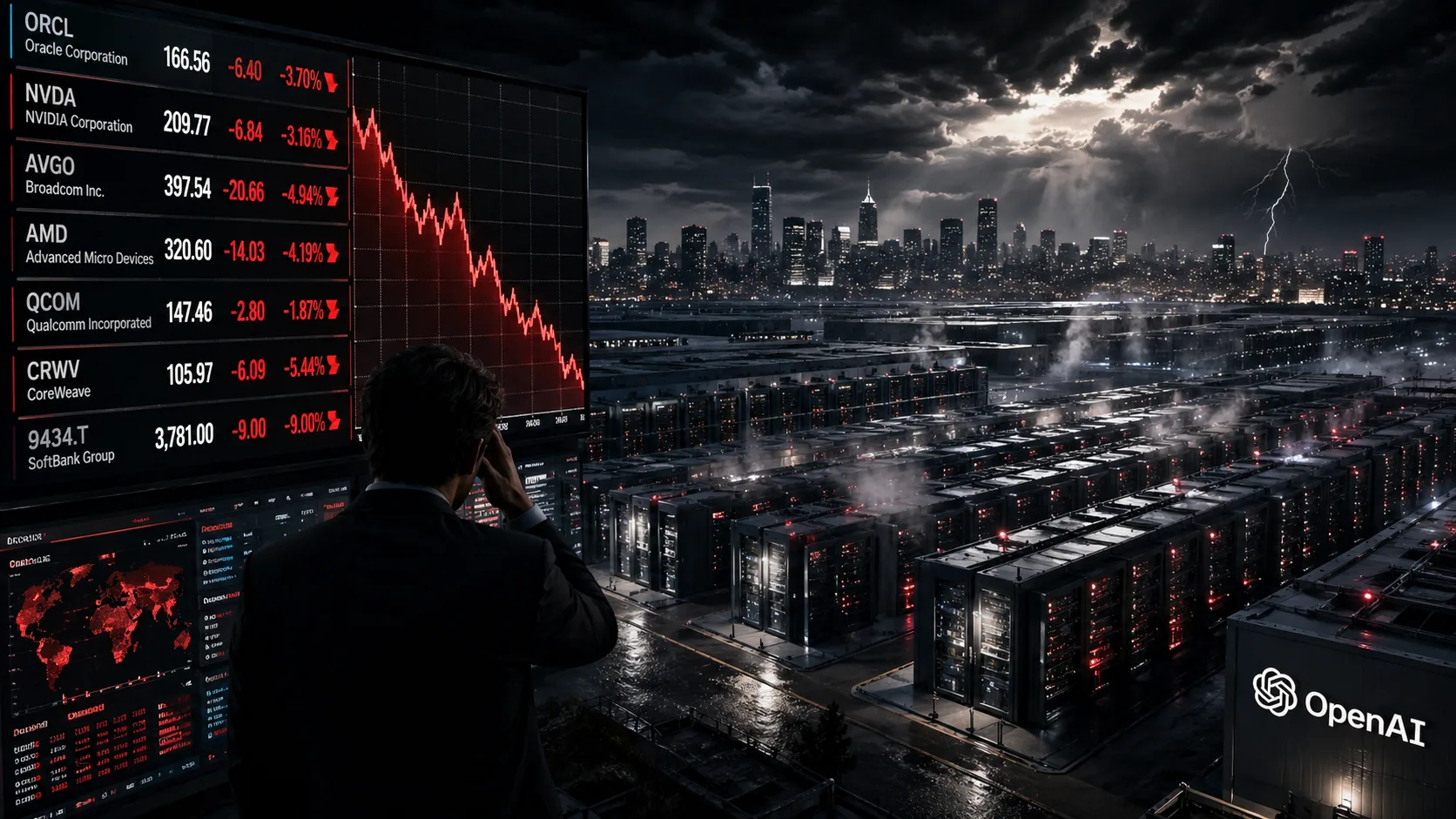
Wall Street spent the past two years pricing artificial intelligence infrastructure stocks like demand would rise in a straight line forever. Tuesday was a reminder that even the hottest trade on Earth can hit turbulence fast.
Shares tied to the AI buildout sold off after a report from The Wall Street Journal revealed OpenAI has reportedly fallen short of its own internal revenue and user growth expectations. That immediately triggered a selloff across the companies most exposed to OpenAI’s spending machine.
- Oracle dropped more than 6%.
- Nvidia, Broadcom, and Advanced Micro Devices fell between roughly 3% and 5%.
- Qualcomm slid after recently getting a boost from reports tied to OpenAI smartphone ambitions.
- CoreWeave dropped roughly 7%.
- And in Japan, SoftBank Group sank nearly 10%.
That’s a massive reaction to what is ultimately one report. But the market’s response tells you something deeper: investors are beginning to question whether AI infrastructure spending has gotten ahead of actual monetization.
What Just Happened
According to The Wall Street Journal, OpenAI internally missed projections tied to user growth and revenue generation.
That matters because OpenAI has signed enormous infrastructure commitments.
The biggest example is its reported $300 billion, five-year partnership with Oracle to secure computing power for future AI expansion.
The Journal also reported that OpenAI CFO Sarah Friar warned internally that if revenue growth fails to accelerate, future compute obligations could become harder to finance.
OpenAI publicly pushed back hard.
“This is ridiculous. We are totally aligned on buying as much compute as we can and working hard on it together every day.”
That response may calm some nerves temporarily, but investors are now forced to ask whether AI demand growth is matching Wall Street’s most aggressive expectations.
This comes just weeks after OpenAI closed a staggering $122 billion funding round at an $852 billion valuation.
That valuation assumed enormous future growth.
Now investors are questioning whether that growth timeline may be longer than expected.
Why This Matters for Investors
This story goes far beyond OpenAI.
It directly impacts the companies that became the picks-and-shovels trade of the AI boom.
Data center winners face scrutiny
Oracle has become one of Wall Street’s biggest AI infrastructure bets because of its OpenAI partnership.
If OpenAI slows spending or renegotiates future compute agreements, Oracle could face renewed skepticism after its massive run.
Semiconductor stocks may see volatility
Nvidia remains dominant in AI chips, but today’s decline shows investors are hypersensitive to any sign hyperscaler spending could cool.
Advanced Micro Devices and Broadcom are also heavily tied to AI infrastructure growth assumptions.
Leveraged AI plays are vulnerable
CoreWeave has become a favorite high-beta AI infrastructure trade.
That also makes it one of the first names investors dump when sentiment turns.
Big Tech competition is intensifying
Anthropic continues gaining enterprise traction.
Google is pushing harder with Gemini.
Many corporate buyers are increasingly choosing multi-model strategies instead of betting everything on OpenAI.
That could pressure OpenAI’s pricing power over time.
The Real Story Wall Street Is Starting to Price In
The AI boom is entering a new phase.
Phase one was simple:
Build as much infrastructure as possible.
Buy every chip.
Build every data center.
Spend whatever it takes.
Phase two is much harder:
Prove customers will pay enough to justify trillion-dollar infrastructure spending.
That’s where cracks can begin to form.
The market is realizing AI demand may still grow rapidly while falling short of the extreme assumptions embedded in some stock prices.
That distinction matters.
A company doesn’t need collapsing demand to trigger a selloff.
It simply needs growth that is slower than perfection.
That’s what investors are reacting to today.
What Happens Next
Watch these catalysts closely:
- Microsoft commentary around OpenAI demand
- Upcoming earnings from Nvidia
- Enterprise adoption data from Alphabet and Amazon
- Whether OpenAI announces new monetization initiatives
- Future updates on data center spending commitments
If hyperscaler capex remains strong, today could become a buying opportunity.
If spending starts slowing broadly, this pullback could get much uglier.
Bottom Line
This is the first major narrative crack in the AI infrastructure trade in months.
That doesn’t mean the AI boom is over.
It means investors can no longer blindly assume every company tied to AI compute will rise forever.
The winners from here may be companies with actual pricing power, recurring enterprise customers, and realistic valuations.
The era of “AI at any price” may be starting to fade.
About Author