Wall Street is witnessing a market anomaly that doesn’t happen often — and when it does, it rarely lasts. According to Deutsche Bank strategist Parag Thatte, AI-driven (computer-guided) traders are at their most bullish in years, while human discretionary traders remain firmly bearish .
The last time this gap was this wide was in early 2020 — just before the COVID-19 crash shook global markets.
Today, that same dynamic is playing out again:
- AI quants are piling into stocks, driven by momentum and volatility models.
- Human portfolio managers are holding back, pointing to stretched valuations, geopolitical risks, and macro uncertainty.
For investors, this “man vs. machine” standoff could be the prelude to a major market move.
What the Data Shows
The divergence isn’t just about opinion — it’s quantifiable:
- Computer-driven funds have sharply increased net equity exposure, tracking trend signals in technology, consumer discretionary, and materials sectors.
- Human-run funds are running light on equity risk, overweighting defensive plays and holding more cash.
This split reflects a fundamental difference in strategy. AI models react quickly to price action and volatility patterns, while humans weigh fundamentals, macroeconomic conditions, and long-term risks.
“This level of disagreement between machine and human sentiment is rare — and historically doesn’t last long,” Thatte noted in a recent client report .
Why AI Is Bullish
AI-driven trading systems don’t “think” in narratives. Instead, they process massive amounts of historical and real-time market data to identify patterns that have preceded rallies in the past.
Key drivers behind the current bullishness include:
- Momentum strength — Mega-cap tech names and growth stocks have maintained upward price trends, triggering buy signals.
- Volatility compression — Lower implied volatility in recent weeks suggests less near-term downside risk in models.
- Sector rotation signals — Quant strategies have picked up on cyclical rebounds in industrials and materials.
The blind spot? These systems don’t always account for macro shifts until the price action reflects them. That means geopolitical shocks, policy changes, or abrupt earnings misses can catch them flat-footed.
Why Humans Are Bearish
Human discretionary managers are looking at the same market — but reading it through a different lens.
Their caution stems from:
- Valuation concerns — Many high-flying AI-linked stocks are trading at price-to-earnings multiples well above historical norms.
- Economic headwinds — Slowing growth in China, sticky inflation, and tariff-related trade risks under the Trump administration.
- Earnings uncertainty — Analysts have warned that margins could be under pressure from wage growth and rising input costs.
In short, humans are focusing on fundamentals that could crack the rally — even if prices keep grinding higher for now.
Sector Positioning: AI vs. Humans
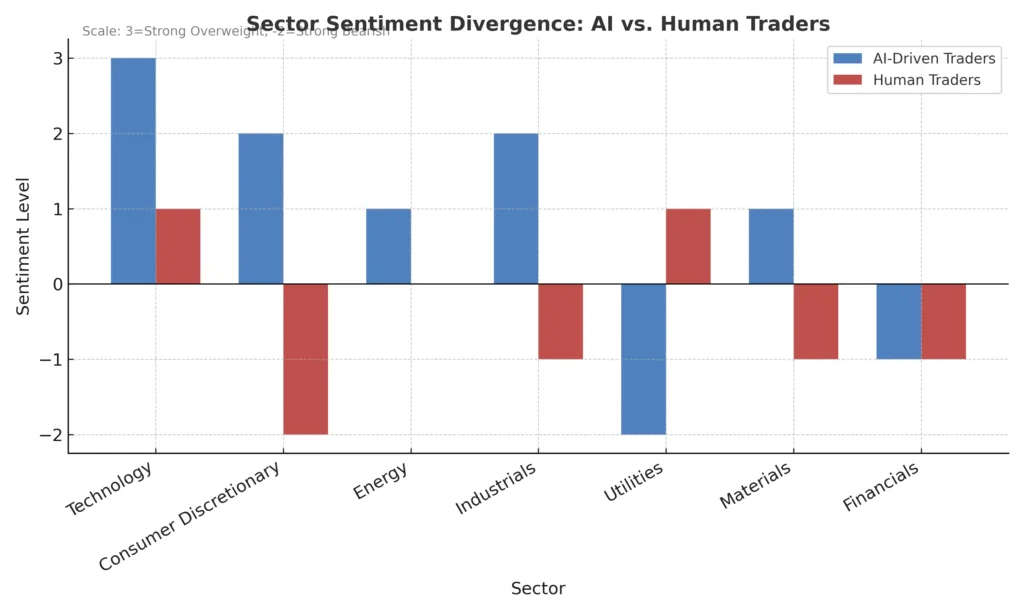
Below is a simplified look at where AI quants and human managers are placing their bets — and where they’re holding back.
| Sector | AI-Driven Traders | Human Traders | Why It Matters |
|---|---|---|---|
| Technology | Strong Overweight | Cautious | Quants see unstoppable momentum; humans see valuation risk. |
| Consumer Discretionary | Overweight | Bearish | Retail data looks strong to models; humans worry about debt and delinquencies. |
| Energy | Mildly Bullish | Split | Rising oil prices trend well; humans fear demand pullback. |
| Industrials | Bullish | Bearish | Manufacturing revival vs. inflation and cost risks. |
| Utilities | Bearish | Neutral/Bullish | AI ignores low-vol sectors; humans hold defensives for downturns. |
| Materials | Bullish | Bearish | Commodity rally supports models; humans fear China slowdown. |
| Financials | Underweight | Bearish | Weak loan growth and regulatory headwinds hurt sentiment. |
Historical Lessons from Past Divergences
History suggests such wide gaps in positioning tend to resolve quickly — and not always gently.
- Early 2020: Quants stayed long into February as markets hit new highs, while many human managers were cautious. The COVID shock triggered a rapid sell-off that algorithmic strategies were slow to adjust to.
- April 2025 Tariff Shock: Human-run hedge funds outperformed after President Trump’s surprise tariff announcement whipsawed markets. Many quants were positioned long in sectors most affected, leading to sharp drawdowns .
The lesson: when market momentum is driven heavily by algos, turning points can be fast and violent.
What This Means for Investors Now
This split presents a strategic crossroads. Investors need to decide whether to lean into the AI momentum, stick with the human caution, or hedge across both.
Option 1: Side with AI (Short-Term Momentum)
- Focus on technology, consumer discretionary, and materials.
- Use tight stop-loss orders to guard against sudden reversals.
- Example ETFs: Invesco QQQ Trust (QQQ), Consumer Discretionary Select Sector SPDR Fund (XLY), Materials Select Sector SPDR Fund (XLB).
Option 2: Side with Humans (Defensive Positioning)
- Overweight utilities, defensive dividend stocks, and high-quality bonds.
- Example ETFs: Utilities Select Sector SPDR Fund (XLU), Vanguard Dividend Appreciation ETF (VIG).
Option 3: Hedge with a Barbell Strategy
- Hold momentum sectors on one side, defensives on the other.
- Allows participation in further upside without full exposure to downside risk.
Trigger Points to Watch
The balance could shift quickly. Key catalysts that could end the divergence include:
- Major earnings misses from tech giants.
- Inflation surprises that force the Federal Reserve to adjust policy.
- Geopolitical shocks, especially trade disputes or conflict escalation.
- Macro data showing sharp deterioration in growth or employment.
They Can’t Both Be Right
Right now, machines are bullish, humans are bearish, and history tells us they can’t both be right for long.
If you chase the AI-driven rally, you’re betting that momentum will keep carrying markets higher despite macro risks. If you side with human caution, you’re betting that fundamentals will reassert themselves sooner rather than later.
Either way, investors should stay nimble — because when this gap closes, it’s likely to happen fast.
Sources:
- Business Standard — Computer-driven traders bullish on stocks while humans remain bearish
- AInvest — Man-Machine Divide in Market Sentiment
About Author