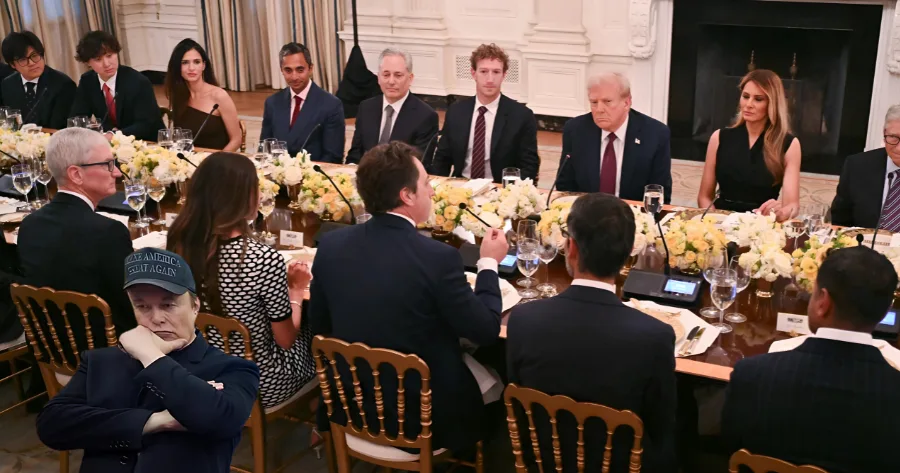
The White House became the stage for a remarkable gathering this week as President Donald Trump hosted some of the world’s most powerful tech leaders for a private dinner. Around the table were Mark Zuckerberg (Meta), Tim Cook (Apple), Bill Gates (Microsoft), Sundar Pichai (Google), Satya Nadella (Microsoft), Sam Altman (OpenAI), Sergey Brin (Google), Sanjay Mehrotra (Micron), Vivek Ranadive (TIBCO), and Shyam Sankar (Palantir), among others.
Conspicuously absent was Elon Musk, despite being invited. Instead, Musk sent a representative, citing scheduling conflicts. Trump, never one to mince words, commented that Musk was “80 percent super-genius” but “has some problems,” underscoring the strained relationship between the two. Musk’s absence was as much a headline as the pledges made inside the room.
Inside, the tone was striking. Sam Altman of OpenAI thanked Trump for being “such a pro-business, pro-innovation president,” calling it “a refreshing change.” Mark Zuckerberg highlighted that Meta and its peers were “making huge investments in U.S. infrastructure and data centers.” And Tim Cook tied Apple’s $600 billion domestic expansion plan directly to the administration’s agenda, saying the policy climate was enabling Apple to move faster on U.S. manufacturing.
The praise was unusually unified, especially given Silicon Valley’s historically strained relationship with Trump. But the real story wasn’t just the compliments , it was the policy shifts being signaled and the trillions in domestic investment commitments that could reshape markets for years to come.
Policy Shifts Driving Market Impact
1. Light-Touch Regulation for AI
Trump is drawing a sharp contrast with the previous administration’s approach to artificial intelligence. Instead of a heavy regulatory hand, his team is positioning the U.S. as the global hub for fast-moving AI innovation. The Federal Trade Commission and Department of Justice are expected to scale back their more aggressive oversight, focusing instead on competition with China rather than breaking up domestic firms.
For investors, that spells potential relief rallies across Big Tech. Microsoft, Meta, Alphabet, and Apple have each pledged hundreds of billions toward U.S.-based infrastructure. With fewer legal clouds hanging over them, these firms could see their valuations expand further, supported by AI-fueled earnings growth.
2. Tax Incentives and Manufacturing Expansion
The dinner spotlighted massive domestic investment commitments. Tim Cook of Apple spoke about a $600 billion expansion in U.S. manufacturing, while Google and Meta pledged $250 billion and $600 billion, respectively, toward data centers and related infrastructure.
These moves are tethered directly to Trump’s renewed “Made in America” tax package, which includes accelerated depreciation, corporate tax incentives, and credits for domestic semiconductor production.
The winners here aren’t just the mega-cap tech names. Contract manufacturers, semiconductor equipment providers, and chip fabricators like Intel, Micron, and U.S.-based TSMC facilities are poised to benefit. The ripple effect could extend to regional construction companies, industrial REITs specializing in data centers, and advanced materials firms.
3. Energy Alignment: Natural Gas and Nuclear
One of the most overlooked aspects of AI growth is energy. Data centers consume staggering amounts of electricity, and the White House is aligning policy to ensure supply keeps up. Trump reiterated his commitment to fossil fuel dominance, while also backing small modular nuclear reactors (SMRs) to power AI computing hubs.
Utilities with exposure to natural gas pipelines and nuclear development could see significant upside. Names like NextEra Energy, Constellation Energy, and regional gas suppliers stand to capture long-term growth as tech scales its energy needs.
For investors, this intersection of AI and energy is a frontier play: the companies that can reliably supply cheap, scalable power will be critical to sustaining the digital economy.
4. Immigration Shift: STEM-First Visas
Trump’s relationship with immigration has always been politically charged, but at this dinner, the tone shifted. Surrounded by leaders like Sundar Pichai (Google) and Satya Nadella (Microsoft), the administration previewed a revamped high-skill immigration system. The new framework emphasizes speed and access for science, technology, engineering, and math (STEM) talent.
That means smoother scaling for AI labs, biotech firms, and advanced R&D companies that rely on top-tier global talent. For investors, this could accelerate innovation pipelines at U.S.-based firms, particularly in software, biotech, and robotics.
5. Infrastructure Streamlining
Building data centers is no small task. Local zoning, environmental reviews, and land-use restrictions can stall billion-dollar projects for years. Trump’s message was clear: those roadblocks are coming down.
This regulatory streamlining will benefit not just tech firms but also infrastructure contractors and real estate players. Data center REITs like Equinix and Digital Realty, construction firms such as Jacobs Engineering, and utility grid expansion companies all stand to gain.
Investors should note: this sector is likely to see a wave of capital inflows as projects break ground faster and at larger scale.
6. Tariffs and Global Trade Realignment
While the dinner focused heavily on domestic commitments, Trump’s looming 100%+ tariffs on foreign tech hardware and semiconductors hung over the conversation. By threatening to hike costs on imported chips and hardware, the administration is creating a strong incentive for companies to localize production.
For Asian exporters like Samsung and Taiwan-based TSMC (outside U.S. operations), this presents headwinds. For U.S. infrastructure and domestic supply chain players, it’s a tailwind. Investors with exposure to reshoring trends should watch companies that stand to gain from supply chain localization.
The Scale of Investment Is Staggering
What stood out most from the dinner wasn’t the rhetoric — it was the raw numbers. Meta’s $600 billion commitment. Google’s $250 billion pledge. Apple’s $600 billion in U.S. manufacturing expansion. Microsoft’s promise of up to $80 billion in new investment.
This isn’t corporate charity. It’s calculated strategy. These companies are positioning themselves for decades of dominance under a friendlier policy environment. And they’re betting that Trump’s administration will deliver the regulatory and fiscal backdrop to make these investments profitable.
For investors, the sheer magnitude of capital deployment should spark interest. Entire sectors from semiconductors to utilities are poised for multi-year growth cycles fueled by this tech-driven industrial buildout.
What Investors Should Do Now
If you’re an investor, the noise of politics can be overwhelming. But the lesson from this dinner is simple: follow the money.
- Tech Megacaps – Expect continued strength in AI leaders. Light-touch regulation and capital commitments provide a supportive backdrop for Microsoft, Google, and Meta.
- Semiconductors – U.S. fabs and equipment makers stand to benefit from domestic tax incentives. Watch Micron, Intel, and Applied Materials.
- Energy & Utilities – AI’s hunger for power means energy suppliers and nuclear developers will see steady demand. Look at Constellation Energy, NextEra, and pipeline operators.
- Infrastructure & REITs – Data center growth supports construction contractors and REITs like Equinix and Digital Realty.
- Immigration-Friendly Growth – Companies that rely on STEM talent, particularly AI labs and biotech, should gain from policy shifts.
The risk? Tariff escalation could trigger retaliation abroad, and Musk’s notable absence from the dinner is a reminder that not all tech leaders are aligned with Trump’s agenda. Disruption and volatility remain part of the landscape.
Policy Shifts and Investor Impacts by Sector
| Sector | Policy Shift | Investor Impact |
|---|---|---|
| Big Tech (Meta, Apple, Google, Microsoft) | Light-touch AI regulation, Antitrust relief | Relief rally potential, multi-trillion capex commitments in U.S. |
| Semiconductors (Intel, Micron, TSMC US Fabs) | Tax incentives for U.S. manufacturing, Tariff threats on imports | Bullish domestic chip manufacturing, neutral-to-bearish for Asian fabs |
| Energy (Natural Gas, Nuclear, Utilities) | Energy dominance push + nuclear support for AI compute | Utility and nuclear plays gain, natural gas demand rises |
| Infrastructure & Construction | Massive data center buildouts, regulatory streamlining | Strong outlook for contractors, REITs tied to data centers |
| Immigration & Talent | Revised H-1B, pro-STEM immigration stance | Talent pipeline expansion boosts productivity & innovation capacity |
| Global Trade | High tariffs on foreign tech hardware & semiconductors | Asian exporters at risk, U.S. supply chain players benefit |
Final Take
The White House dinner wasn’t just a social event. It was a power realignment between Washington and Silicon Valley. Big Tech is betting that Trump’s deregulation, tax incentives, and energy policies will clear the way for historic investment.
And Musk’s absence? A reminder that even in a moment of apparent unity, alliances can shift fast in both politics and business. For investors, the bottom line is simple: follow the money — and it’s flowing into U.S. tech infrastructure, energy buildouts, and supply chain reshoring at a scale the market hasn’t seen in decades.
About Author