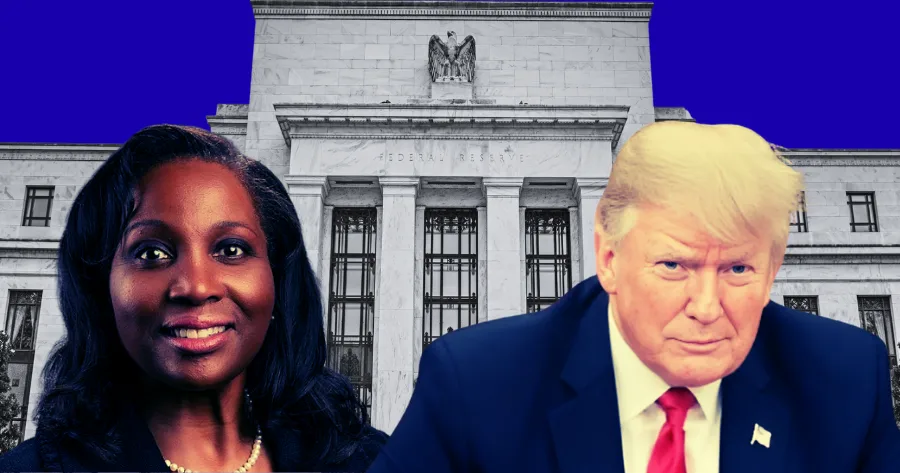
The U.S. Justice Department has opened a criminal investigation into Federal Reserve Governor Lisa Cook, probing allegations of mortgage fraud tied to properties she owned in Michigan, Georgia, and Massachusetts. The news comes just days after Cook filed a lawsuit against President Donald Trump, challenging his attempt to fire her from the Fed.
The clash has now escalated into a legal and political showdown that threatens to reshape not only the leadership of the U.S. central bank but also how markets interpret the independence of the Federal Reserve. For investors, the implications are immediate: shifts in board composition could alter the Fed’s policy path, while political interference risks stoking volatility across equities, bonds, and currencies.
Why Lisa Cook Matters
Cook joined the Fed’s Board of Governors in 2022 after a contentious confirmation fight. Seen by many as an advocate for progressive economic policy, she has often aligned with the Fed’s cautious approach to interest rates during the inflationary surge of the early 2020s.
If Cook is removed and replaced by a Trump-aligned appointee, the balance of power at the Fed could swing in favor of faster interest rate cuts—a development with wide-ranging market consequences.
- Equities: A dovish shift could lift cyclicals, tech, and consumer discretionary stocks.
- Bonds: Yields may come under pressure if investors anticipate a quicker pivot to easing.
- Dollar: A weaker currency is possible if markets sense diminished resolve on inflation.
The Allegations Driving the Probe
The criminal case traces back to Bill Pulte, a Trump appointee at the Federal Housing Finance Agency, who flagged Cook’s mortgages to the Justice Department. At issue is whether Cook misrepresented how the homes would be used declaring more than one property as a primary residence, a violation that could constitute mortgage fraud.
Cook and her legal team, led by attorney Abbe Lowell, have denied wrongdoing. Lowell argues that the allegations were “litigated by tweet” and politically motivated, noting Cook had disclosed her financial information during the Senate confirmation process.
While prosecutions for occupancy-related mortgage fraud are rare, the DOJ’s decision to issue subpoenas signals the case is being taken seriously. The timing, so close to her legal battle with Trump has only intensified perceptions that this is more than a simple financial dispute.
Fed Independence at Risk
At the heart of the fight is a bigger question: how independent is the Federal Reserve?
Trump has already shown a willingness to challenge the Fed directly, and Cook’s case gives him a pathway to reshape the central bank more aggressively. If the courts side with Trump, it would establish a precedent that presidents can remove Fed governors for “cause” far more easily than before.
For markets, that’s a double-edged sword:
- Short-term bullish: Investors might cheer if new appointees push for quicker rate cuts.
- Long-term risk: Undermining Fed independence could raise doubts about U.S. credibility in controlling inflation, lifting risk premiums and volatility.
Political Weaponization of Mortgage Records
This case also highlights a new political tactic: leveraging personal financial records as weapons. Mortgage filings are public data, but rarely have they been used to bring down high-level officials. According to the Wall Street Journal, mortgage fraud cases averaged just 38 federal prosecutions in 2024, with sentences averaging about 14 months.
That rarity underscores why Cook’s case is extraordinary. Investors should recognize the broader pattern: data-driven enforcement is becoming a political tool, and it’s likely not the last time personal financial filings will be used to pressure decision-makers.
What Investors Should Consider
1. Track the Fed Board Composition
Any vacancy will open the door for Trump to nominate a replacement. Traders should position for market shifts depending on whether the board tilts more dovish or hawkish.
2. Monitor Legal Rulings Closely
Court injunctions or delays could inject bursts of volatility. Expect headline-driven swings in bond yields and equities as rulings come down.
3. Hedge Against Policy Uncertainty
If Fed independence is undermined, volatility could rise. Safe-haven assets like gold may benefit, as well as defensive equity sectors.
4. Watch Global Market Reactions
Foreign investors value U.S. institutions as stable anchors. If trust erodes, the dollar could weaken, impacting exporters, multinational corporations, and commodity prices.
Forward-Looking Scenarios
| Scenario | Market Implication | Investor Takeaway |
|---|---|---|
| Cook stays on the board | Stability returns, Fed independence upheld | Policy continuity, muted volatility |
| Cook removed, Trump appoints ally | Board tilts dovish, markets price in cuts | Equity upside, bond rally, weaker USD |
| Prolonged legal battle | Ongoing uncertainty, political tension | Volatility spikes, hedging strategies advised |
It’s Not About Paperwork
The DOJ’s probe into Lisa Cook isn’t just about one Fed official’s mortgage paperwork—it’s about the future of the central bank’s independence and credibility. For investors, this is a test case with broad consequences: whether monetary policy remains insulated from politics, or whether the Fed becomes another battlefield in Washington’s power struggle.
Action for investors: Stay nimble. Position for potential rate-cut optimism, but protect portfolios against volatility if political interference undermines long-term confidence in U.S. markets.
Sources:
- WSJ – DOJ Opens Criminal Investigation Into Fed’s Cook
- Reuters – DOJ Opens Mortgage Fraud Probe Into Fed Governor Lisa Cook
- Washington Post – Trump, Cook, and the Fed Fight
About Author