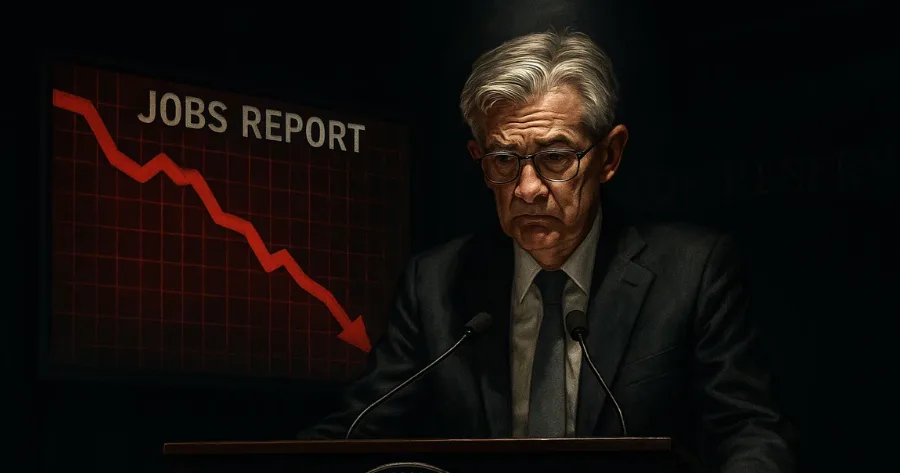
The U.S. labor market is faltering, and the timing couldn’t be worse for policymakers. After years of steady job creation, the latest government reports show hiring has slowed to a crawl. Employers added only 22,000 jobs in August, while revisions revealed that the economy actually lost jobs in June for the first time since the pandemic recovery. With the unemployment rate ticking up to 4.3%, investors are staring at an economy that’s not collapsing—but no longer charging ahead either.
For Wall Street, the implications are clear: pressure on the Federal Reserve to cut interest rates at its September 16–17 policy meeting is building. The question is not if the Fed cuts, but how much, and what that means for equities, bonds, and global markets.
A Job Market Losing Momentum
The slowdown is not a blip. Over the last three months, the U.S. has averaged just 29,000 new jobs, compared to 111,000 as recently as March. That’s what economists call “stall speed” enough to avoid a recessionary collapse, but too weak to inspire confidence.
The pain is unevenly spread:
- Manufacturing: Shed 12,000 jobs in August and is down 78,000 compared to a year ago, a blow to the Trump administration’s promise of an industrial revival.
- Wholesale trade: Also down by roughly 12,000, reflecting tariff-related disruptions in supply chains.
- Federal workforce: Cut another 15,000 jobs, bringing the year-to-date decline to nearly 100,000.
- Bright spots: Healthcare added jobs, while leisure and hospitality gained 28,000 and retail 11,000. Services are doing the heavy lifting, but not enough to offset weakness elsewhere.
This composition matters. As Jason Pride of Glenmede put it: “The labor market appears to be walking a tightrope, but it’s a fragile balance as downside risks are rising.”
Fed Chair Powell’s “Curious Balance”
Federal Reserve Chair Jerome Powell, speaking at Jackson Hole, noted the “curious balance” of the labor market: demand for workers has softened, but so has supply. Immigration restrictions, aging demographics, and worker hesitancy are keeping participation low.
That’s why unemployment is creeping higher even without mass layoffs. Both job seekers and employers are pulling back at once. Powell is watching closely because this balance complicates policy: the Fed can’t assume that weaker hiring will automatically push inflation lower.
Economists Sound the Alarm
Market strategists are already framing the jobs data as a turning point:
- Jeff Roach, LPL Financial: “The labor market is coming to a standstill as businesses slow the pace of hiring and await clarity on tariffs and Fed policy.”
- Jim Baird, Plante Moran: “Labor conditions have cooled considerably in recent months, whether due to worker scarcity, cautious hiring, or tariff uncertainty.”
- Lara Castleton, Janus Henderson: “Despite the weak headline, the labor market is still generating jobs, and 4.3% unemployment remains historically healthy.”
The consensus: the economy isn’t melting down, but the cracks are widening.
The Fed’s September Decision: Quarter Point or More?
Most analysts expect the Fed to cut rates by 25 basis points, bringing the federal funds target range down to 4.0%–4.25%. That would mark a modest step toward easing, justified by labor softness but constrained by inflation still above the 2% target.
Why not a larger cut? Because, as Powell signaled, unemployment is still low by historical standards. A move of 50 basis points would risk fueling inflation or being perceived as panicked. Investors should expect a careful, data-dependent Fed message rather than a bold pivot.
What Weak Jobs + Fed Cuts Mean
The combination of slowing jobs growth and looming Fed rate cuts creates a tricky environment. Here’s what it means across markets:
1. Equities: Defensive Rotation Likely
Weak labor markets hurt cyclical sectors most. Industrials, discretionary retailers, and small caps tied to U.S. hiring trends may lag. Conversely, healthcare, consumer staples, and select tech (AI and cloud leaders) could outperform as capital shifts to defensiveness.
2. Bonds: Yields Facing Downward Pressure
Treasury yields are already falling as investors price in rate cuts. A quarter-point move may push the 10-year yield lower, offering capital gains for bondholders. Longer-term, if unemployment rises further, the Fed may need multiple cuts, strengthening the bond bull case.
3. Commodities: Gold Shines in Uncertainty
Gold has surged past $3,500 an ounce this year, reflecting both inflation hedging and monetary easing expectations. If the Fed cuts, gold’s appeal as a store of value strengthens. Oil markets, however, could soften if consumer demand weakens further.
4. Dollar and FX: Downside Risk
Rate cuts erode the dollar’s yield advantage. A weaker greenback could support emerging-market equities and commodities priced in dollars but may amplify volatility in global capital flows.
Comparing to Past Labor Slowdowns
Investors have seen this movie before. In the early 2000s, the U.S. experienced a “jobless recovery” after the dot-com crash corporate profits recovered faster than hiring. In the late 2010s, trade wars with China eroded manufacturing employment even as GDP growth held up.
Today’s slowdown is unique because it’s both structural (immigration restrictions, demographics) and policy-driven (tariffs, higher rates). That makes it harder for a single Fed cut to fix. Investors should be wary of assuming this is just another temporary dip.
Where to Position Now
Stocks
- Favor: Healthcare providers, consumer staples, big tech with durable growth (Microsoft, Nvidia, Amazon).
- Avoid for now: Industrial-heavy ETFs, small caps overly reliant on U.S. demand, and companies with high tariff exposure.
Bonds
- Extend duration selectively. A weakening economy plus rate cuts should benefit intermediate- and long-dated Treasuries. Investment-grade corporate bonds also stand to gain.
Alternatives
- Gold and Bitcoin may see inflows as investors hedge against both policy missteps and financial instability.
- Real estate remains mixed: housing could benefit from lower mortgage rates, but commercial demand is vulnerable to weaker hiring.
Global Ripple Effects
A slowing U.S. consumer base affects global growth. Export-heavy economies like Germany, South Korea, and Mexico could see demand weaken, pressuring their markets. At the same time, a weaker U.S. dollar may offer relief to emerging markets carrying heavy dollar-denominated debt.
Bottom Line for Investors
The August jobs report confirms it: the U.S. labor market is not in freefall, but the days of steady expansion are over. Weak hiring is amplifying pressure on the Federal Reserve to cut rates, likely starting with a quarter-point move in September.
For investors, the challenge is balancing opportunity against risk:
- Rate cuts support asset prices in the short run.
- Slower hiring undermines long-run growth and corporate earnings.
- Defensive sectors, bonds, and gold look attractive, while cyclical bets require caution.
The economy is walking Powell’s “curious balance,” and so must investors. The next few months will test whether the Fed can manage a soft landing or whether the cracks in the labor market deepen into something more disruptive.
Sources
About Author