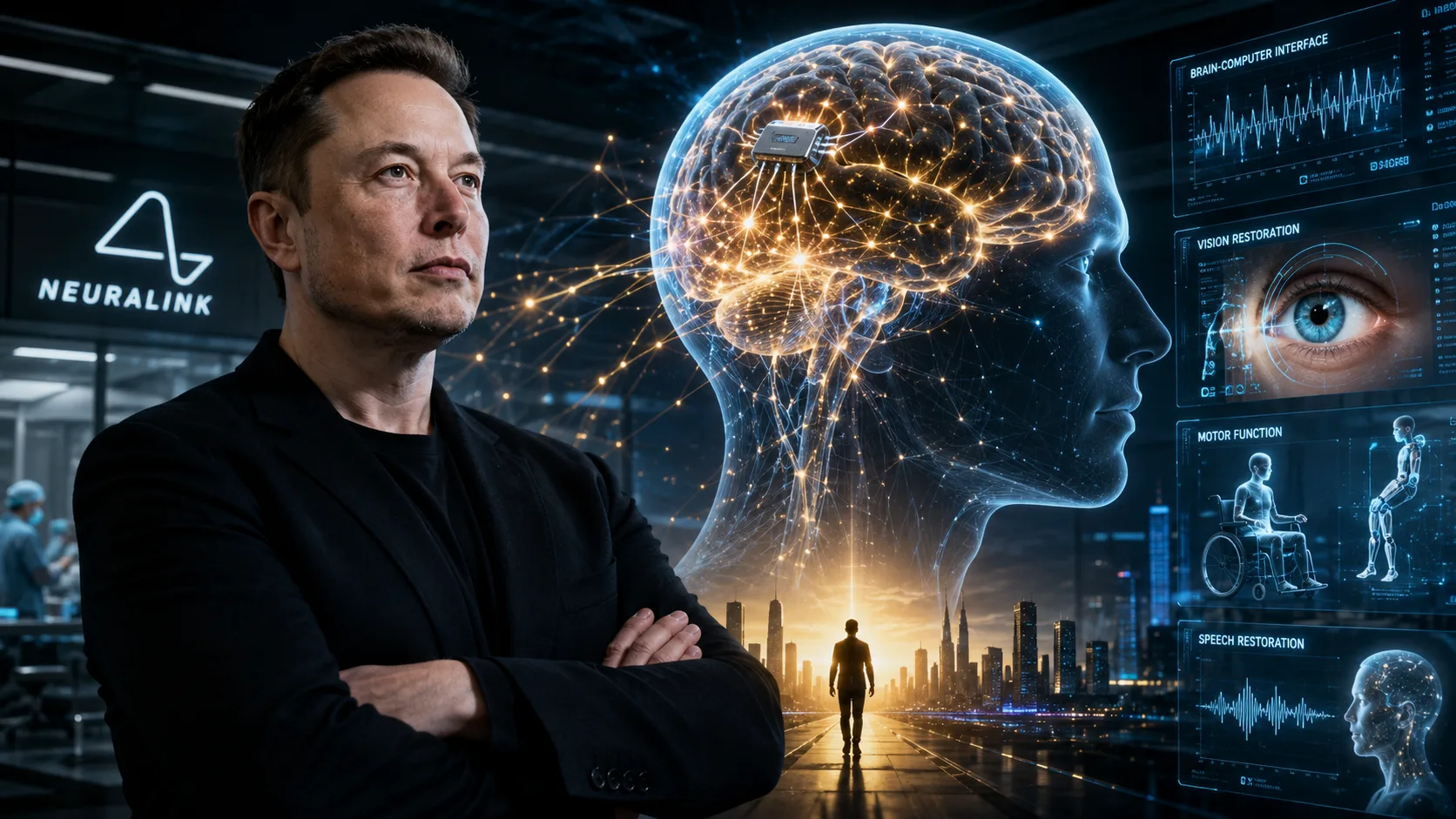
Speaking virtually Monday at the Samson International Smart Mobility Summit in Tel Aviv, Musk said Neuralink’s work restoring speech, movement, and eventually vision amounts to “Jesus-level technologies.” The comments arrived alongside fresh timelines for Neuralink’s expansion, including a new prediction that the company could implant its vision-restoration device, Blindsight, into a human patient before the end of this year.
For investors, this was more than another headline-grabbing Musk appearance. It was a reminder that one of the world’s richest men is trying to build an entirely new medical and computing industry at the same time the AI boom is reshaping capital markets.
The Next Frontier of the AI Trade Is Moving Into Human Biology
Musk described Neuralink’s brain-computer interface technology as already helping patients who lost brain-body connection regain the ability to communicate. The company has implanted devices into at least 21 paralyzed patients, allowing them to interact with computers and devices using only neural signals.
Now the ambitions are getting much larger.
Musk said Neuralink expects to implant its Blindsight device by year-end, aiming to restore vision for blind patients. Over time, he suggested the technology could eventually produce “perhaps superhuman vision.”
That statement matters because investors increasingly view the BCI industry as a future convergence point between AI, robotics, semiconductors, healthcare, and defense technologies. Morgan Stanley estimates the market could reach $80 billion by 2035, and venture money is already flooding into the space.
More than 130 BCI startups have launched since 2016. Neuralink remains among the most heavily capitalized players, reportedly raising over $1.2 billion and reaching a valuation near $9 billion.
The broader implication is becoming harder to ignore: the AI arms race is no longer confined to software models and cloud infrastructure. Capital is beginning to rotate toward companies attempting to merge computing directly with the human nervous system.
Why Wall Street Is Paying Attention
Markets have spent the last two years rewarding companies tied to AI infrastructure, chips, hyperscale data centers, and automation. Neuralink introduces a different layer of that trade.
If BCIs gain regulatory traction and demonstrate scalable clinical success, several sectors could see major repricing over the next decade:
- Medical device companies
- Advanced semiconductor manufacturers
- Robotics firms
- AI infrastructure providers
- Neurotechnology startups
- Defense and rehabilitation technology firms
This also creates a new speculative branch of the Musk ecosystem trade.
Investors already assign enormous optionality premiums to companies connected to Musk because of Tesla’s autonomous ambitions, SpaceX’s dominance in launch systems, and xAI’s growing AI footprint. Neuralink adds another long-duration moonshot with potentially massive addressable markets.
The timing is notable as well. Investors are increasingly searching for the “next AI category” after major semiconductor names experienced enormous runs. Neurotechnology gives venture capital and public markets another frontier narrative to chase.
That does not mean commercialization will be smooth.
Regulatory scrutiny, ethical backlash, clinical setbacks, and reimbursement questions remain enormous risks. Human brain implants face a vastly different regulatory landscape than consumer software or electric vehicles. Even optimistic timelines could stretch for years.
Still, Wall Street rarely waits for certainty before pricing future industries.
Musk Is Quietly Reframing Tesla Again
The Neuralink comments were not the only market-moving remarks Musk made Monday.
He also reiterated that Tesla’s autonomous vehicles could operate in a “widespread” capacity across the United States by the end of 2026. Tesla currently operates autonomous vehicles in limited Texas markets and plans to expand ride-hailing operations to additional cities next month.
That matters because Tesla’s valuation increasingly depends on investors believing the company is an AI and robotics platform rather than a traditional automaker.
Musk saying, “The car feels like it is sentient,” reinforces the same narrative architecture underpinning Neuralink. In both cases, Musk is selling investors on machine intelligence becoming increasingly human-like, autonomous, and eventually integrated into daily life at a scale few competitors can match.
The market consequence is straightforward: Tesla’s multiple remains heavily dependent on future autonomy revenues, not current car deliveries alone.
Every time Musk publicly reinforces the autonomy thesis, he is effectively defending Tesla’s premium valuation.
The Hidden Battle Happening Underneath the Headlines
Most investors still treat brain-computer interfaces as fringe science.
That may be a mistake.
The deeper story is that AI leaders, venture capital firms, and sovereign powers increasingly view neurotechnology as strategically important infrastructure. Whoever controls the next generation of human-machine interaction could influence healthcare, communications, military systems, productivity software, and eventually cognitive enhancement markets.
Several high-profile players are already entering the space.
OpenAI CEO Sam Altman is tied to Merge Labs, which reportedly raised $252 million earlier this year. Other startups are aggressively pursuing implants designed for paralysis treatment, speech restoration, and neurological disorders.
China is also investing heavily in neurotechnology research, creating another layer of geopolitical competition around emerging AI-linked industries.
Investors should pay close attention anytime Musk, Altman, and major institutional capital all converge around the same long-term category. Historically, those areas tend to attract enormous speculative inflows long before profitability arrives.
Catalysts Traders Should Watch Closely
Several developments could determine whether neurotechnology becomes a legitimate institutional investment theme or remains a niche speculative sector:
- FDA approvals tied to Neuralink’s Blindsight program
- Additional human trial data from Neuralink and competitors
- Expansion of AI-assisted medical technologies
- Venture capital funding acceleration in BCI startups
- Strategic partnerships with healthcare systems or defense agencies
- Tesla robotaxi rollout milestones in 2026
- Potential IPO activity tied to Musk-linked private companies
Investors should also watch semiconductor supply chains connected to advanced sensing, edge computing, and neural processing hardware.
If the BCI industry scales meaningfully, it could create entirely new hardware demand cycles.
The Market Is Starting to Price Science Fiction as Future Infrastructure
Musk’s “Jesus-level technologies” line will dominate headlines because it sounds outrageous.
But underneath the theatrics is a much bigger financial reality: some of the largest pools of capital in the world are beginning to treat neurotechnology as inevitable rather than hypothetical.
That shift matters.
The companies that successfully bridge AI, biology, robotics, and computing may become the next generation of trillion-dollar platforms. Markets are still early in trying to identify who those winners will be.
For now, Neuralink remains speculative, controversial, and years away from proving commercial scale.
But the investment world has officially entered the phase where brain implants are no longer viewed purely as science fiction.
About Author