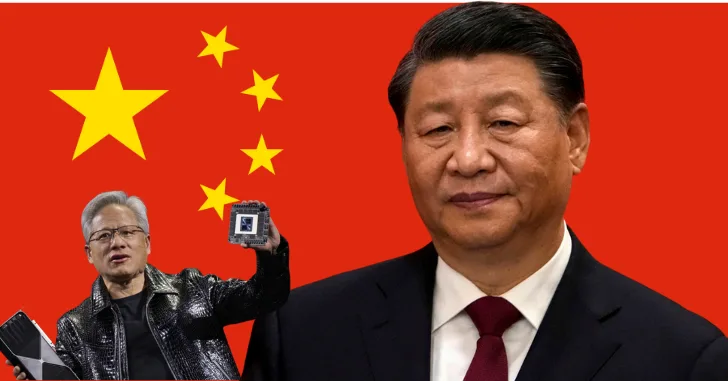
China has escalated its drive for technological self-reliance in AI hardware. In recent days, regulators have ordered major domestic tech giants like Alibaba and ByteDance to halt purchases and even cancel existing orders of Nvidia’s AI chips, particularly the recently introduced RTX Pro 6000D, a model specially tailored for the Chinese market.
This directive isn’t just another policy tweak. It’s a strategic strike: Beijing is clearly signaling that in the AI race, dependence on U.S. hardware is no longer acceptable. At the same time, some analysts see it as a high-stakes bargaining move ahead of potential trade talks with Washington.
What’s Behind the Move
- Dependence and Risk
For years, China has imported or licensed advanced chips from firms like Nvidia. With rising geopolitical tensions, supply chain vulnerabilities, and escalating export controls from the U.S., the risks have become too large to ignore. Cutting off purchases of these chips is one way to reduce exposure. - Domestic alternatives are catching up
Beijing believes, and in some cases claims, that its local chipmakers now have hardware that rivals Nvidia’s China-approved models in certain functionality. Projects like China Unicom’s data centre in Qinghai powered mostly by home-grown chips (from firms like Alibaba’s T-Head unit, Biren Tech, Moore Threads, etc.) are examples of China putting its money behind that claim. (reuters.com) - Regulatory pressure and antitrust claims
Alongside the hardware ban, China has launched an investigation into Nvidia over alleged violations of its anti-monopoly laws (notably surrounding Nvidia’s acquisition of Mellanox). That provides legal justification and pressure behind the policy. (apnews.com) - Part of a broader strategy and a possible bargaining chip
The chips ban aligns with long-standing plans by Beijing to boost domestic semiconductor capacity and insulate itself against export controls and supply chain disruptions. It may also be a deliberate negotiating tactic. By striking at a marquee U.S. firm, China signals it has credible leverage that could be reversed or softened in exchange for concessions in future trade or tech-policy negotiations.
Global Implications
- For Nvidia
The company faces lost revenue (especially in China, which has been a major growth market). Its stock price has already reacted, dropping about 1 to 1.5% in response to the news. Longer term, Nvidia will have to adjust its China strategy in terms of what it can sell, which products are allowed, and how it supports or partners with local firms. If this is a negotiating tactic, any softening or reversal of the ban could swing the stock sharply.
- For Chinese tech firms
There’s going to be friction. Some projects already in the works will stall. Performance trade-offs are likely, especially in edge or cutting-edge use cases where domestic chips may still lag in scale, efficiency, reliability, or supporting ecosystems. But the policy gives firms strong impetus and regulatory pressure to transition. If Beijing relaxes the order as part of a deal, firms may regain access to Nvidia hardware while still advancing local alternatives. - On the semiconductor supply chain
Global chipmakers and equipment suppliers will feel the ripple. If demand from China shifts toward domestic chipmakers, that changes how foundries, chip designers, packaging and testing services are contracted globally. Export restrictions from the U.S. and counter policies from China will further shape the landscape. - Strategic and geopolitical risk
This is another front in the U.S.–China tech rivalry. Both sides are using regulation, trade, licensing, and now enforced procurement policy to tilt the field. Countries and firms allied with either side will need to navigate this carefully, considering where their supply dependencies lie, how secure their chip supply chains are, and how quickly they can pivot.
The Catch and What’s Unclear
- Performance gap: Domestic chips are improving, but matching Nvidia’s top-end performance in AI especially large models, high throughput, energy efficiency is still hard. There may be trade-offs in speed, cost, or compatibility.
- Implementation friction: Even when orders are cancelled, supply contracts, verification or testing pipelines, existing infrastructure and staff all make a sudden shift difficult. Some companies will resist, or lag behind official policy.
- Enforcement: Ruling from regulators is one thing; getting firms to fully comply (especially large, partially private ones with global ties) is another. Monitoring and penalties will matter.
- International reaction: U.S. policymakers, investors, global semiconductor firms all will respond. There may be tighter export controls, counter measures, or incentives for non U.S. chip makers to serve China. If this is tactical, it could be withdrawn quickly or escalated further depending on how negotiations unfold.
Navigating a Splintering and Weaponized AI Hardware Market
China’s directive for its tech giants to stop buying Nvidia chips is more than just another policy in the U.S.–China rivalry. It’s a sharp pivot. Beijing is no longer content to be reliant, even on ostensibly “China-friendly” versions of foreign hardware. At the same time, the move gives China a potent bargaining chip ahead of trade negotiations with Washington.
For global markets, the message is clear: the AI hardware landscape is fracturing and also becoming a tool of statecraft. Companies will have to decide whose rulebook to follow U.S. export controls, China’s procurement mandates, or try to straddle both. The rewards for those who adapt fast could be big; those who don’t may find themselves squeezed.
About Author