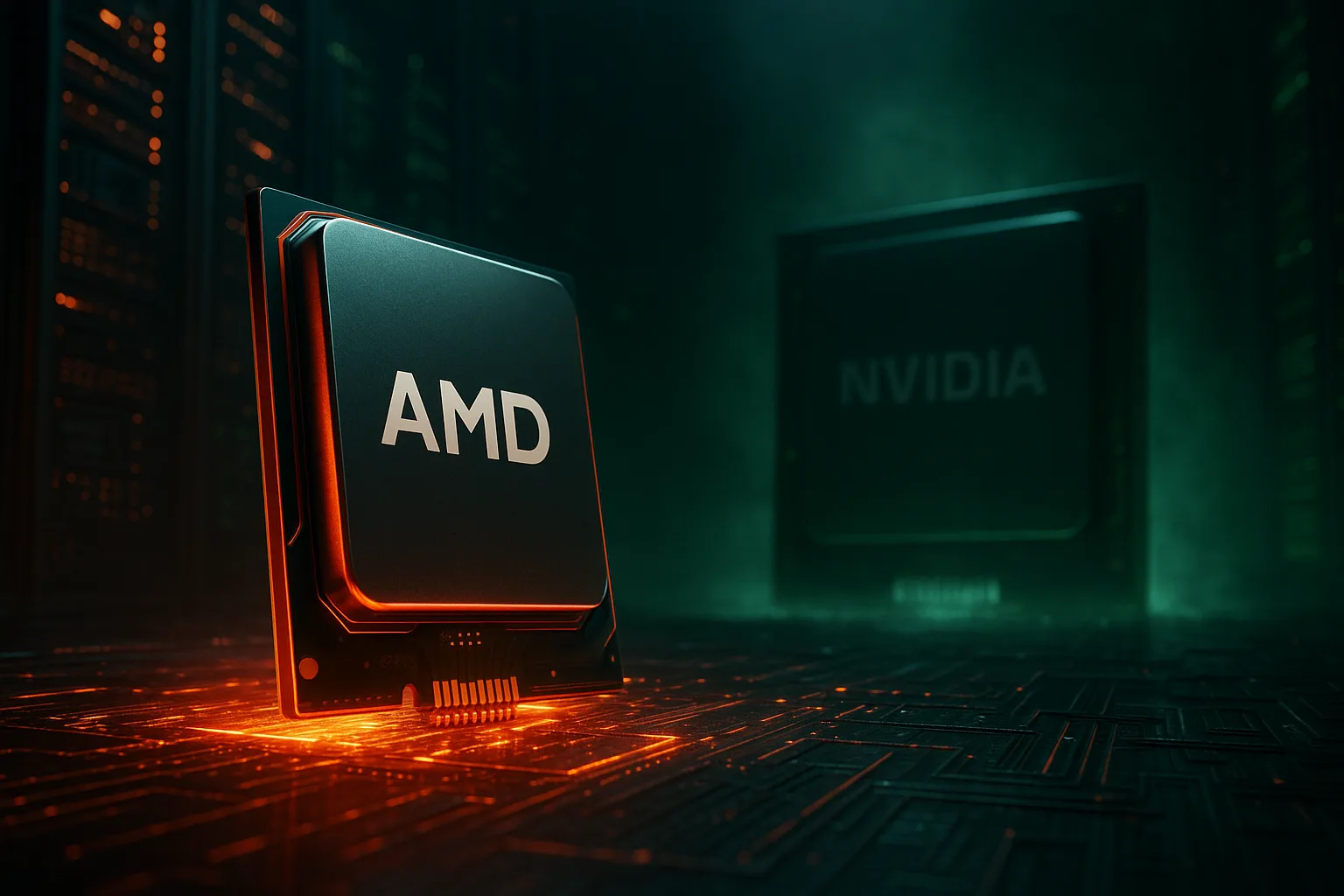
The artificial intelligence arms race just entered a new phase. OpenAI and Advanced Micro Devices announced a five-year, multibillion-dollar deal that could finally challenge Nvidia’s grip on AI infrastructure. For investors, this partnership is not just another tech headline — it is a signal that the supply chain for AI compute is widening, the economics of chipmaking are shifting, and the coming wave of AI infrastructure spending could dwarf anything the market has seen in decades.
In a world where compute power has become the new oil, this agreement puts AMD directly in the path of capital, data centers, and explosive enterprise demand.
The Deal That Changes the AI Chip Landscape
Under the agreement, OpenAI will purchase 6 gigawatts worth of AMD’s upcoming MI450 chips beginning next year. The company can acquire them directly or through cloud partners like Microsoft and Oracle. While exact dollar figures were not disclosed, AMD said it costs tens of billions of dollars per gigawatt, implying a deal value well north of $100 billion over the lifespan of the partnership.
AMD CEO Lisa Su said in an interview that the pact will generate “tens of billions of dollars” in revenue for the company over the next five years.
As part of the partnership, OpenAI will also receive warrants for up to 160 million AMD shares — around 10 percent of the company — exercisable at just one cent per share if certain deployment milestones and stock price targets are met. In other words, OpenAI now has a direct financial stake in AMD’s success.
The market responded instantly. AMD stock opened 33 percent higher on the news.
OpenAI CEO Sam Altman explained the strategic focus of the deal in plain terms: access to compute is now the single biggest bottleneck in AI development. “It is hard to overstate how difficult it has become to get enough computing power,” Altman said. “We want it super fast, but it takes some time.”
Nvidia Still Leads — But Its Moat Is Shrinking
Nvidia currently controls more than 70 percent of the AI chip market, according to Mizuho Securities. Its flagship Grace Blackwell processors are the beating heart of nearly every advanced AI model, and its upcoming Vera Rubin chip — expected to more than double performance — could extend that lead.
But cracks are forming.
Every major AI company, cloud provider, and hyperscaler is now focused on diversifying its compute stack. Google and Amazon are designing their own chips. Meta is building proprietary silicon. Microsoft is investing in alternatives. And OpenAI itself recently signed a separate $10 billion agreement with Broadcom to develop its own in-house chip.
AMD has been trying to break into the high-performance AI segment for years. Its chips already dominate in gaming, PCs, and traditional data center servers. What it lacked was a breakout moment in the world’s most transformational tech category.
This deal gives it one.
Why OpenAI Chose AMD: Inference is King
Unlike Nvidia’s chips, which have become synonymous with AI training, AMD’s MI450 chips will initially power inference — the computation that allows chatbots and AI tools like ChatGPT to generate responses.
Demand for inference workloads has exploded as large language models move from development to mass deployment. Every chatbot interaction, every image generated, every voice assistant response requires inference. The more end users pile in, the more compute the backend must deliver in real time.
Altman put it bluntly: “We are in a phase of the build-out where the entire industry has to come together and everybody is going to do super well.”
This partnership gives OpenAI the throughput it needs to scale models without being handcuffed to a single hardware supplier.
For AMD, this is not just new revenue — it is an opportunity to become the second pole in a two-player market.
A Warrant Structure With Massive Upside
One of the most notable features of the deal is OpenAI’s ability to secure up to 160 million AMD shares at almost no cost if certain milestones are hit. This is not just a discount — it is equity-based alignment.
Su called it “pretty innovative” and acknowledged it was not something the company offered casually.
For AMD shareholders, this means three things:
- OpenAI is incentivized to scale using AMD hardware. The more deployment, the greater its equity reward.
- Stock appreciation is built into the arrangement. AMD’s share price must rise for most of the warrants to be exercised.
- Wall Street now has a clearer roadmap for AMD growth. Tens of billions in potential revenue is now contractually tied to deployment, not speculation.
Altman Is on a Buying Spree the Market Has Never Seen
This announcement is part of a much bigger play.
Over the past month, Sam Altman has been assembling a global compute empire through increasingly unconventional megadeals:
- $300 billion deal with Oracle for 4.5 gigawatts of cloud computing over five years
- $10 billion agreement with Broadcom to co-develop in-house AI chips
- $100 billion Nvidia partnership, still pending final regulatory filings
“We are seeing demand for AI at a reasonable revenue rate continue to steeply increase,” Altman said. He added that the “entire industry’s fate” will be tied to shared infrastructure build-outs.
This is no exaggeration. In Abilene, Texas, OpenAI and Oracle executives recently laid out plans to spend trillions of dollars on AI data centers to support ChatGPT’s 700 million weekly users.
Greg Brockman, OpenAI’s president and co-founder, said his biggest concern is not overbuilding. “I am far more worried about us failing because of too little compute than too much.”
The Funding Question: Who Pays for the AI Buildout?
That is the trillion-dollar question.
OpenAI is on track to generate $13 billion in revenue this year — impressive, but small compared to its infrastructure commitments. The company told investors it expects to spend $16 billion renting computing servers this year alone, and that such costs could reach $400 billion by 2029.
Altman has responded by focusing on higher-margin enterprise products and longer-term contracts. He has also leveraged warrant-based compensation, cloud provider partnerships, and capital recycling agreements to secure massive compute without exhausting cash reserves.
The AMD deal is one of the clearest examples of this strategy in action.
The Coming Surge in AI Infrastructure Spending
To understand the scale of capital flowing into AI build-outs, look at where this trend is heading globally.
Below is a chart illustrating projected AI infrastructure spending growth through 2030:
Analysts expect annual AI infrastructure spending to soar from roughly $150 billion in 2024 to nearly $900 billion by 2030. If spending tracks with current momentum, cumulative capital investment this decade could exceed $3.5 trillion.
This matters for investors because the AMD–OpenAI deal is not happening in isolation. It is a leading indicator of how capital will be allocated across semiconductors, cloud platforms, and data center infrastructure — and who is likely to benefit.
Nvidia’s Response: Invest to Maintain Dominance
In late September, Nvidia announced plans to invest $100 billion into OpenAI over the next decade. The structure is circular — OpenAI would use Nvidia’s cash to buy Nvidia’s chips.
While the deal has not been finalized, Nvidia’s willingness to bankroll its own demand shows how far incumbents are willing to go to defend market share.
Nvidia is also rolling out its next-generation Vera Rubin platform in 2025, which promises more than double the power of Grace Blackwell. At $60,000 per unit for current-generation AI GPUs, even modest market share retention will produce staggering revenue.
AMD’s Breakout Moment
For AMD, this is its biggest swing yet at the AI hardware market.
Here is what this partnership signals:
- Revenue pipeline: Tens of billions of dollars through 2027 are now in play.
- Market expansion: AMD is targeting inference, not training — different economics, faster adoption.
- Investor tailwinds: Even a single-digit percentage gain in market share could add hundreds of billions in shareholder value over time.
- Ecosystem positioning: Tied to OpenAI’s growth and positioned for secondary partnerships.
Su told investors the deal is “a clear validation of our technology roadmap.”
For years, AMD has been seen as Nvidia’s cheaper cousin. That narrative may be ending.
What It Means for Investors
This deal has broad implications across semiconductors, cloud infrastructure, and capital markets. Here is what investors should take away:
1. AMD Is No Longer a Side Bet — It’s a Primary AI Player
The partnership puts AMD in the same sentence as Nvidia for the first time in the AI era. A company long tied to PCs and gaming now has a direct claim on the world’s most valuable AI pipeline.
2. Nvidia Still Wins — But Not Alone
Nvidia’s dominance does not disappear, but capital diversification means the market share ceiling is closer than before. Investors may see multiple chipmakers rise rather than one monopoly.
3. Data Center Builders Stand to Gain
Oracle, Microsoft, Amazon, Cisco, and specialized energy providers are all poised to benefit as 6+ gigawatts of AI compute are deployed in the next phase.
4. The AI Spending Supercycle Is Just Starting
The chart above captures only infrastructure spend. Layer in software, services, security, and power generation, and the investment scope becomes historic in scale.
5. Secondary Plays Matter
Companies supplying cooling systems, power transmission, memory chips, advanced packaging, and fiber connectivity could see exponential growth.
The Bigger Risk: A Bubble or a Miscalculation?
Market historians are already comparing this wave of spending to iconic infrastructure booms:
- 19th century railroads
- Early electric grids
- Telecom and fiber-optic expansions
Each cycle created explosive gains — and high-profile collapses.
The key difference this time is utility. AI is not speculative or discretionary. It is already embedded in enterprise productivity, national security planning, finance, logistics, health care, and consumer technology.
But the risk is not gone. If capital dries up, or regulation stalls adoption, the companies investing the most will face pressure.
For now, the imbalance is clear: demand is outpacing supply by a wide margin.
Final Word
The AMD–OpenAI partnership is not just a headline about chips. It is a strategic reshaping of the AI cost structure and a signal of where capital markets are moving next. Nvidia still leads, but AMD now has the clearest path yet to becoming a real competitor. The warrant structure, revenue projections, and infrastructure roadmap give AMD years of visibility and momentum.
For investors, the opportunity is twofold: ride the AI infrastructure surge through direct chip plays like AMD, Nvidia, and Broadcom — and position early in the secondary supply chain that will power the next generation of data centers.
The build-out has already begun. The money is following. The question now is not whether AI infrastructure spending will spike, but who will own the most profitable pieces of it.
If the projections hold, today’s deals are just the down payment.
About Author