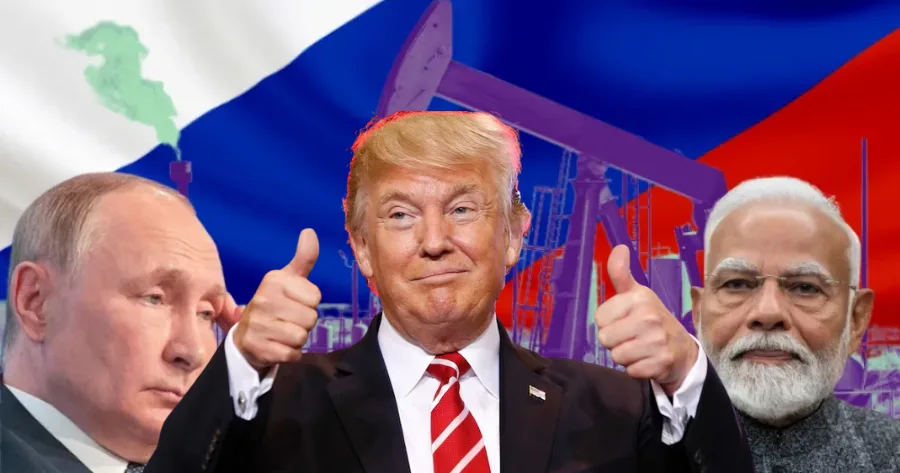
Donald Trump said this week that Indian Prime Minister Narendra Modi has assured him New Delhi will stop buying oil from Russia, a move that could reshape global energy flows and alter investor expectations for crude prices, sanctions policy, and emerging market relations. But there is one problem: no one has given a timeline.
During a press briefing in the Oval Office, Trump said, “Modi assured me today that they will not be buying oil from Russia. That is a big stop. Now we have got to get China to do the same thing.” He also argued that Russian crude sales help finance what he called Moscow’s “ridiculous war” in Ukraine.
India did not publicly commit to any immediate halt. Its External Affairs Ministry signaled that its energy decisions will continue to “safeguard the interests of the Indian consumer in a volatile energy scenario.” That gap between the political rhetoric in Washington and the policy signaling in New Delhi creates uncertainty that energy markets are still digesting.
For investors, this is not a headline to ignore. India is one of the largest buyers of Russian crude, alongside China. Any disruption or even perceived friction in that trade could affect pricing, shipping costs, sanctions enforcement, and global crude benchmarks like Brent and West Texas Intermediate.
This article breaks down the geopolitical dynamics, India’s official stance, Russia’s reliance on Asian demand, and the likely market and investor implications. It also explains why both oil equities and commodities traders need to watch not just U.S. statements, but what New Delhi actually does.
India, Russia, and a Volatile Energy Balance
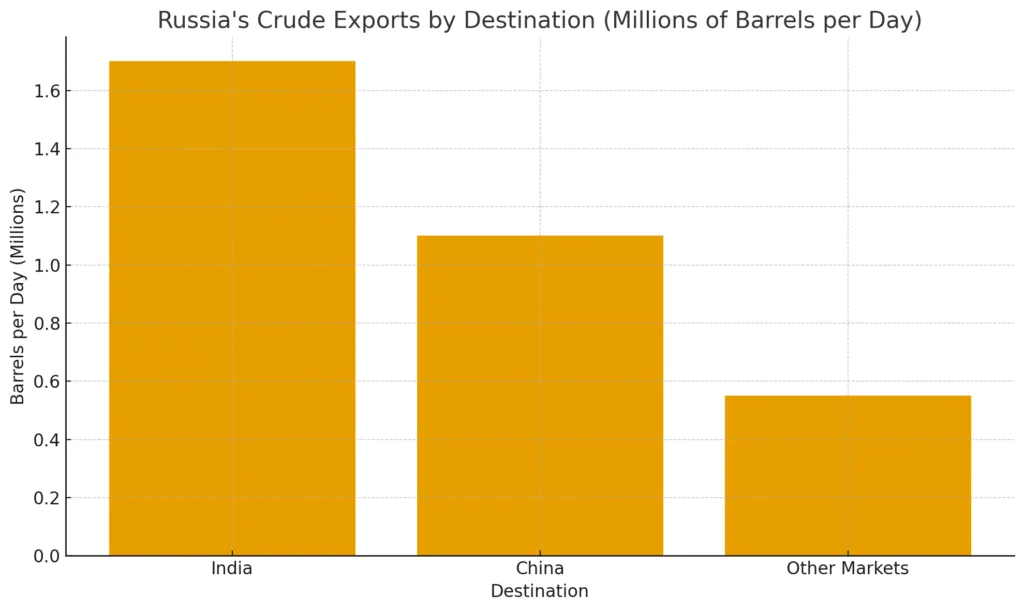
India has imported roughly 1.7 million barrels of Russian crude per day, according to data from energy analytics firm Kpler. Russia exports about 3.35 million barrels per day globally, with India and China taking the lion’s share.
When Russia was hit with sanctions following its 2022 invasion of Ukraine, global energy markets spiked, and Washington quietly signaled to India that it could continue buying Russian oil as long as it complied with the G7 and European Union price cap. That cap, currently set at $47.6 per barrel, is supposed to limit Moscow’s revenue without triggering a price shock.
India’s petroleum minister Hardeep Singh Puri reminded Western critics of that reality in a July interview with CNBC. “If people or countries had stopped buying at that stage, the price of oil would have gone up to 130 dollars a barrel,” he said. “That was a situation in which we were advised, including by our friends in the United States, to please buy Russian oil, but within the price cap.”
That statement matters in this new context. Trump’s comments suggest impatience with that arrangement and a desire for coordinated pressure on both India and China to cut off revenue streams that keep Russia’s war economy alive. But India’s messaging indicates no sudden pivot.
Official Responses Show a Different Tone
While Trump called the expected halt a “big stop,” India’s External Affairs Ministry struck a more measured tone. Spokesperson Randhir Jaiswal said India’s oil import decisions are “entirely” guided by efforts to protect consumers and ensure stable pricing.
He added that India has been expanding energy cooperation with the United States over the past decade and that discussions are continuing under the current administration.
That suggests India will not completely abandon Russian supply without alternative affordable volume. Washington may push, but New Delhi will set terms based on domestic demand, inflation management, and global price stability.
India has also criticized the United States over its own trade with Russia, pointing out inconsistencies in Western demands. And Trump himself raised tariffs on India in August, lifting the total levy to 50 percent. That kind of trade pressure could complicate energy negotiations behind the scenes.
No Clear Timetable
Trump acknowledged there would be “a little bit of a process” and did not give a timeline for the halt. He said India would resume buying Russian oil “after the war is over.” That could mean months or years, depending on how the conflict evolves or how sanctions are enforced.
For investors, the uncertainty is the story. If India slowly unwinds purchases, markets may absorb the change. If Washington ramps up pressure or secondary sanctions enforcement, a sharper disruption could push crude prices higher.
As of late Wednesday night, Brent futures were up 0.82 percent to $62.43 a barrel, and West Texas Intermediate futures were up 0.89 percent at $58.79. Those are not panic-level moves, but markets are waiting for clarity.
Why This Matters to Investors
The investor implications break into three key areas:
1. Energy Prices and Volatility
Any reduction in Indian demand for Russian crude could reroute shipments, increase shipping and insurance costs, and put upward pressure on Brent and WTI. Traders should monitor announcements from both Washington and New Delhi, as well as maritime tracking data.
Energy-sensitive sectors such as airlines, shipping, manufacturing, and utilities may feel price swings before consumers do. Crude ETFs, such as the United States Oil Fund (USO), and major energy stocks could see momentum moves based on future policy signals.
2. Sanctions Policy and Compliance Risk
If Washington shifts from encouraging price cap compliance to demanding a phase-out of Russian oil, banks, insurers, and logistics companies will need to reassess risk exposure. Secondary sanctions could hit firms that facilitate trade outside the cap.
Investors in companies with global energy exposure — shipping, commodities trading, ports, tankers, refining — should stay alert to changes in enforcement and financing rules.
3. India’s Energy Mix and Trade Relations
India’s pivot will not happen in a vacuum. If Russian supply is curtailed, the country may turn to Middle Eastern producers, U.S. liquefied natural gas, or new long-term contracts with allies. That creates opportunities for U.S. energy exporters, pipeline investors, and infrastructure firms.
Given India’s rapid economic growth and rising fuel demand, its sourcing decisions will affect global pricing and investment pipelines for years ahead.
Geopolitics and Trade Friction
Trump’s message mixes strategic signaling with political leverage. By publicly saying Modi pledged to halt Russian oil imports, he increases the pressure on New Delhi to follow through — or risk being portrayed as enabling the war in Ukraine.
At the same time, the United States and India are deepening strategic and defense ties. India has also been frustrated by tariffs, technology transfer conditions, and slower progress on trade access. Washington may offer energy incentives, security cooperation, or tariff relief in exchange for a phased cutback in Russian oil purchases.
China remains the larger question. Trump said, “Now we have got to get China to do the same thing.” But Beijing has shown no willingness to limit its imports from Russia. If India moves and China does not, the impact on Russia would be muted.
Investor Takeaways
Investors should not treat this as political noise. Several actionable insights emerge:
✔ Watch for Language Shifts
If India stops framing energy decisions solely around consumer price stability and begins acknowledging geopolitical costs, a policy pivot may be coming.
✔ Follow Sanctions Enforcement
The price cap has been loosely enforced. If Washington tightens compliance, insurers and shipowners may exit trades carrying Russian crude to Asia.
✔ Track Oil Benchmarks and Shipping Rates
Even modest disruptions can lead to volatility in tanker day rates, refinery margins, and crude spreads such as Brent-WTI.
✔ Monitor U.S.-India Trade Tensions
Tariff negotiations could be exchanged for energy concessions. That would create sector-level opportunity in liquefied natural gas, pipelines, refining, and renewables.
✔ Anticipate Market Rotation
Energy equities, defense stocks, emerging market ETFs, and commodities-based funds could see premium valuation swings based on new policy direction.
The Bigger Picture
The price cap model has struggled to fully constrain Russian revenue. India and China became indispensable buyers when Europe stepped back. Now Washington is signaling a desire to go further. Whether that turns into sustained policy or remains aspirational depends on how negotiations evolve with New Delhi.
India’s official stance leaves the door open to gradual change but does not commit to a timetable. “The current Administration has shown interest in deepening energy cooperation with India. Discussions are ongoing,” Jaiswal said in reference to the United States.
Investors should be prepared for a drawn-out process, incremental announcements, and market-testing headlines. Sudden enforcement actions or tariff concessions could trigger sharp price movements.
A Potential Turning Point
Trump’s statement marks a potential turning point in U.S.-India energy diplomacy, but not a completed policy shift. India will balance consumer needs, price stability, and geopolitical leverage before acting. Russia will look to China, discounted pricing, and shadow fleets to preserve flows. The United States will use tariffs, diplomacy, and sanctions enforcement to reshape crude markets without causing price spikes that hurt American voters.
For investors, this is not a wait-and-see situation. It is a watch-and-prepare moment. Price cap compliance, shipping logistics, crude benchmarks, and trade talks will all intersect in unpredictable ways.
About Author