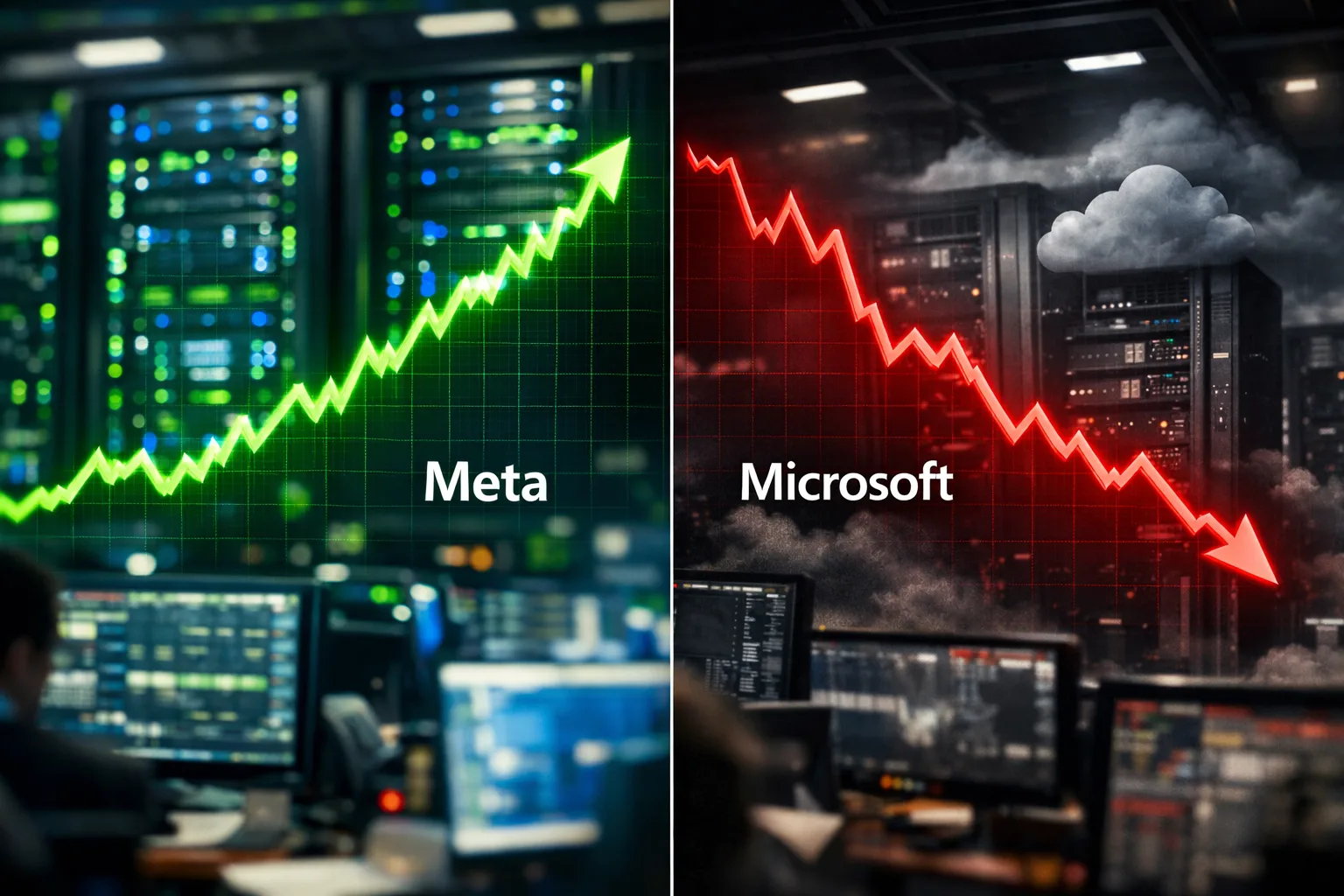
This earnings season is shaping up as a sharp contrast between technology giants when it comes to artificial intelligence spending and investor confidence. While Meta Platforms earned praise for translating massive AI investments into tangible financial gains, Microsoft struggled to convince markets that its ballooning costs are delivering enough near-term returns.
The diverging reactions highlight a growing theme on Wall Street. Investors are no longer impressed by AI ambition alone. They want proof that spending is improving margins, strengthening competitive positions, and generating durable revenue growth.
Meta Shows Clear Payoff From AI Investments
Meta shares surged more than 10 percent after the company delivered results that suggested its AI strategy is already enhancing profitability. The company posted 24 percent year over year revenue growth, driven largely by strength in digital advertising, which continues to benefit from AI-powered targeting and content optimization.
Buoyed by that performance, Meta issued upbeat guidance and reaffirmed aggressive spending plans. Management said it expects to invest between $115 billion and $135 billion this year to expand its AI infrastructure, nearly double what it spent in 2025.
In previous quarters, that level of spending had unsettled investors who questioned whether Meta was overbuilding ahead of demand. This time, the tone was notably different. Strong revenue growth helped ease concerns and signaled that Meta’s AI investments are reinforcing its core advertising engine rather than draining it.
Chief executive Mark Zuckerberg said the company is developing a broad slate of new AI-powered products in 2026 and beyond, with investments aimed at advancing what he described as “building personal super intelligence.”
The market reaction was decisive. Meta added more than $176 billion in market value following the earnings release, a sign that investors are increasingly willing to support high AI spending when there is visible payoff.
Microsoft Faces Investor Pushback Despite Massive Demand
Microsoft’s earnings told a different story. Shares fell roughly 10 percent, wiping out more than $357 billion in market capitalization and marking the company’s worst single-day decline since March 2020.
The selloff was driven by a combination of slowing growth in the Azure cloud business and escalating capital expenditures. Azure revenue growth slowed to 39 percent from 40 percent in the prior quarter, a modest deceleration but one that rattled investors who closely watch the segment as a barometer for enterprise AI demand.
At the same time, Microsoft’s capital expenditures and finance leases surged 66 percent year over year to $37.5 billion, exceeding analyst expectations. The company said the spending reflects ongoing investment to support AI workloads and cloud capacity.
Microsoft also acknowledged that demand continues to outstrip supply, with ongoing constraints in compute capacity. Finance chief Amy Hood said Azure growth would have reached 40 percent if the company had directed all newly acquired graphics processing units toward the cloud business in recent quarters.
She added that Microsoft is balancing efforts to better align incoming supply with Azure demand while continuing to invest in internal AI products such as GitHub Copilot and Microsoft 365 Copilot.
Despite near-term concerns, demand remains robust. Microsoft reported a demand backlog of $625 billion, up 110 percent from a year earlier. That figure includes a $250 billion cloud agreement with OpenAI, which now accounts for 45 percent of Microsoft’s commercial remaining performance obligations.
Analysts at Evercore ISI said investor worries about OpenAI’s ability to meet long-term funding commitments likely contributed to the selloff but described the reaction as “overblown.”
AI Ripples Spread Across the Tech Sector
The contrasting reactions to Meta and Microsoft spilled into the broader technology sector, reinforcing the idea that investors are selectively rewarding companies that can demonstrate AI monetization.
IBM shares climbed about 5 percent after the company exceeded expectations and showed solid growth in both software and infrastructure. IBM said its AI book of business more than doubled to $12.5 billion, up from $5 billion a year earlier, lending credibility to its strategy of pairing AI with automation and consulting services.
Analysts at Goldman Sachs said the performance suggests IBM is on track to complete its pivot toward long-term growth, citing software momentum and market share gains in consulting.
Similarly, analysts at JPMorgan described IBM as a relatively defensive technology name with improving exposure to software and AI tailwinds.
Not every software company benefited from the AI narrative. ServiceNow shares dropped roughly 10 percent, extending a sharp decline that has left the stock down about 25 percent this year and nearly 50 percent over the past twelve months.
While ServiceNow reported better-than-expected earnings, investor concerns lingered that AI-driven automation could erode demand for traditional workflow software and licensing models. Some shareholders have also questioned whether the company’s recent multibillion-dollar acquisition spree signals difficulty sustaining organic growth.
During the earnings call, chief executive Bill McDermott pushed back on those concerns.
“Let’s clear it up with the facts,” he said. “Enterprise AI will be the largest driver of return on the multitrillion-dollar supercycle of investment in AI infrastructure.”
What This Means for Investors
The latest earnings underscore a critical shift in how markets evaluate AI strategies. The era of blank-check enthusiasm appears to be fading, replaced by a demand for measurable results.
Companies like Meta and IBM are being rewarded for showing that AI spending directly supports revenue growth, operating leverage, or competitive advantage. Others, including Microsoft and ServiceNow, are facing tougher scrutiny as investors weigh long-term potential against rising costs and near-term execution risks.
For investors, the takeaway is clear. AI remains a powerful growth driver, but stock performance increasingly depends on who can prove the return on investment rather than simply promise it.
About Author