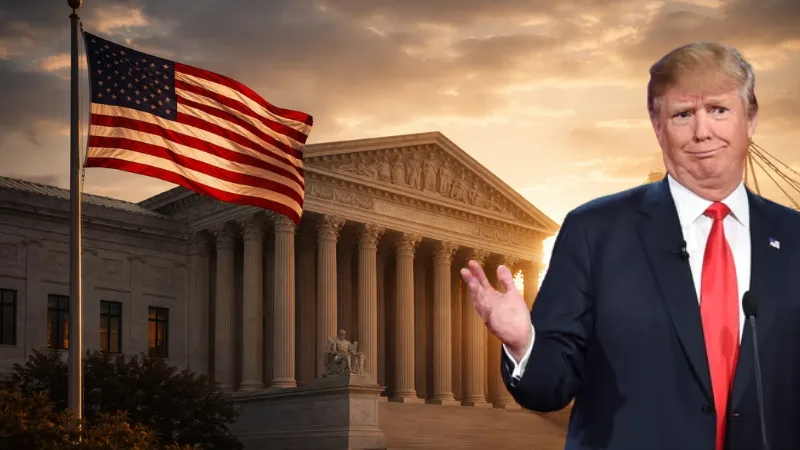
The U.S. Supreme Court delivered a major blow to President Donald Trump’s trade agenda on Friday, striking down the sweeping global tariffs he imposed under emergency powers. The 6-3 ruling curtails one of the administration’s most aggressive economic strategies and sets up a high-stakes battle over executive authority, trade policy, and billions of dollars in collected duties.
At issue were the so-called “reciprocal” tariffs announced in April 2025, which applied broadly across trading partners. The administration justified the measures under the International Emergency Economic Powers Act, or IEEPA, arguing that persistent trade deficits and drug trafficking constituted national emergencies that warranted import taxes.
The Court disagreed.
The Constitutional Question
In a majority opinion written by Chief Justice John Roberts, the Court held that the Constitution clearly assigns the power to levy taxes, including tariffs, to Congress.
“The Framers did not vest any part of the taxing power in the Executive Branch,” Roberts wrote.
The majority emphasized that IEEPA, a 1977 law that grants the president authority to regulate economic transactions during national emergencies, does not explicitly authorize the imposition of tariffs. While presidents have used the statute dozens of times for sanctions and asset freezes, no prior administration had interpreted it as allowing unilateral import taxes.
“And the fact that no President has ever found such power in IEEPA is strong evidence that it does not exist,” Roberts added.
The ruling also invoked the Court’s “major questions doctrine,” which requires clear congressional authorization when the executive branch claims broad regulatory authority with significant economic and political impact. The doctrine was previously used to block large-scale executive actions such as President Joe Biden’s student loan forgiveness initiative.
“There is no exception to the major questions doctrine for emergency statutes,” Roberts wrote.
The decision reinforces a constitutional boundary that markets and businesses will now have to factor into long-term planning.
A Divided Court
The 6-3 split reflected ideological divisions, but the majority included several conservative justices appointed during Trump’s first term. The dissenters argued that the tariffs fell within the president’s foreign affairs powers and emergency authority.
Justice Brett Kavanaugh, while addressing refund questions separately, acknowledged the practical complexity of the aftermath.
“The Court says nothing today about whether, and if so how, the Government should go about returning the billions of dollars that it has collected from importers. But that process is likely to be a ‘mess,’ as was acknowledged at oral argument,” Kavanaugh wrote.
The Financial Stakes
According to Treasury Department data, the administration collected more than $133 billion in tariffs under the emergency authority through December. Over a ten-year horizon, projections suggested the cumulative impact could approach $3 trillion.
The immediate legal question now turns to refunds. The Court declined to rule on whether companies are entitled to repayment of tariffs already paid. That issue will likely be decided in lower courts.
Major importers, including warehouse retailer Costco, are reportedly preparing to pursue reimbursement claims. Numerous lawsuits were filed by states and private businesses ranging from plumbing suppliers to toy retailers to specialty apparel companies.
If refund claims succeed on a wide scale, the Treasury could face a significant financial and administrative burden. The ripple effects could extend to federal budgeting and deficit projections.
The Political Fallout
President Trump, who was meeting with governors when the decision was announced, reportedly reacted strongly. He had described the case as one of the most consequential in American history and warned that a loss would undermine U.S. leverage in global trade.
Polling has consistently shown mixed public support for tariffs, particularly amid inflation and affordability concerns. Legal opposition to the emergency tariffs also crossed ideological lines, with libertarian and pro-business groups challenging the administration’s authority.
Despite the setback, the ruling does not eliminate tariffs entirely. The president retains authority under other trade statutes, such as Section 232 of the Trade Expansion Act and Section 301 of the Trade Act of 1974. However, those mechanisms involve more procedural safeguards, investigations, and congressional oversight.
Senior administration officials have indicated they intend to continue pursuing tariff strategies through alternative legal pathways.
Market Implications
Financial markets will likely interpret the ruling through several lenses.
First, the decision reduces policy uncertainty in one area by clarifying constitutional limits. Investors tend to reward predictable governance frameworks. Removing the possibility of sudden, sweeping tariffs under emergency declarations could ease volatility in sectors heavily reliant on imports.
Second, industries previously impacted by the tariffs, including manufacturing, retail, and consumer goods, may experience short-term relief if refund claims appear viable.
Third, the ruling reinforces the Supreme Court’s increasing willingness to scrutinize expansive executive power claims. That has implications beyond trade policy, potentially affecting regulatory decisions in energy, technology, and finance.
Companies with global supply chains now face a recalibration period. They must assess whether tariff risk shifts from unilateral executive action toward a more structured congressional process.
The Broader Constitutional Debate
At its core, the case centers on separation of powers.
The Constitution grants Congress authority to “lay and collect Taxes, Duties, Imposts and Excises.” While Congress has delegated certain powers to the executive branch over time, the Court signaled that such delegations must be explicit when they carry sweeping economic consequences.
The administration argued that tariffs are intertwined with foreign policy and national security, domains traditionally granted wide presidential discretion. The majority rejected that argument, concluding that foreign affairs implications do not override constitutional text.
For legal scholars, the decision represents another data point in the Court’s broader project of limiting expansive interpretations of executive authority.
For investors, it underscores how judicial doctrine can shape economic reality.
What Comes Next
The immediate next steps include:
- Lower court litigation over refunds.
- Possible legislative action from Congress clarifying emergency trade powers.
- Potential new tariff actions under alternative statutes.
- Ongoing political debate as trade policy remains central to economic messaging.
The administration may attempt to repackage similar trade measures under different legal frameworks. Congress, if aligned politically, could also move to codify broader emergency tariff authority. That scenario would likely spark renewed constitutional challenges.
Investors should monitor:
- Developments in refund litigation.
- Congressional trade proposals.
- Supply chain shifts among multinational corporations.
- Sector-specific exposure to import duties.
The ruling does not eliminate trade tensions or tariff risk. It narrows the pathway through which such measures can be imposed.
Why It Matters for Investors
Trade policy directly influences corporate margins, consumer prices, and geopolitical positioning. Sudden tariffs can disrupt supply chains and pressure earnings. Conversely, tariff rollbacks or legal invalidations can boost sentiment in affected industries.
The Supreme Court’s decision creates clearer boundaries around executive action, which may reduce extreme policy swings. However, it also increases the importance of legislative outcomes in determining trade strategy.
Investors operating in globally integrated sectors should reassess risk models that previously assumed broad emergency tariff authority.
Markets dislike uncertainty, but they also adapt quickly to new legal guardrails. This ruling establishes one.
Sources
https://www.supremecourt.gov/opinions
https://www.treasury.gov/resource-center/data-chart-center/Pages/index.aspx
https://www.law.cornell.edu/uscode/text/50/chapter-35
https://www.reuters.com/
https://www.bls.gov/
About Author