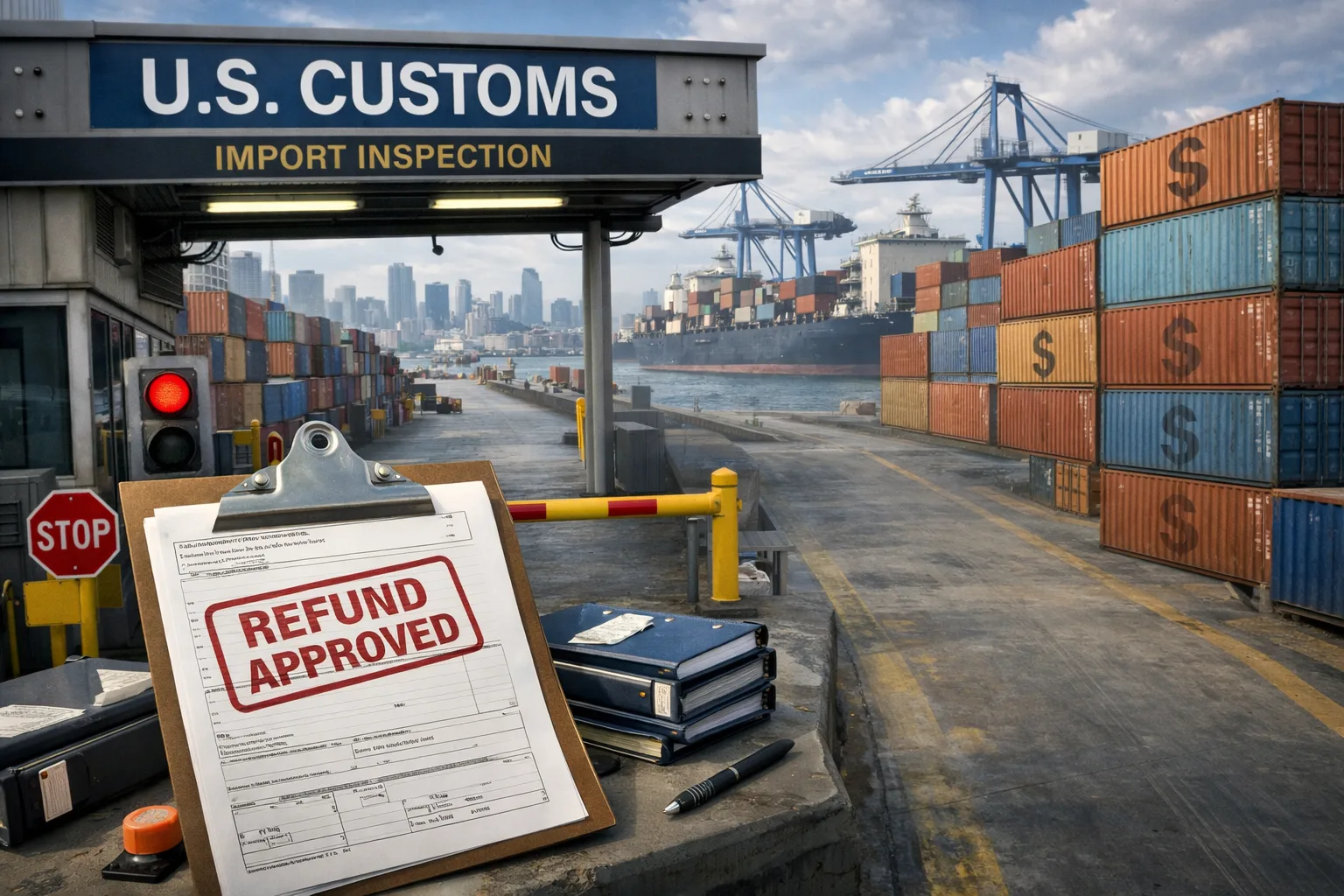
A federal trade court has ordered the U.S. government to begin issuing refunds on billions of dollars in tariffs that the Supreme Court recently ruled were collected illegally, a decision that could have sweeping implications for importers, supply chains, and U.S. trade policy.
The ruling, delivered by Judge Richard Eaton of the U.S. Court of International Trade in Manhattan, directs U.S. Customs and Border Protection (CBP) to begin the process of reimbursing companies that paid tariffs under the International Emergency Economic Powers Act (IEEPA).
Those tariffs were a central component of President Donald Trump’s trade strategy during his current administration. However, the Supreme Court ruled last month that the use of IEEPA to impose certain tariffs exceeded the authority granted under the statute.
Now the government faces the challenge of unwinding one of the largest tariff programs in recent history.
A Massive Refund Process Begins
Judge Eaton’s order requires Customs officials to begin calculating the correct duty amounts on shipments that previously included the now invalid tariffs.
Under the normal customs process, importers pay an estimated duty when goods enter the United States. The final amount is determined later through a process known as liquidation. This typically occurs roughly 314 days after the shipment arrives.
The judge ordered Customs to finalize those entries without the tariff assessment, effectively triggering refunds for companies that overpaid.
During the hearing, Eaton made it clear that Customs already has systems for issuing refunds.
“Customs knows how to do this,” he said during the court proceedings.
He added that the process should not be overly complicated because CBP routinely processes refunds when importers pay more duty than they owe.
“They do it every day. They liquidate entries and make refunds.”
Still, the scale of this case is unprecedented.
More Than $130 Billion at Stake
According to court filings and trade estimates, the U.S. government collected more than $130 billion in tariffs that could potentially be subject to reimbursement.
That makes the ruling one of the most financially significant trade decisions in modern U.S. history.
The tariffs were imposed under the International Emergency Economic Powers Act, a law originally intended to allow the president to respond to national security emergencies.
In this case, the tariffs targeted a broad range of imports as part of a strategy to pressure foreign governments and protect domestic industries.
However, the Supreme Court concluded that the law did not authorize tariffs of this type.
That ruling triggered a wave of litigation from importers seeking refunds.
Thousands of Lawsuits Already Filed
The case that led to Judge Eaton’s order was filed by Atmus Filtration Technologies, a global filtration manufacturer.
According to court documents, the company paid approximately $11 million in tariffs that it argues were unlawful.
But Atmus is far from alone.
Nearly 2,000 lawsuits have already been filed with the Court of International Trade by companies seeking reimbursement for the tariffs they paid.
Those cases represent businesses across multiple industries including manufacturing, consumer goods, electronics, and automotive supply chains.
Judge Eaton indicated that he does not intend to handle each case individually.
Instead, he wants a broader system that allows importers to submit claims and receive refunds without the need for individual litigation.
“We want to work out a method by which those importers can make a claim for duties that were unlawfully applied,” Eaton said during the hearing.
Customs Warns of a Huge Administrative Challenge
While the court views the refund process as straightforward, Customs officials have warned that the scale of the operation could be enormous.
CBP said in court filings that the task could require reviewing more than 70 million import entries.
Officials described the situation as “unprecedented.”
The agency has argued that processing refunds could require significant manual review because tariff calculations were built into existing customs systems.
CBP had asked the court for as much as four months to determine how it would implement the refund program.
Judge Eaton, however, signaled that the government needs to move faster.
He scheduled another hearing for Friday to receive updates on the agency’s progress.
Importers Push for a Simple Refund System
More than 300,000 importers paid the tariffs in question.
The vast majority of them are small and mid sized businesses rather than large multinational corporations.
Many of these companies say they cannot afford long legal battles to recover their money.
Some told reporters they would likely abandon their claims if the process becomes too complex or expensive.
Trade attorney George Tuttle said the government should be able to process the refunds efficiently.
“There should be no impediment to CBP issuing refunds,” he said.
Legal experts believe the court may ultimately require Customs to adopt a standardized reimbursement system to avoid overwhelming the judiciary.
What This Means for U.S. Trade Policy
The ruling could reshape how tariffs are used in U.S. economic policy.
For years, tariffs have been a major tool in trade negotiations, particularly in disputes with China and other large trading partners.
The Supreme Court’s ruling suggests that the executive branch may face stricter legal limits when attempting to impose tariffs under emergency powers.
Future administrations may need to rely more heavily on traditional trade statutes or congressional approval to implement similar measures.
For businesses, the decision creates a rare opportunity to recover billions of dollars in previously paid duties.
However, the final outcome will depend on how the refund process is implemented.
Market Implications for Investors
The potential return of more than $130 billion to businesses could have ripple effects across several sectors.
1. Manufacturing and Industrial Firms
Many manufacturers paid tariffs on imported parts and raw materials.
Refunds could improve margins and strengthen balance sheets.
Companies involved in global supply chains may benefit the most.
2. Retail and Consumer Goods Companies
Retailers that rely heavily on imports could also see financial gains if they recover tariff payments.
Those funds could be used for inventory purchases, capital investment, or shareholder returns.
3. Shipping and Logistics Firms
If refunds stimulate new trade activity, companies in transportation, shipping, and logistics could see increased demand.
4. Trade Policy Uncertainty
At the same time, the ruling introduces new uncertainty around U.S. trade policy.
If courts limit the government’s ability to impose tariffs quickly, it could weaken a major economic leverage tool in geopolitical negotiations.
Investors may need to watch closely how the Trump administration and Congress respond.
What Happens Next
The immediate next step is determining how the refunds will actually be paid.
Judge Eaton’s order requires Customs to finalize entry calculations and remove the unlawful tariffs.
Once that happens, the government will begin issuing refunds with interest.
However, legal experts believe the government could still challenge the scope of the order.
Ryan Majerus, a former senior Commerce Department official now at the law firm King & Spalding, said the ruling appears to support broad reimbursement.
“The language in this order strongly suggests an across the board approach that importers are entitled to IEEPA refunds, full stop,” Majerus said.
He added that the government could ask the court for more time due to the complexity of the process.
Whether the refunds arrive quickly or take years will likely depend on how efficiently Customs can adapt its systems.
What is clear is that the financial stakes are enormous.
If the full amount is reimbursed, the ruling will result in one of the largest tariff refunds in U.S. history.
For businesses and investors alike, that could mean billions of dollars flowing back into the economy.
Sources
https://www.cbp.gov/trade/basic-import-export
https://www.law.cornell.edu/uscode/text/50/chapter-35
https://www.congress.gov/bill/ieepa-international-emergency-economic-powers-act
About Author