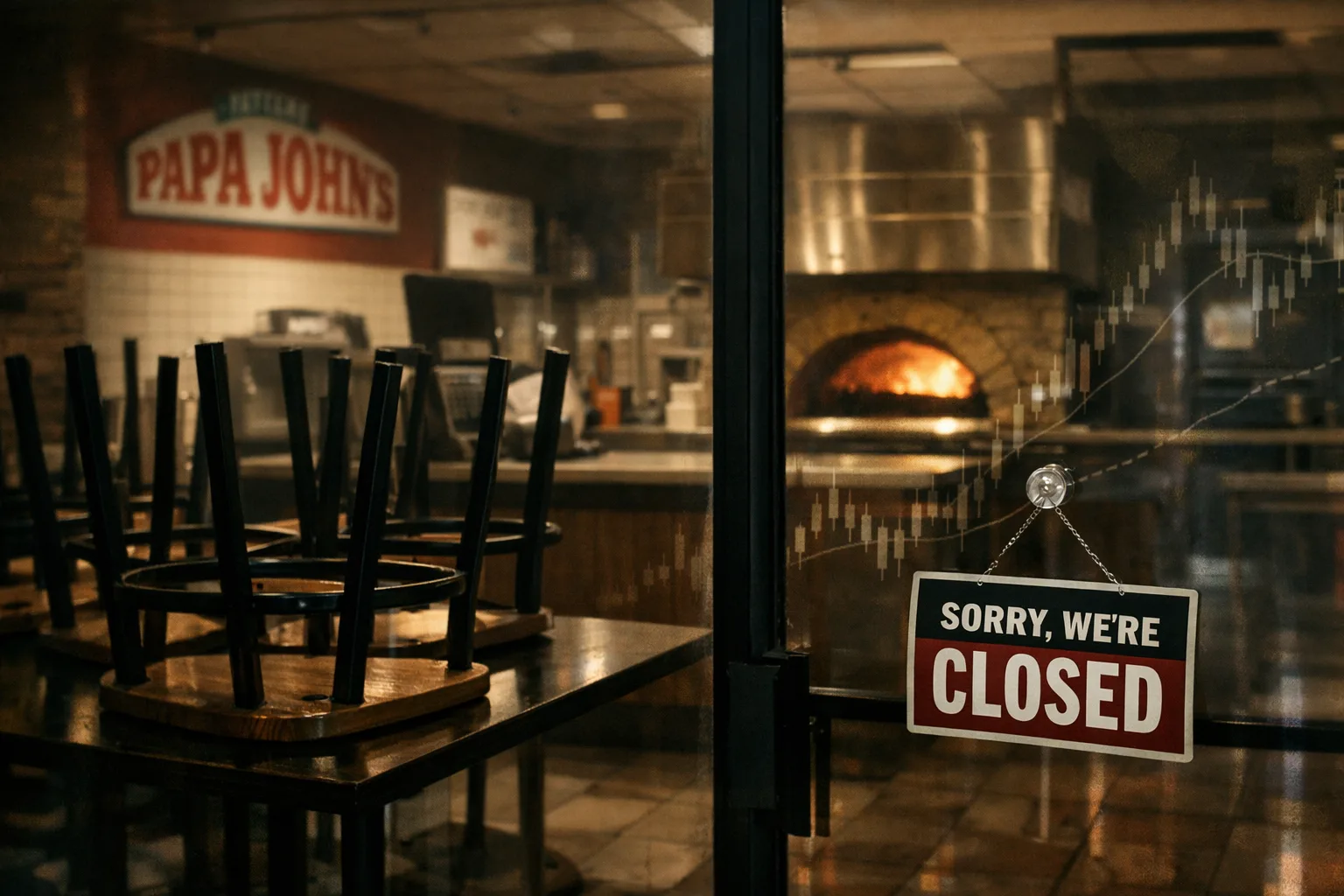
Papa John’s is preparing to shut down hundreds of underperforming restaurants across North America over the next several years as the company attempts to strengthen profitability and reposition its franchise system in a challenging consumer environment.
The pizza chain disclosed the plan during its latest quarterly earnings call, signaling that the closures are part of a broader restructuring effort aimed at improving franchise performance and increasing average sales per restaurant.
Company Targets 300 Underperforming Locations
According to Papa John’s Chief Financial Officer Ravi Thanawala, the company has identified approximately 300 restaurants that are not meeting brand expectations.
“We have identified approximately 300 underperforming restaurants across North America that are not meeting brand expectations or lack a clear path to sustainable financial improvement, as well as locations where we can effectively transfer sales to a nearby restaurant,” Thanawala said during the company’s fourth quarter earnings call.
The locations slated for closure share several characteristics. Most are franchise owned, more than a decade old, and generate relatively low annual sales.
Thanawala noted that many of the restaurants produce less than $600,000 in annual unit volume, a metric widely used across the restaurant industry to measure store productivity.
The majority of these closures are expected to occur gradually through 2027, with about 200 locations likely shutting their doors during 2026.
Strategy Focused on Increasing Profitability
Papa John’s leadership argues the closures are designed to strengthen the overall health of its restaurant system.
“We believe these closures will further strengthen the system, increasing AUVs by at least 3% and improve franchisee health by allowing franchisees to reallocate resources towards operational excellence in their remaining restaurants and open units in priority markets,” Thanawala said.
In practical terms, the company expects sales from closed locations to migrate to nearby stores, which would increase average unit volumes across the system.
Higher sales per restaurant typically translate into better margins for franchise owners while also improving the brand’s overall financial performance.
Thanawala added that the majority of the company’s locations worldwide remain profitable.
He said the brand has historically delivered strong returns to franchise operators and corporate stakeholders, and that pruning weaker stores is one of the most effective ways to strengthen the system.
Sales Declines Highlight Consumer Weakness
The restructuring effort comes at a time when many quick service restaurants are experiencing softer demand.
Papa John’s reported a 5.4 percent decline in same store sales during the fourth quarter, a drop that executives attributed largely to pressure on consumers.
CEO Todd Penegor said the decline “reflected a weak consumer backdrop and elevated promotional environment.”
Inflation remains a major factor weighing on restaurant spending. Even though inflation has cooled compared with its peak in 2022 and 2023, food prices and housing costs remain elevated for many American households.
As a result, many consumers are becoming more selective about dining out or ordering delivery.
Discounting across the fast food industry has also intensified competition, forcing brands to spend more on promotions to maintain traffic.
Papa John’s Still Expanding in Key Markets
Despite the closures, Papa John’s is not retreating from growth altogether.
The company continues to expand in higher performing regions and opened 96 new restaurants during its most recent fiscal year.
As of the fourth quarter of 2025, Papa John’s operated 3,523 restaurants in North America.
Globally, the brand maintains thousands more locations across international markets.
Executives say the goal is not to shrink the brand but to rebalance its restaurant footprint.
Older, low volume stores may be replaced with new locations in stronger markets, particularly in high population suburban areas or regions experiencing economic growth.
Many restaurant chains are taking a similar approach as they modernize their physical locations and invest more heavily in digital ordering, delivery partnerships, and technology.
Pizza Chains Facing Broad Industry Challenges
Papa John’s is not the only major pizza chain reevaluating its store base.
Pizza Hut recently announced plans to close roughly 250 locations in the United States as part of a modernization effort.
Ranjith Roy, chief financial officer of Yum! Brands, the parent company of Pizza Hut, said the closures will primarily affect weaker performing restaurants.
The goal is to modernize the chain’s footprint and focus on more efficient locations that can support stronger delivery and takeout operations.
The pizza industry has experienced significant structural changes in recent years.
Delivery aggregators such as DoorDash and Uber Eats have reshaped how consumers order food, while new competitors continue to enter the market.
At the same time, rising labor costs and food ingredient prices have forced restaurants to rethink how they operate.
Many older locations built for dine in traffic are now less efficient than smaller, delivery focused stores.
Delivery and Technology Driving Restaurant Strategy
One of the biggest shifts across the restaurant industry has been the rise of digital ordering.
Online orders, mobile apps, and third party delivery platforms now account for a large portion of pizza sales.
Chains like Papa John’s, Domino’s, and Pizza Hut have invested heavily in technology to capture these orders more efficiently.
Papa John’s has emphasized improving its mobile app and loyalty programs as a way to drive repeat orders.
Restaurants that struggle to adapt to these digital ordering trends often see declining traffic compared with newer, more tech focused locations.
This is another reason why older stores may be targeted for closure or relocation.
Franchise Health Is Critical to Long Term Growth
For franchise based restaurant companies like Papa John’s, the financial health of franchise operators is critical.
If franchisees struggle to make money, expansion slows and brand quality can suffer.
By closing weaker locations and redirecting sales to stronger restaurants, the company hopes to improve franchise profitability.
Executives also say the strategy will allow franchise owners to invest more in marketing, staffing, and operational improvements at their remaining locations.
This approach has become increasingly common across the restaurant industry.
Chains such as McDonald’s, Subway, and Burger King have also closed hundreds of lower performing restaurants in recent years as part of similar restructuring efforts.
What It Means for Investors
For investors, restaurant closures do not necessarily signal a weakening brand.
In many cases, strategic closures can actually improve financial performance.
When underperforming locations are removed, average sales per restaurant rise and operating margins often improve.
Higher AUVs also make it easier for franchise operators to invest in growth and maintain brand standards.
However, declining same store sales remain a concern for investors watching the restaurant industry.
Consumer spending trends will likely determine whether pizza chains can return to stronger growth in the coming quarters.
If inflation pressures continue to ease and consumer confidence improves, quick service restaurants could see stronger demand heading into 2026 and beyond.
For now, Papa John’s leadership believes trimming weaker restaurants is the best way to strengthen the brand’s long term outlook.
Sources
https://www.cnbc.com/2026/03/01/papa-johns-to-close-hundreds-of-restaurants.html
https://www.qsrmagazine.com/story/papa-johns-plans-restaurant-closures-to-boost-profitability
About Author