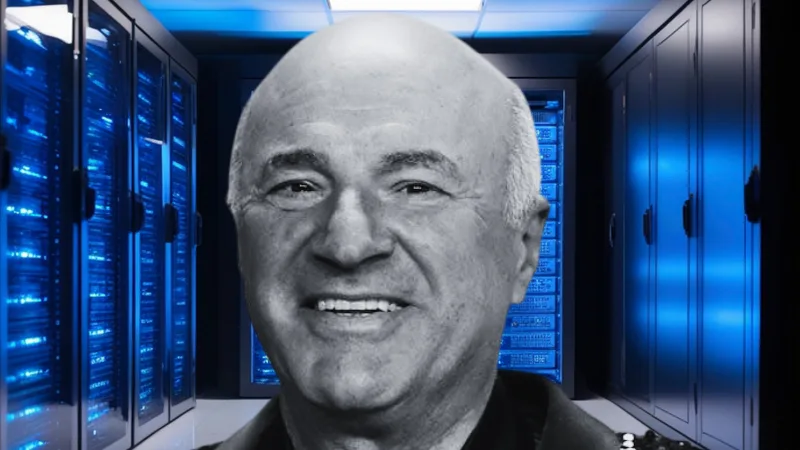
The proposed 40,000-acre “Stratos Project” in western Utah, backed by O’Leary Digital, is a direct signal that the AI arms race is entering a new phase where who controls power generation may matter more than who builds the best models.
That is the real story.
For the past two years, Wall Street has largely treated AI as a semiconductor trade led by companies like Nvidia, Advanced Micro Devices, Microsoft, Amazon, and Alphabet.
That trade may now be entering its next chapter:
The infrastructure war.
And this war is far more capital intensive, politically sensitive, and potentially lucrative for investors willing to look beyond obvious AI names.
O’Leary’s Utah project is one of the clearest signs yet that America’s next trillion-dollar investment boom may center around power, land, cooling systems, utilities, natural gas infrastructure, nuclear development, and rural real estate.
That’s where investors should be paying attention.
What Actually Happened
O’Leary appeared before Utah’s Military Installation Development Authority (MIDA) to push forward approvals for what could become one of North America’s largest AI infrastructure developments.
The project includes:
- 40,000 acres of land
- Up to 7.5 gigawatts of planned power capacity
- Massive hyperscale data centers
- Advanced manufacturing facilities
- Housing developments
- Commercial infrastructure
- On-site energy development
To put this in perspective:
The entire state of Utah consumes roughly 4 gigawatts annually.
This project alone could eventually require nearly double that amount.
That should immediately get investors’ attention.
The MIDA board approved multiple resolutions helping move the project forward, including aggressive tax incentives:
- 100% personal property tax rebates for data center infrastructure
- Reduced real property taxes
- Major reductions in energy-use taxes
- Additional regulatory support
Utah officials are effectively signaling:
We want this project badly.
And states across America may soon copy that playbook.
AI Is Becoming an Energy Story
Wall Street continues obsessing over chipmakers.
That may be yesterday’s trade.
The next bottleneck in AI is increasingly clear:
Electricity.
Every major AI company needs dramatically more compute power.
That means they need:
- More GPUs
- More data centers
- More cooling systems
- More transmission lines
- More natural gas
- More nuclear energy
- More water infrastructure
That demand is becoming extreme.
According to University of Southern California energy experts cited in Utah discussions:
- AI data centers consume 8 to 10 times more power than traditional facilities
- The U.S. already has roughly 3,000 operating data centers
- Another 75 gigawatts of utility power demand is expected by 2028
That is enormous.
For comparison:
75 gigawatts is larger than the annual electricity consumption of many countries.
This explains why companies are increasingly trying to secure power directly rather than relying on overloaded grids.
We are watching AI companies evolve from software businesses into quasi-utilities.
That shift changes everything.
The AI Infrastructure Stack
Investors need a better framework for understanding where capital may flow next.
Here’s the AI Infrastructure Stack:
Layer 1: Semiconductor Winners
These remain obvious beneficiaries:
- Nvidia
- Advanced Micro Devices
- Broadcom
These companies still matter.
But they’re crowded trades.
Layer 2: Hyperscalers
These firms need massive compute expansion:
- Microsoft
- Amazon
- Alphabet
- Meta Platforms
They may increasingly pursue direct power deals.
Layer 3: Utility Beneficiaries
This area gets less attention.
Potential beneficiaries include:
- Constellation Energy
- Vistra Corp.
- NextEra Energy
- Duke Energy
Power demand growth could dramatically improve pricing power.
Layer 4: Natural Gas Infrastructure
O’Leary specifically referenced Utah’s access to major natural gas pipelines.
That matters.
Potential beneficiaries include:
- Kinder Morgan
- Williams Companies
- Energy Transfer
Natural gas may become AI’s bridge fuel.
Layer 5: Nuclear and Geothermal
This may be the biggest long-term wildcard.
Utah’s “Operation Gigawatt” initiative explicitly references nuclear and geothermal growth.
Watch:
- Oklo Inc.
- NuScale Power
- Cameco
Small modular reactor speculation could intensify.
Layer 6: Water and Cooling Infrastructure
This is the overlooked trade.
AI facilities consume enormous amounts of water.
Watch industrial cooling and infrastructure firms like:
- Xylem
- Ecolab
Why Utah Could Become America’s Unexpected AI Hub
Most investors think AI infrastructure will cluster in Silicon Valley.
That may be wrong.
Utah offers several advantages:
Cheaper land
40,000 acres would be almost impossible to secure near major urban tech hubs.
Faster permitting
O’Leary directly said speed matters.
States that move quickly may attract billions.
Political alignment
Utah leadership appears highly motivated to become an AI hub.
Spencer Cox publicly backed the project.
Energy ambitions
Utah wants to double power production through “Operation Gigawatt.”
That aligns perfectly with AI demand.
National security angle
O’Leary repeatedly framed AI development as competition with China.
That argument could unlock federal support.
Who Really Benefits?
Many investors assume massive AI infrastructure spending automatically benefits Big Tech.
That assumption deserves skepticism.
These projects are extraordinarily expensive.
Margins could come under pressure.
Cloud providers may face:
- Higher electricity costs
- Rising land prices
- Regulatory pushback
- Water restrictions
- Longer development timelines
The companies enabling the boom may actually outperform the companies leading the headlines.
That happened during prior commodity booms.
Sometimes the people selling picks and shovels win bigger than the miners.
AI may follow that pattern.
What Investors Should Watch Next
Federal AI infrastructure policy
Washington may begin treating AI infrastructure like defense infrastructure.
Nuclear approvals
Watch for accelerated small modular reactor approvals.
Utility earnings calls
Expect more mentions of AI-related electricity demand.
Rural land values
Land near energy corridors may become increasingly valuable.
Water regulation
This could become a major growth bottleneck.
Private equity expansion
Infrastructure funds may aggressively pursue similar projects.
Blackstone, Brookfield Asset Management, and KKR could all become larger players.
Bottom Line
Kevin O’Leary’s Utah project is easy to dismiss as another flashy megaproject headline.
That would be a mistake.
This project exposes where the AI trade is heading next.
The market spent two years chasing chip stocks.
The next decade may belong to investors who understand the businesses powering AI’s physical backbone:
Energy
Utilities
Natural gas
Nuclear
Water infrastructure
Industrial real estate
That’s where the bottlenecks are forming.
And bottlenecks often create the biggest investment opportunities.
About Author