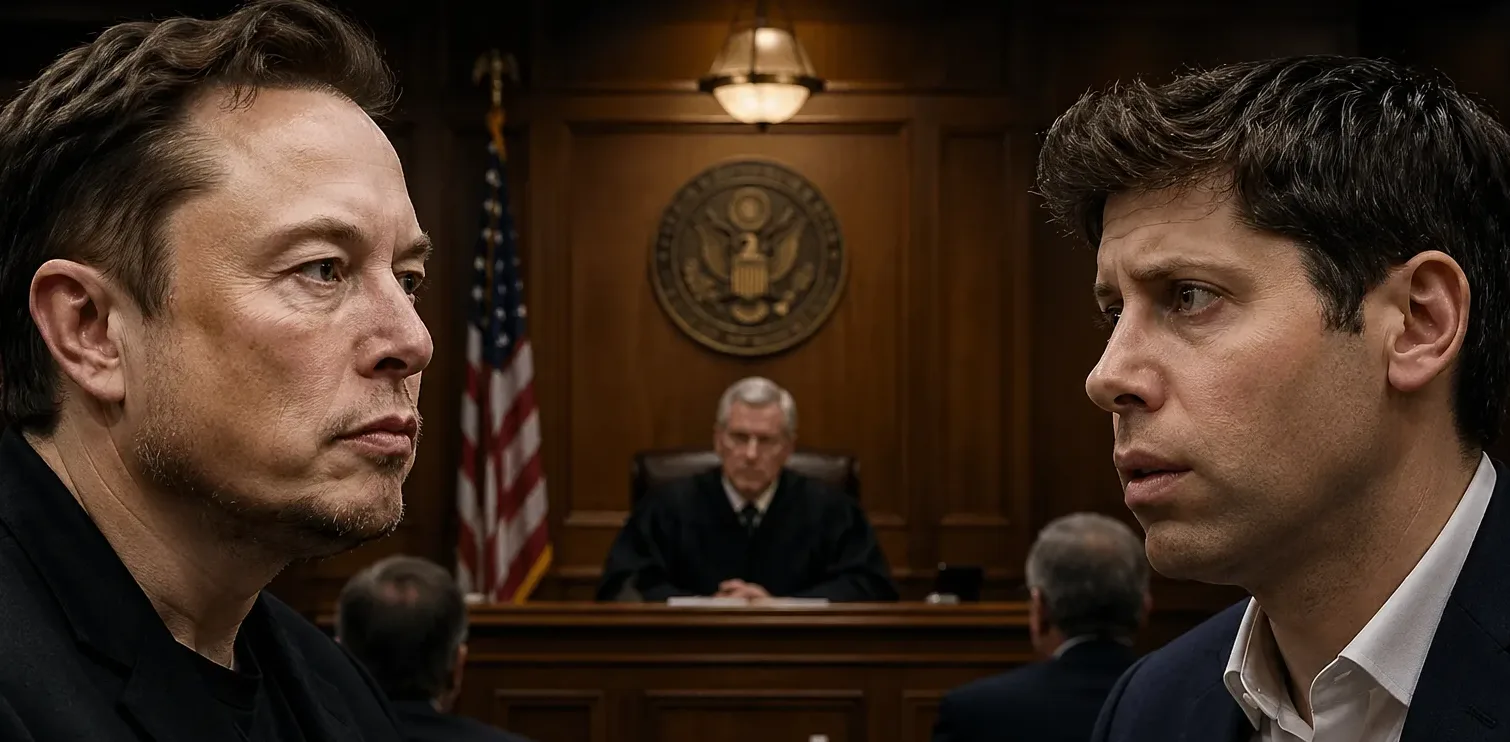
Elon Musk just dropped fraud claims against Sam Altman and Greg Brockman days before trial. At first glance, that looks like a retreat. Wall Street may read it as Musk blinking.
That would be a mistake.
The bigger story is that Musk may have made his case more dangerous by stripping away the noisy allegations and forcing the courtroom to focus on a far more uncomfortable question for OpenAI, Microsoft, and the broader AI sector:
Did OpenAI abandon its original nonprofit mission to become one of the largest wealth creation vehicles in Silicon Valley history?
That question matters far beyond courtroom drama between Musk and Altman. It touches valuation models, regulatory risk, AI infrastructure spending, private market exits, and whether investors are massively underpricing governance risk in the AI boom.
And if this trial exposes ugly internal details, it could become one of the most important AI-related legal events of 2026.
What Actually Happened
Elon Musk voluntarily dropped fraud and constructive fraud claims against OpenAI ahead of trial, according to court filings approved by U.S. District Judge Yvonne Gonzalez Rogers.
The trial will now focus on two major claims:
- Breach of charitable trust
- Unjust enrichment
Musk argues that OpenAI was originally created as a nonprofit organization designed to develop artificial intelligence for humanity’s benefit. He claims that leadership later shifted toward aggressive monetization and private enrichment.
OpenAI strongly disputes that narrative and has argued Musk previously supported structural changes before leaving the company.
Jury selection begins Monday. Opening arguments are expected Tuesday. Musk is reportedly seeking up to $134 billion in damages, though he has said any winnings would go toward OpenAI’s charitable mission rather than personal gain.
This legal fight arrives as OpenAI continues scaling at a breathtaking pace.
The company recently raised capital at valuation levels that place it among the most valuable private companies in the world. It remains deeply tied to Microsoft through cloud infrastructure partnerships while also competing in an increasingly brutal AI arms race against:
- xAI
- Anthropic
- Meta Platforms
- Amazon
That is why this case matters.
The Hidden Story: This Trial Is Really About AI’s Business Model
Most headlines are treating this like billionaire soap opera content.
That misses what investors should care about.
This case is forcing public scrutiny on the economic model powering the AI boom.
For years, investors largely accepted the following story:
- Build powerful AI models
- Burn enormous amounts of capital
- Capture enterprise customers
- Reach monopoly-like economics later
That story only works if investors trust the governance structures behind these companies.
OpenAI’s original nonprofit framework helped build trust.
It told regulators, employees, and the public:
“We are building this responsibly.”
Now critics argue that framework may have helped OpenAI attract talent, goodwill, and funding before eventually evolving into a highly commercial enterprise.
If Musk successfully proves OpenAI improperly shifted its mission, it could trigger:
- Greater regulatory oversight
- New restrictions on AI corporate structures
- Increased investor due diligence demands
- Delays to potential liquidity events
- Pressure on other AI firms with unusual governance frameworks
That could reshape how capital flows into AI startups.
Why This Matters for Investors
1. Microsoft Has Quiet Exposure
Microsoft remains one of OpenAI’s biggest strategic partners.
Its cloud infrastructure through Microsoft Azure powers major portions of OpenAI’s growth.
If the trial creates structural uncertainty around OpenAI:
- Microsoft’s AI monetization timeline could slow
- Azure growth expectations could face pressure
- Enterprise adoption could temporarily pause
This probably won’t derail Microsoft long term.
But investors treating OpenAI exposure as pure upside should understand the legal risk.
2. Nvidia Still Wins Either Way
Nvidia remains one of the safest picks in the AI arms race.
Why?
Every major AI player still needs chips.
Even if OpenAI stumbles:
- xAI spends more
- Meta spends more
- Google spends more
- Sovereign governments spend more
The compute war continues.
That makes Nvidia one of the most insulated names from this legal drama.
3. IPO Markets Could Get Messier
Private AI companies have been pricing themselves aggressively.
Some investors expect OpenAI to eventually pursue an IPO path.
This trial could delay that timeline if governance concerns escalate.
That matters for venture funds, private equity firms, and retail investors hoping for AI IPO opportunities.
4. Secondary AI Players Could Benefit
If OpenAI emerges damaged:
Anthropic may gain enterprise clients.
Google could benefit from stronger demand for Gemini.
Meta Platforms may gain momentum through open-source AI initiatives.
Amazon could strengthen enterprise cloud relationships.
Market leaders can lose share faster than investors expect when trust gets damaged.
The AI Governance Risk Ladder
Here’s a simple framework investors can use:
Level 1: Product Risk
Can the model compete?
Level 2: Infrastructure Risk
Can the company afford compute costs?
Level 3: Regulatory Risk
Will governments intervene?
Level 4: Governance Risk
Can leadership be trusted?
Most investors focus heavily on Levels 1 and 2.
Smart money increasingly watches Levels 3 and 4.
This trial pushes governance risk into the spotlight.
And governance failures often destroy valuations faster than product failures.
Look at:
WeWork
FTX
Theranos
Different industries. Same lesson.
Narratives can collapse quickly when governance cracks appear.
The Contrarian Take
Most investors assume legal drama helps OpenAI competitors.
That may be wrong.
This trial could actually strengthen OpenAI.
Why?
If OpenAI survives intense scrutiny and wins convincingly:
- Institutional trust improves
- IPO odds increase
- Competitor narratives weaken
- Altman emerges stronger
That would make OpenAI even more dominant.
Sometimes surviving a public attack makes a company stronger than avoiding one.
Watch how institutional capital reacts after the trial.
That will matter more than headlines.
What Investors Should Watch Next
Trial testimony
Internal emails and communications could move sentiment fast.
Microsoft commentary
Watch earnings calls for any shifts in AI commentary.
Regulatory response
Washington may take greater interest in AI governance structures.
Private AI funding rounds
Watch whether valuations cool.
xAI fundraising
xAI may benefit if investors want an alternative narrative.
AI chip demand
Nvidia remains a major signal.
Bottom Line
This case is being framed as Musk vs Altman.
That is surface-level thinking.
The real issue is whether AI’s most powerful companies can promise one mission while operating under another reality.
That question could impact trillions in future AI investment.
Investors chasing AI momentum should pay close attention.
Because the biggest risk in AI may no longer be technological failure.
It may be governance failure hiding behind explosive growth.
About Author