The automaker is recalling more than 421,000 vehicles in the United States after regulators discovered a software defect that could cause certain Hyundai models to brake unexpectedly, raising the risk of rear-end crashes and creating another headache for an auto industry already under pressure from rising costs, recalls, and slowing consumer demand.
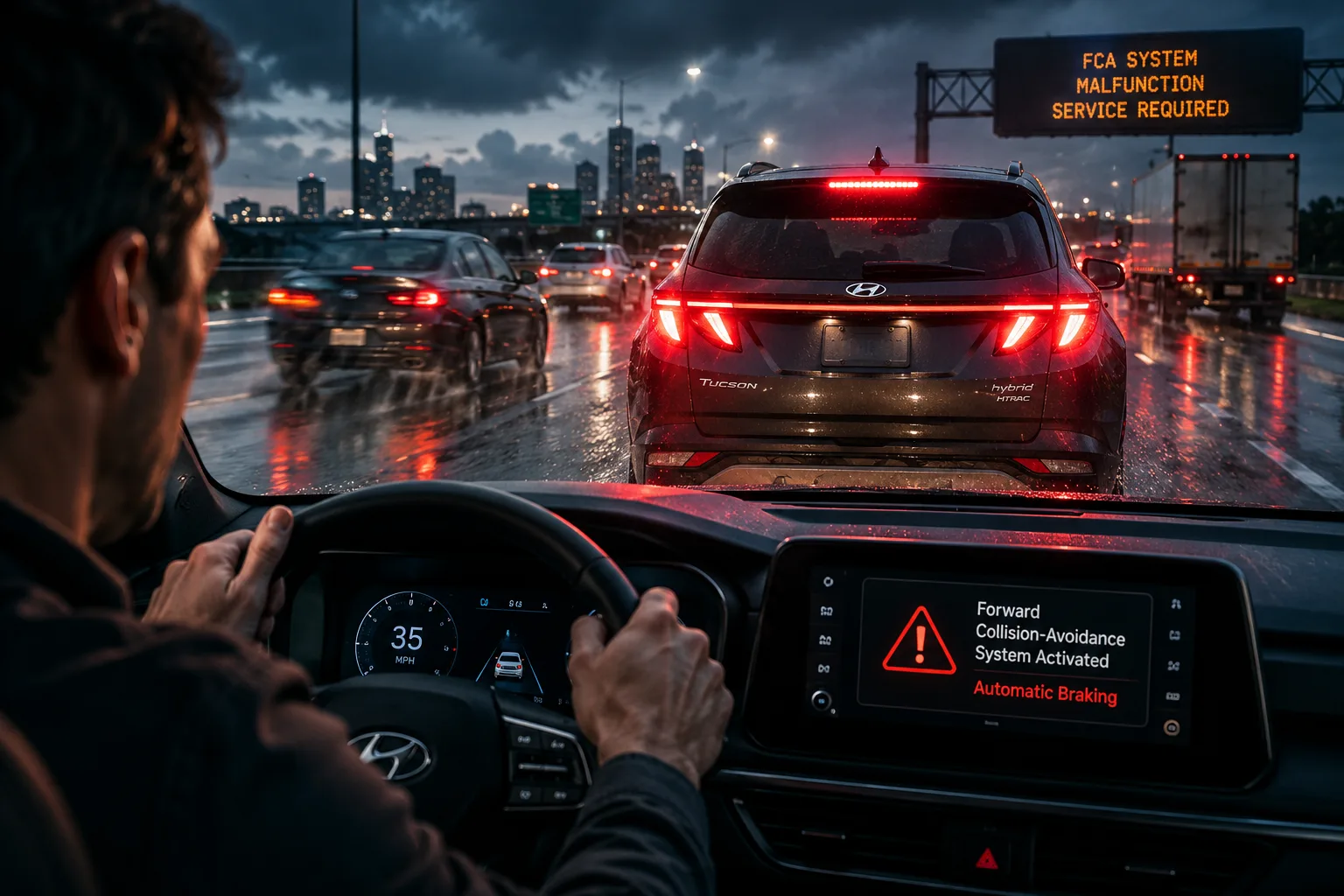
According to the National Highway Traffic Safety Administration, the issue involves the vehicles’ Forward Collision-Avoidance (FCA) system, which may incorrectly trigger emergency braking because of a software problem tied to the front camera system.
That means drivers could suddenly experience hard braking even when no obstacle is present.
For investors, this recall matters for far more than just repair costs.
It highlights the growing hidden risk inside modern vehicles: software complexity.
Automakers are no longer just manufacturing engines, transmissions, and body panels. They are now operating as rolling software companies, where a coding error can suddenly create legal liabilities, regulatory scrutiny, reputational damage, and rising warranty expenses across hundreds of thousands of vehicles.
And that trend is accelerating.
The Recall Hits Some of Hyundai’s Most Important Vehicles
The recall affects several of Hyundai’s most commercially important models, including:
- 2025–2026 Hyundai Santa Cruz
- 2025–2026 Hyundai Tucson
- 2025–2026 Hyundai Tucson Hybrid
- 2025–2026 Hyundai Tucson Plug-In Hybrid
These are not niche vehicles.
The Tucson lineup has become one of Hyundai’s strongest-performing product families in North America, especially as consumers continue shifting toward SUVs and hybrid models.
That makes this recall more significant than a small-volume defect involving specialty vehicles.
According to regulators, Hyundai received 376 reports between October 2024 and April 2026 related to Forward Collision-Avoidance system behavior.
Among those reports were four crashes in which Hyundai vehicles were rear-ended after allegedly braking unexpectedly. Regulators said four injuries were reported.
While four injuries may appear limited compared to the scale of the recall, the bigger concern is the pattern regulators are seeing.
Unexpected braking incidents tied to driver-assistance systems have become an increasingly sensitive issue across the auto industry.
The Auto Industry’s Software Problem Keeps Growing
Modern vehicles now contain tens of millions of lines of code.
Some luxury and electric vehicles contain more software code than advanced military aircraft.
That has fundamentally changed the risk profile for automakers.
In the past, recalls were often mechanical:
- Faulty airbags
- Defective fuel pumps
- Transmission failures
- Steering issues
Now software bugs are increasingly triggering recalls.
And software recalls carry a unique danger.
Mechanical defects are often isolated and physically understood. Software defects can behave unpredictably, spread across multiple systems, and sometimes remain hidden until vehicles accumulate millions of miles of real-world driving data.
That creates uncertainty regulators hate.
It also creates liability risk investors often underestimate.
The Hyundai recall follows years of growing scrutiny around automated braking systems, adaptive cruise control, lane-keeping systems, and semi-autonomous driving technology.
Consumers increasingly assume these systems make vehicles safer.
But regulators are becoming more focused on situations where safety systems themselves create hazards.
Automated Safety Systems Are Becoming a Double-Edged Sword
One of the hidden tensions inside the automotive industry is that automakers are under enormous pressure to advertise advanced safety technology while simultaneously trying to avoid overpromising what the systems can actually do.
Consumers hear phrases like:
- Collision avoidance
- Driver assistance
- Autonomous safety
- Smart braking
- AI-powered driving
But many drivers misunderstand the limits of the technology.
That creates dangerous behavioral changes.
Some drivers become overly dependent on automated systems. Others react unpredictably when systems behave unexpectedly.
Phantom braking has emerged as one of the biggest complaints surrounding advanced driver-assistance systems industrywide.
Unexpected braking can become especially dangerous at highway speeds or in heavy traffic, where following vehicles may have little time to react.
The Hyundai recall shows the issue is not isolated to one automaker.
This has become a broader industry challenge.
A Hidden Cost Investors Often Miss
Many investors focus heavily on:
- EV sales
- vehicle deliveries
- battery costs
- tariffs
- interest rates
But software reliability may become one of the most important competitive advantages of the next decade.
The automakers that master software stability could eventually command stronger margins and better consumer loyalty.
The ones that struggle may face:
- Higher recall expenses
- More lawsuits
- Higher insurance-related costs
- Increased regulatory intervention
- Weaker resale values
This is one reason why some analysts increasingly compare modern automakers to technology companies rather than traditional manufacturers.
Software execution now directly impacts profitability.
That shift is changing how Wall Street values automotive companies.
What Happens Next
Hyundai says owners will begin receiving notification letters by July 17.
Dealers will update the front camera software free of charge.
The company has not announced any fatalities connected to the issue.
Still, investors should watch several developments closely:
- Whether additional crashes are reported
- Whether regulators expand scrutiny into Hyundai’s driver-assistance systems
- Whether similar software issues emerge in other Hyundai or Kia vehicles
- Whether recall-related costs begin impacting earnings guidance
Investors should also pay attention to a broader macro trend developing across the auto industry.
As vehicles become more software-driven, recalls tied to coding errors, AI systems, sensors, and automation features may become far more common.
That could reshape:
- Insurance costs
- Consumer confidence
- Regulatory policy
- Vehicle valuation models
- Auto-sector profitability
The industry’s future increasingly depends not only on building cars that drive well, but on building software that behaves predictably under real-world conditions.
And that may prove much harder than many automakers initially expected.
About Author