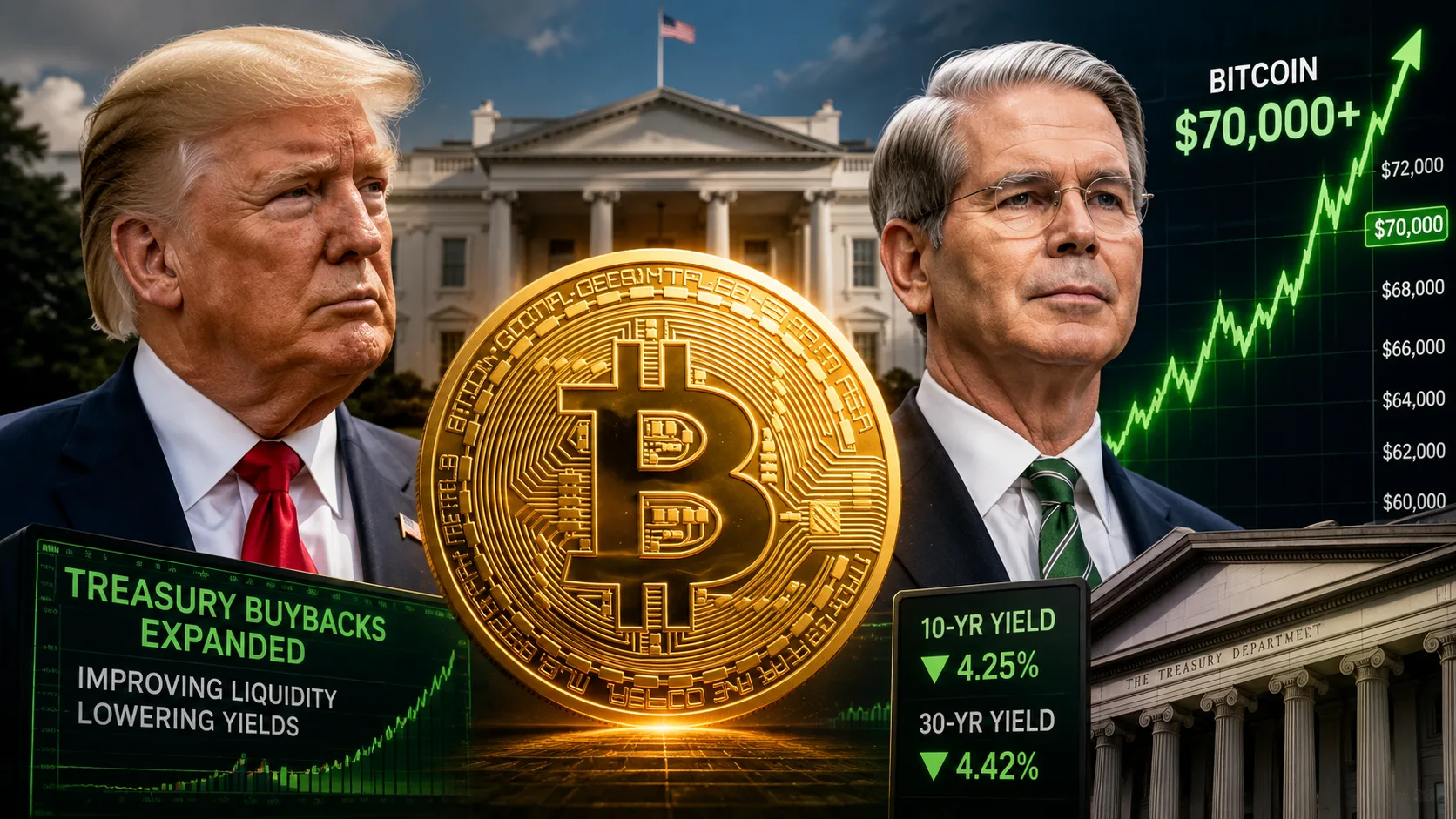
Bitcoin has surged back above $70,000 in one of its strongest rallies of 2026, but President Donald Trump’s White House meeting with cryptocurrency executives is only part of the story. A shift in the Treasury market, improving regulatory expectations and a massive short squeeze all hit within roughly the same window, creating an unusually powerful combination of catalysts. For investors, the question now is whether this is a temporary burst of forced buying—or the beginning of a more durable Bitcoin recovery.
Bitcoin bulls suddenly have something they have been missing for much of the summer: momentum.
The world’s largest cryptocurrency surged more than 10% over a two-day period, climbing above $70,000 and reaching its highest level since early June. The rally spread well beyond Bitcoin. Ether jumped sharply, while Solana, XRP, Dogecoin and other major cryptocurrencies also participated as money rushed back into digital assets. (Forbes)
At first glance, the explanation appears obvious. President Donald Trump hosted cryptocurrency executives at the White House Wednesday and urged Congress to advance legislation intended to give the industry greater regulatory certainty. Bitcoin accelerated around the same period, making Trump’s meeting an obvious catalyst.
But attributing the entire rally to Trump misses a much bigger story.
A significant Treasury-market development improved the backdrop for financial assets just as Washington delivered several crypto-friendly regulatory signals. Bitcoin then broke important technical levels, trapping traders who had positioned for additional declines and forcing many of them to buy back their bearish bets.
Put simply, Treasury developments improved the macro environment, Trump and Washington strengthened the bullish narrative, and a massive short squeeze supplied the fuel.
Understanding that combination could help investors determine whether Bitcoin’s rally has staying power.
Trump’s White House Crypto Meeting Was an Important Catalyst
Trump met Wednesday with influential figures from cryptocurrency and traditional finance, including executives from Coinbase, Robinhood, Kraken and Intercontinental Exchange. Senior financial regulators were also represented, underscoring how deeply digital assets have moved into mainstream U.S. financial-policy discussions.
Trump used the gathering to renew his push for the Digital Asset Market Clarity Act, commonly called the CLARITY Act. The legislation seeks to establish clearer rules for digital assets, including determining when tokens fall under securities or commodities regulation and which federal agencies have authority over different parts of the market.
That may sound like a technical regulatory issue, but it has enormous implications for investors.
Regulatory uncertainty has long been one of the biggest obstacles preventing deeper institutional participation in digital assets. Banks, asset managers and financial institutions want predictable rules governing custody, trading, token classification and compliance before committing significant amounts of capital.
Federal legislation could provide greater permanence than regulations that can change substantially from one administration to another. That potentially reduces one of the risks facing institutions considering larger investments in cryptocurrency.
Trump’s meeting therefore delivered something beyond another pro-Bitcoin speech. It reinforced the perception that the administration wants digital assets integrated more deeply into America’s financial system and views cryptocurrency partly through the lens of international economic competition.
For investors, however, the timing is important. Bitcoin’s rally was already developing alongside another event with implications extending far beyond cryptocurrency.
The Treasury Market May Be the Bigger Story
While crypto investors focused on Trump’s White House meeting, bond traders were watching developments in the enormous U.S. Treasury market.
The Treasury moved to expand buybacks of longer-dated government securities, increasing the maximum size of certain operations from roughly $2 billion to at least $4 billion. The move came after significant pressure on longer-term government bonds and was viewed as an effort to improve liquidity and functioning in the Treasury market.
The announcement helped spark a broader market reaction. Bonds strengthened, yields eased, stocks moved higher, gold rallied and Bitcoin surged. That cross-asset response is important because it suggests Bitcoin’s move wasn’t simply the product of cryptocurrency-specific news.
Treasury buybacks should not be confused with Federal Reserve quantitative easing. The Treasury isn’t simply printing money and injecting it into Bitcoin or stocks. But the market’s reaction still tells investors something important about the environment surrounding risk assets.
Bitcoin has become increasingly sensitive to liquidity, interest rates and the U.S. dollar. When Treasury yields rise sharply, investors can earn relatively attractive returns from government securities while taking substantially less risk than they would owning cryptocurrency. Higher yields can therefore create competition for speculative assets.
When yields decline and bond-market stress eases, the equation can change. Investors may become more willing to move capital toward assets with greater potential upside.
Bitcoin can also benefit when investors become concerned about government borrowing, currency purchasing power or long-term monetary conditions. That helps explain why Bitcoin and gold sometimes rally simultaneously despite being very different assets.
The fact that Bitcoin, gold, stocks and bonds all responded positively around the Treasury announcement is therefore a major clue about what drove this rally. A broader shift in financial conditions was occurring at almost exactly the same time as Trump’s crypto gathering.
Washington Is Sending Multiple Pro-Crypto Signals
Trump’s White House meeting also didn’t happen in isolation.
The Securities and Exchange Commission had already taken steps toward creating a more tailored regulatory environment for certain digital assets. That added to the broader perception that Washington’s stance toward cryptocurrency has changed dramatically from only a few years ago.
Investors effectively received several potentially bullish signals close together: regulators appeared increasingly open to crypto-specific frameworks, industry executives gained direct access to the White House, and Trump publicly pressured Congress to advance market-structure legislation.
The message to Wall Street is increasingly clear: cryptocurrency is becoming part of the established U.S. financial system rather than something operating entirely outside it.
There is an important caveat. The CLARITY Act still faces political obstacles, meaning the market is trading partly on expectations rather than completed legislation. Crypto-friendly rhetoric can lift sentiment immediately, but investors ultimately need to see whether Congress can turn that optimism into law.
That distinction will become increasingly important if Bitcoin continues rising.
The Short Squeeze Turned the Rally Into an Explosion
The macroeconomic and political developments explain why investors became more optimistic. They don’t fully explain why Bitcoin moved so violently.
For that, investors need to look at positioning.
Bitcoin had been under considerable pressure before the rally. After falling substantially from its 2025 highs, the cryptocurrency spent much of the summer struggling to regain momentum. Traders betting on additional weakness accumulated short positions.
Then the market moved against them.
As Bitcoin climbed on the Treasury and regulatory news, bearish positions began losing money. Once Bitcoin broke through technical resistance, leveraged short sellers increasingly faced margin calls and liquidations.
Closing a Bitcoin short generally requires buying Bitcoin back. That creates a feedback loop: Bitcoin rises, shorts lose money, traders are forced to buy, that buying pushes Bitcoin higher, and still more bearish positions are liquidated.
Roughly $1.9 billion in cryptocurrency positions were liquidated over a 24-hour period, with shorts representing the large majority, according to CoinGlass data cited by Blockhead. (Blockhead)
That helps explain why Bitcoin didn’t merely gain 2% or 3% following positive news.
The news lit the match. Leverage poured gasoline on it.
This is also one of the most important factors for investors trying to determine what happens next.
Can Real Demand Replace Forced Buying?
Short squeezes can produce extraordinary price gains, but forced buying eventually ends. Once vulnerable short positions have been liquidated or closed, Bitcoin needs genuine demand from investors willing to purchase it at the new, higher price.
That makes the next phase of trading more important than the initial surge.
If Bitcoin can remain around or above the upper-$60,000 to $70,000 region after liquidations fade, it would suggest that fresh capital is supporting the breakout. Stronger institutional buying, positive fund flows and investors consistently purchasing dips would make the rally more convincing.
If Bitcoin rapidly falls back once short covering disappears, the move may have been more mechanical than fundamental.
That doesn’t make the rally meaningless. A short squeeze can still mark an important market turning point. But investors shouldn’t assume that an explosive two-day move automatically means a new Bitcoin bull market has begun.
The market now needs confirmation.
Bitcoin’s Technical Breakout Matters
The rally also attracted attention because Bitcoin broke through levels that had constrained it for weeks.
Bitcoin moved rapidly from the mid-$60,000 range toward $70,000, breaking technical resistance and closely watched moving averages along the way. These levels matter because cryptocurrency markets contain significant amounts of momentum, algorithmic and leveraged trading.
When an asset breaks a major resistance level, traders waiting for confirmation can begin buying. Automated strategies can respond as well. Meanwhile, short sellers may simultaneously rush toward the exit.
That can create another reinforcing cycle: fundamental news pushes Bitcoin higher, the move breaks technical resistance, momentum traders enter, shorts are squeezed and the additional buying produces another breakout.
This is one reason cryptocurrency markets can move much faster than traditional assets.
Ethereum and Altcoins Add Another Signal
Bitcoin wasn’t alone in the rally. Ether climbed dramatically, while Solana, XRP, Dogecoin and other major cryptocurrencies also moved higher.
That breadth is worth watching. When Bitcoin rises while the rest of crypto remains weak, investors can question whether demand is concentrated in a single asset. When capital begins flowing across the cryptocurrency complex, it can signal a broader increase in investor risk appetite.
However, the same caution applies. More speculative cryptocurrencies are particularly sensitive to leverage and positioning, meaning their dramatic gains don’t necessarily indicate equally dramatic improvements in their underlying fundamentals.
For investors, the broad rally is encouraging but it isn’t proof that the crypto market has entered another sustained bull cycle.
So, Did Trump Cause Bitcoin to Surge?
Yes, but only partially.
Trump’s White House meeting clearly mattered. Bringing major cryptocurrency executives together with senior financial officials sent a powerful symbolic message, while his push for the CLARITY Act reinforced expectations that the administration intends to maintain a crypto-friendly policy direction.
But politics alone doesn’t explain the magnitude of Bitcoin’s move.
A better interpretation is that several forces aligned almost simultaneously. Treasury developments improved financial conditions. Washington strengthened expectations for a more favorable regulatory environment. Bitcoin broke important technical levels. Traders positioned for further declines were then forced to cover, turning an ordinary rally into an extraordinary one.
The Treasury development was the macro catalyst.
Trump and Washington provided the policy catalyst.
The technical breakout provided the market signal.
The short squeeze became the accelerant.
That combination is much more significant than a simple “Bitcoin rises after Trump meeting” headline suggests.
What Investors Should Watch Next
The first thing investors should watch is whether Bitcoin can hold the breakout zone after the excitement subsides. Staying near or above $70,000 would suggest buyers are willing to support substantially higher prices. A rapid decline back through the upper-$60,000 range would increase concerns that forced buying drove too much of the move.
Treasury yields are another critical indicator. If longer-term yields resume climbing aggressively, financial conditions could again become less supportive for Bitcoin and other risk assets. If yields stabilize or decline, the macro backdrop could remain favorable.
Investors should also watch Washington. Trump’s rhetoric is clearly supportive of cryptocurrency, but legislation matters more than speeches. Progress on the CLARITY Act or other digital-asset legislation could reinforce the argument that regulatory risk is structurally declining.
Finally, watch institutional demand. A short squeeze can launch a rally, but sustained institutional buying is what can transform it into a longer-term trend.
The Bigger Bitcoin Story
Perhaps the most important takeaway isn’t whether Bitcoin trades at $68,000, $72,000 or $75,000 tomorrow.
The larger story is how deeply Bitcoin has become intertwined with Washington, Wall Street and global financial conditions.
Bitcoin spent much of its early history outside the traditional financial establishment. Today, major financial institutions offer cryptocurrency products, regulators are building specialized digital-asset frameworks, Congress is debating comprehensive legislation, and cryptocurrency executives are meeting directly with the president.
At the same time, Bitcoin increasingly responds to many of the same macroeconomic forces that influence stocks, bonds, currencies and gold.
Bitcoin isn’t simply trading on Bitcoin news anymore.
For long-term investors, that evolution could ultimately matter more than any single White House meeting.
Bottom Line for Investors
President Trump’s crypto meeting helped drive Bitcoin higher, but Trump alone doesn’t explain the rally.
The stronger explanation is that multiple bullish forces converged at nearly the same time: Treasury developments eased pressure in the bond market, Washington delivered increasingly crypto-friendly policy signals, Trump renewed his push for clearer cryptocurrency regulation, Bitcoin broke technical resistance and a heavily bearish derivatives market produced a massive short squeeze.
The result was an unusually powerful Bitcoin rally.
Now comes the more important test.
If Bitcoin can hold its breakout after forced short covering fades and particularly if institutional demand strengthens—the market may be signaling that something more durable is developing.
If prices quickly retreat once the squeeze runs its course, investors may discover that the rally was driven more by positioning than by a fundamental change in demand.
Either way, the surge has delivered an important message: Bitcoin is increasingly being shaped by U.S. financial policy, regulation, institutional capital and global macroeconomic conditions simultaneously.
The question is no longer why Bitcoin suddenly jumped.
The question is whether enough real buyers are waiting behind the short sellers to keep it there.
About Author