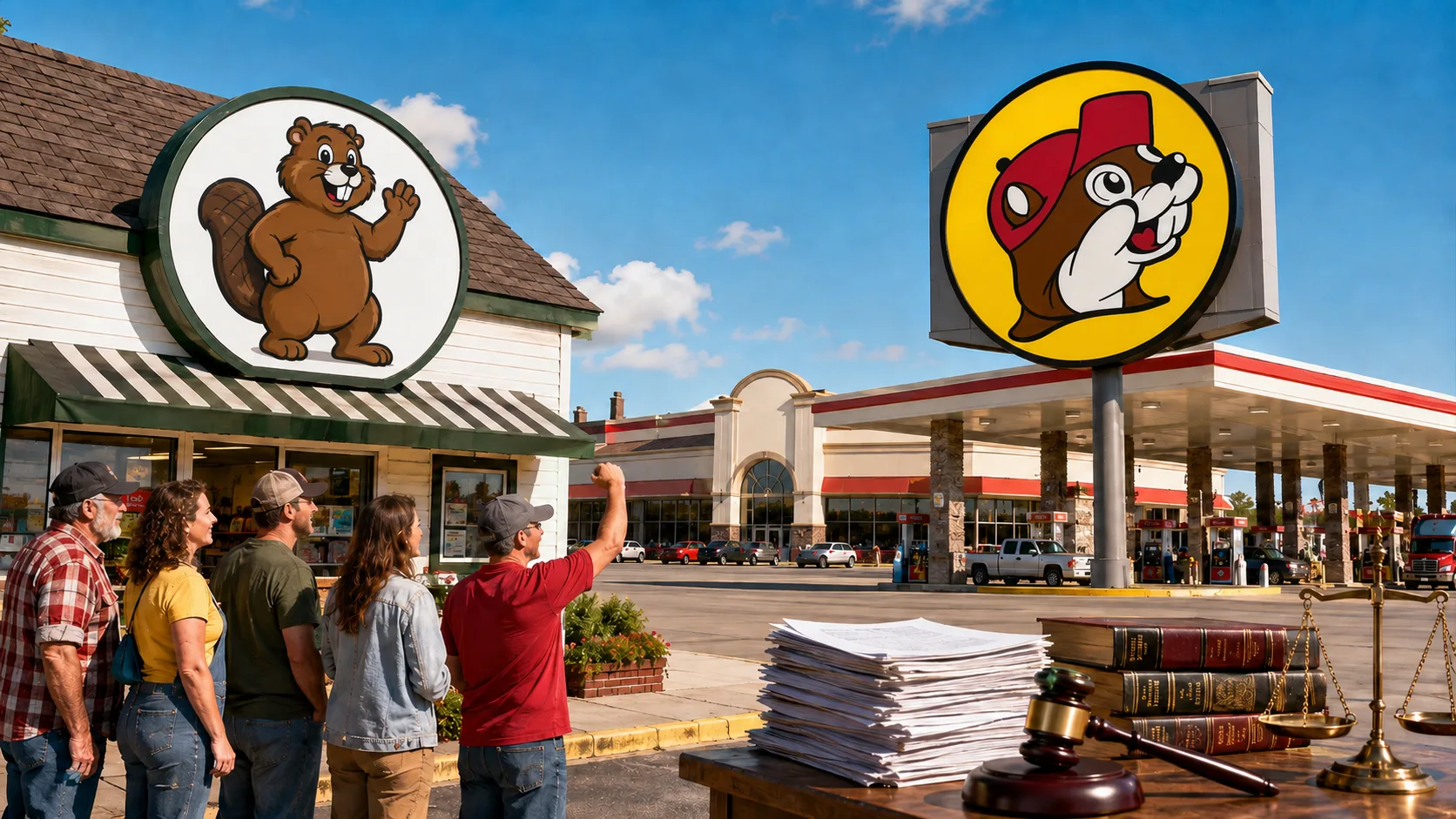
Buc-ee’s built one of America’s strongest retail brands around clean bathrooms, oversized travel centers and a smiling beaver. Its latest effort to protect that beaver is now threatening the customer goodwill that made the mascot so valuable.
The Beaver Battle Spreading Across Ohio
Buc-ee’s filed a federal trademark infringement lawsuit against Hanes Road Carryout Inc., which operates Beaver’s Mini Mart in Beavercreek, Ohio, on July 28.
The Texas-based travel center chain argues that the neighborhood store’s name and cartoon beaver logo are similar enough to make customers believe the businesses are connected. Both companies operate convenience stores, both use smiling beavers and both feature red prominently in their branding.
The similarities largely end there.
Buc-ee’s logo shows the head of a buck-toothed beaver wearing a red baseball cap inside a yellow circle. Beaver’s Mini Mart uses a full-body beaver waving beside the store’s name.
Their physical operations are even further apart.
Beaver’s Mini Mart occupies a small building at a suburban intersection. The first Ohio Buc-ee’s, which opened in April near Dayton, covers approximately 74,000 square feet and includes more than 100 gas pumps, 24 electric vehicle chargers and 700 parking spaces.
Buc-ee’s is asking a federal court to stop the mini mart from using its current branding. The complaint also seeks the destruction of allegedly infringing materials, financial damages, attorneys’ fees and any profits connected to the disputed marks. Buc-ee’s has requested a jury trial.
The lawsuit remains in its early stages, and the court has made no determination that Beaver’s Mini Mart infringed any Buc-ee’s trademark.
Buc-ee’s Has a Real Trademark Argument
The public reaction has largely portrayed the dispute as a national chain bullying a neighborhood store. Trademark law is more complicated.
Buc-ee’s has spent decades turning its beaver into a recognizable commercial asset. The mascot appears on stores, billboards, clothing, food, drinkware and other merchandise. The company argues that its marks are valuable because customers immediately associate the beaver with a particular retail experience.
Federal trademark protection also extends beyond exact copies. According to the U.S. Patent and Trademark Office, two marks can create a likelihood of confusion when they are similar in appearance, sound, meaning or overall commercial impression and are used for related goods or services.
That gives Buc-ee’s a credible basis for raising the issue. Both businesses operate in the convenience-store category and use cheerful cartoon beavers.
Buc-ee’s says the timeline also matters.
Hanes Road Carryout was incorporated in 2017, but public records cited by Buc-ee’s show that the business registered the Beaver’s Mini Mart trade name in October 2025 and adopted that name in January 2025. Buc-ee’s had broken ground on its nearby Ohio travel center several months earlier.
The company says it attempted to contact the mini mart’s owner repeatedly before suing. Beaver’s Mini Mart has disputed aspects of that account and maintains that its branding represents its connection to Beavercreek.
Those competing claims could make the timing of commercial use important. Registration dates matter, but courts can also examine when and where a mark was actually used in business.
The Legal Strategy Created a Bigger Business Problem
Buc-ee’s may have a defensible trademark case. The company’s handling of the conflict has turned a technical legal dispute into a national referendum on corporate power.
That is the deeper business story.
The beaver is valuable because customers see it as friendly, fun and distinctly American. Buc-ee’s stores have become tourist attractions, with shoppers buying branded merchandise and sharing visits on social media. The company’s growth depends heavily on that emotional relationship.
A lawsuit against a tiny store in a city named Beavercreek disrupts that image.
Ohio residents have visited Beaver’s Mini Mart specifically to support it. A GoFundMe campaign for the store’s legal expenses raised at least $69,000. Local bakeries began selling beaver cookies to contribute to the defense. Other businesses temporarily added beavers to their logos in solidarity.
Beavercreek City Council unanimously approved a resolution affirming the beaver as part of the community’s history. Ohio Gov. Mike DeWine, who had praised the new Buc-ee’s during its grand opening, called the lawsuit “absurd.”
Then John Oliver amplified the dispute nationally.
The comedian highlighted Buc-ee’s history of pursuing businesses with animal mascots and promoted parody merchandise featuring a squirrel named Mr. Nutterbutter. Calls to boycott Buc-ee’s spread across social media.
Every additional headline increased the reputational cost of a case that initially involved one small suburban store.
Buc-ee’s Is Testing the Limits of Brand Enforcement
Companies routinely defend trademarks because inconsistent enforcement can make future disputes harder. Buc-ee’s also has a legitimate interest in preventing competitors from borrowing its identity as it expands into new markets.
The risk comes from treating every possible similarity as equally dangerous.
Buc-ee’s has previously pursued businesses using other cartoon animals, including an alligator, a moose and a bear. Earlier in 2026, the company sued an Ohio operator of Mickey Mart gas stations over its smiling moose mascot.
Those cases may strengthen the message that Buc-ee’s aggressively protects its intellectual property. They also create a growing public record that critics can use to portray the company as overly litigious.
The Ohio dispute is especially sensitive because the local connection to beavers predates Buc-ee’s arrival. The city is called Beavercreek. Its schools use a beaver mascot, and many area businesses include “beaver” or “Beavercreek” in their names.
A courtroom will focus on consumer confusion, commercial use and trademark rights. Customers are applying a simpler test: Does anyone truly believe a neighborhood mini mart is affiliated with a 74,000-square-foot Buc-ee’s travel center?
Buc-ee’s faces a communications problem if the public answer is overwhelmingly no.
The Three-Part Brand Protection Test
Investors evaluating consumer companies should look at aggressive trademark enforcement through three separate lenses.
1. Confusion Risk
Could an ordinary customer reasonably believe the smaller business is affiliated with the larger brand?
This is the central legal question. Similar names, mascots, colors and products strengthen the claim. Major differences in size, design, location and customer experience weaken it.
2. Commercial Threat
Could the disputed business damage sales, expansion plans or licensing opportunities?
A regional competitor copying Buc-ee’s format across multiple highway locations would pose a meaningful threat. A single suburban mini mart may present a much smaller economic risk unless it plans to expand or license its branding.
3. Backlash Exposure
Could enforcement cost more in customer loyalty than it protects in brand value?
This is where Buc-ee’s appears most vulnerable. The company is defending a cheerful mascot through a lawsuit that customers increasingly view as hostile. The resulting boycott calls, negative press and political criticism may reach far more people than the original mini mart ever could.
The best brand enforcement strategy balances all three. Winning the legal argument can still produce a poor business outcome.
Why Consumer-Facing Companies Should Pay Attention
Buc-ee’s is privately held, so investors cannot directly buy or sell its shares. The dispute still offers a useful warning for anyone evaluating restaurant, retail, entertainment and consumer-products companies.
Brand Equity Can Reverse Quickly
Strong consumer brands often receive premium valuations because loyal customers accept higher prices, visit more frequently and promote the company without being paid.
That goodwill can disappear quickly when a company appears to violate the identity customers assigned to it.
Buc-ee’s markets an experience built around hospitality, abundance and fun. A lengthy fight with a neighborhood store introduces a very different set of associations: legal aggression, corporate power and hostility toward small businesses.
National Expansion Raises Local Sensitivity
Buc-ee’s has been expanding beyond Texas into new states. Each opening requires local approvals, infrastructure support, workers and community acceptance.
The company’s first Ohio store received considerable enthusiasm. This lawsuit risks converting some of that enthusiasm into resentment just months after the opening.
Companies entering new markets need to protect their brand while respecting local history. A national company can control its logo. It cannot easily claim ownership over a regional identity that communities have used for generations.
Social Media Changes the Cost Calculation
Trademark enforcement once played out mainly through private letters, negotiations and court filings. Social platforms now allow a small defendant to turn a legal disadvantage into a powerful marketing advantage.
Beaver’s Mini Mart could never match Buc-ee’s advertising resources. The lawsuit gave the store something potentially more valuable: a national story featuring a clear underdog.
Community fundraisers, parody merchandise and celebrity commentary transformed a local dispute into free publicity for the defendant. This is a textbook example of how legal pressure can amplify the target it was intended to contain.
Buc-ee’s May Still Benefit From Taking a Hard Line
There is another side to the argument.
A company that repeatedly tolerates similar marks may encourage larger and more sophisticated imitators. Buc-ee’s rapid expansion makes that risk more serious because its identity now has value far outside Texas.
The company may also believe that a quiet settlement would send the wrong signal. If Beaver’s Mini Mart keeps its current name and logo, another convenience-store operator could cite that outcome when adopting similar branding.
From that perspective, accepting short-term criticism may protect a more valuable asset over several decades.
The problem is proportionality. Buc-ee’s could achieve much of its legal objective through a negotiated logo modification, clearer disclaimers or restrictions on expansion. A full federal lawsuit raises the stakes for both sides and makes a compromise look more difficult.
The smartest outcome may involve protecting Buc-ee’s core marks while allowing a Beavercreek business to retain a locally relevant identity.
About Author