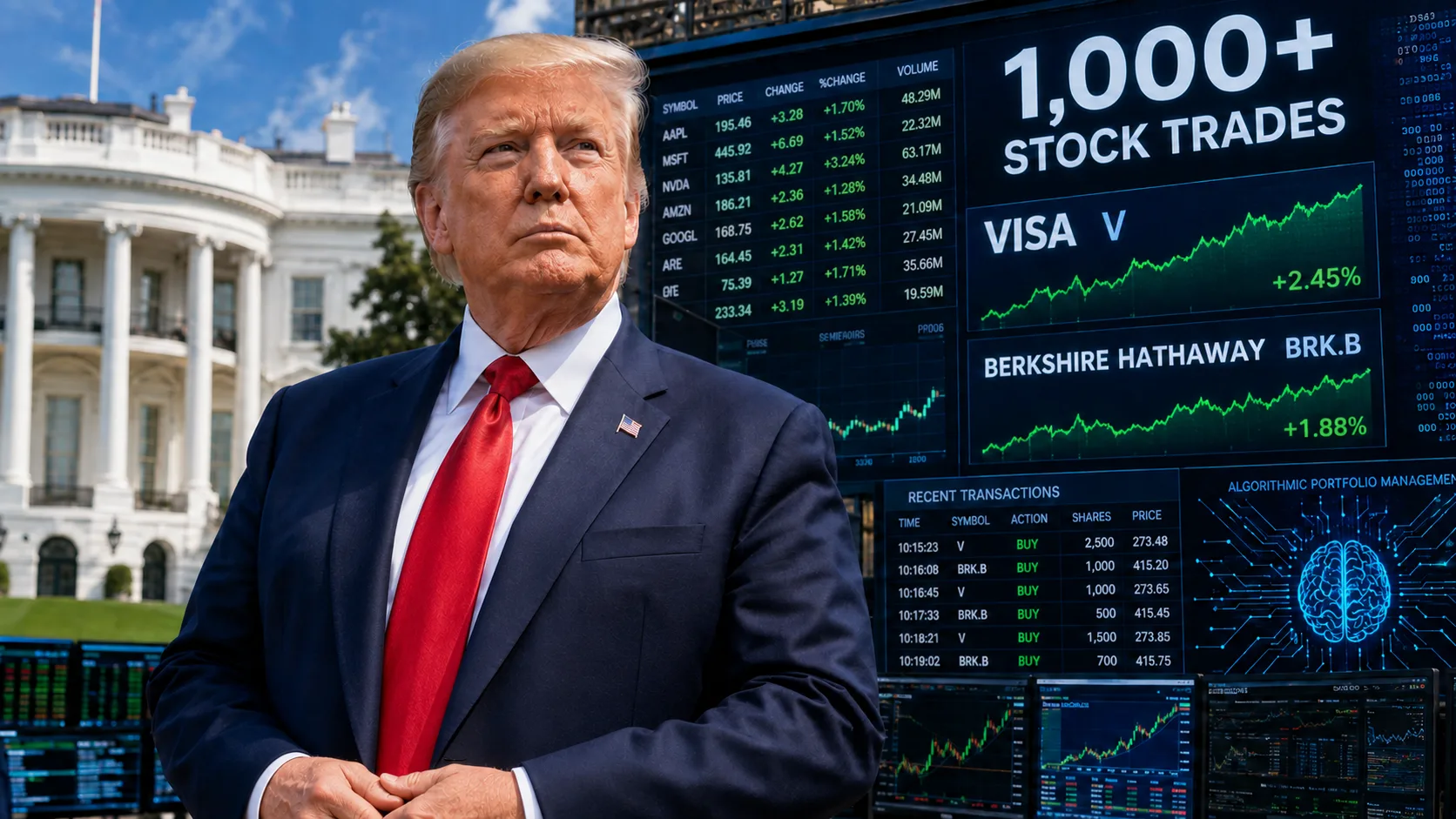
President Donald Trump’s investment accounts reported more than 1,000 stock transactions in June, including major purchases of Berkshire Hathaway, Visa and Mastercard. The enormous trading volume is drawing scrutiny, but investors should understand what may be driving it before treating the disclosure as a map of the president’s market views.
More Than 550 Purchases and 450 Sales
Trump’s latest government disclosure revealed more than 550 stock purchases and over 450 sales during June.
Among the largest reported transactions were purchases of at least $1 million each in Berkshire Hathaway, Visa and Mastercard. His accounts had previously traded all three companies.
The Berkshire purchase added exposure to one of the world’s largest diversified conglomerates. Visa and Mastercard offer exposure to the continuing shift from cash toward electronic payments, consumer spending and global transaction growth.
On June 18, the accounts also reported selling more than $1 million each in Meta Platforms and Motorola Solutions. The transactions occurred one day after Trump signed an interim agreement in Versailles, France, aimed at ending the conflict with Iran.
The timing is certain to attract attention. It does not establish that the trades were connected to the agreement or directed by the president.
The White House says Trump has no role in the investment decisions. According to spokesman Davis Ingle, the portfolio is managed by independent financial institutions through discretionary accounts.
“Neither President Trump nor any member of his family has any ability to direct, influence, or provide input regarding how the portfolio is invested or when investments are bought or sold,” Ingle said.
The investment accounts are held in a revocable trust overseen by Donald Trump Jr.
Why 1,000 Trades May Be Less Dramatic Than It Sounds
A thousand stock transactions in a single month looks like aggressive trading. The structure of the portfolio may offer a more technical explanation.
The White House says the accounts use computer-based model portfolios designed to replicate recognized indexes, including the Schwab 1000 Index.
Instead of purchasing an index fund that holds an entire basket of companies, a direct-indexing strategy buys many of the individual stocks that make up the index. Software then adjusts the holdings to keep the portfolio aligned with its benchmark.
That can produce hundreds or thousands of individual transactions even when the investor has made no new market call.
The strategy may also harvest tax losses. A manager can sell a stock that has declined, use the loss to offset taxable gains and purchase a comparable security to maintain similar market exposure. The portfolio can later be rebalanced again as prices, index weights and tax considerations change.
This creates an important distinction. A large purchase of Visa or Berkshire Hathaway might look like a bullish bet when viewed alone. Inside a direct-indexed portfolio, the transaction could reflect an index adjustment, a replacement trade, a new cash allocation or tax management.
The same applies to the sales of Meta and Motorola Solutions. A sale does not automatically mean the managers expect the stock to fall.
The Real Question Is Control, Not Trade Count
The sheer number of trades makes a strong headline. The larger issue is whether the portfolio’s structure creates enough separation between presidential power and personal financial interests.
Independent management lowers the risk that Trump is personally selecting stocks based on government information. Automated index strategies provide another layer of separation because investment decisions can be tied to preset rules.
Yet a discretionary managed account is different from a federally qualified blind trust.
The Office of Government Ethics says a qualified blind trust requires an independent trustee approved by the agency. The beneficiary generally cannot know which new assets the trustee acquires and faces strict limits on communications with the trustee.
Trump’s reported arrangement provides independent management, according to the White House, while the periodic transaction reports still reveal the underlying securities after trades occur. That leaves the public able to see that the president has financial exposure to companies affected by federal policy.
The distinction matters because conflicts can emerge in two directions.
First, presidential decisions can influence the value of companies held in the accounts. Financial regulation affects Visa and Mastercard. Antitrust enforcement and artificial intelligence policy can influence Meta. Federal procurement and public-safety spending can affect Motorola Solutions.
Second, the appearance of a conflict can weaken confidence even when no improper direction occurred. For markets, perceived integrity can matter almost as much as legal compliance. A policy announcement followed by the disclosure of a well-timed trade can create suspicion that is difficult to eliminate after the fact.
Why Investors Should Be Careful About Copying the Trades
Government disclosures can be useful, but Trump’s filings have serious limitations as investment signals.
The Information Arrives Too Late
Periodic transaction reports generally cover trades that have already happened. By the time the public sees them, the market, policy environment and original reason for the transaction may have changed.
A stock purchased weeks earlier could already have moved sharply. Copying the position at a different price changes the risk and potential return.
The Dollar Amounts Are Reported in Ranges
Public financial disclosures typically identify transactions using value categories rather than exact amounts.
Knowing that a purchase exceeded $1 million does not reveal the precise size of the position, the portfolio’s total exposure or whether the purchase represented a meaningful change in allocation.
Without that context, investors cannot determine the manager’s real conviction.
Individual Trades May Be Mechanical
Direct indexing is built around coordinated portfolio management. One trade cannot be separated cleanly from the hundreds of other purchases and sales surrounding it.
A sale might generate a tax loss. A purchase might replace exposure sold elsewhere. A large transaction might simply reflect the amount of capital needed to maintain an index weight.
Following one disclosed trade without understanding the entire portfolio can create a very different investment from the one the manager intended.
Trump’s Financial Exposure Extends Beyond Public Stocks
Earlier disclosures showed extraordinary activity across Trump’s investment accounts, including more than 21,000 transactions during 2025. His broader financial interests also include private businesses, real estate, licensing arrangements and cryptocurrency ventures.
That means the public-stock portfolio represents only one part of his overall financial position. Investors should avoid treating it as a complete picture of where Trump believes the economy or markets are heading.
What the June Trades May Say About the Portfolio
Even if the transactions were mechanical, the largest trades still reveal the kind of exposure being maintained within the portfolio.
Berkshire Hathaway offers broad exposure to insurance, energy, railroads, industrial businesses and a large portfolio of public equities. It can function as a diversified financial holding rather than a narrow company bet.
Visa and Mastercard benefit from payment volume and the long-term transition toward digital commerce. Their business models generate fees from transactions without carrying most consumer credit risk directly.
Together, the three purchases tilt toward profitable, established companies with strong cash generation and durable market positions.
The Meta sale reduced exposure to a company whose valuation is increasingly connected to artificial intelligence investment, digital advertising growth and heavy capital spending. Motorola Solutions provides communications and public-safety technology to government and commercial customers, making its outlook sensitive to public budgets and contract activity.
Still, investors should resist building a sweeping market narrative around five companies selected from more than 1,000 transactions.
The most reasonable interpretation is that Trump’s managers were rebalancing a large, complex portfolio with substantial exposure to major U.S. companies.
The Disclosure Paradox
The June filing creates what could be called the disclosure paradox.
The more transparent the portfolio becomes, the more potential conflicts the public can identify. Yet that transparency does not reveal why each trade occurred or who designed the underlying investment rules.
Three questions provide a better way to evaluate future disclosures:
1. Was the Transaction Rules-Based?
Look for evidence that a trade resulted from index replication, tax-loss harvesting or routine rebalancing. A mechanical explanation reduces the likelihood that the transaction reflected a specific market or policy view.
2. Was the Company Directly Affected by Federal Action?
Greater scrutiny is justified when a trade involves a company facing an imminent contract award, regulatory change, merger review, tariff decision or government investigation.
3. Was the Position Large Enough to Be Meaningful?
A seven-figure transaction sounds significant. Its importance depends on the size of the total portfolio and the account’s previous exposure to the company. A large dollar amount can still represent a minor portfolio adjustment.
This test cannot prove intent. It can help investors separate routine portfolio activity from transactions that deserve closer examination.
Automated Trading Does Not Eliminate Every Concern
The strongest defense of Trump’s arrangement is straightforward: independent managers following computer models can execute thousands of trades without presidential participation.
That explanation is financially credible. Direct-indexing strategies routinely trade individual securities for benchmark tracking, portfolio customization and tax management.
The arrangement still leaves an unresolved governance issue.
An automated system follows instructions selected by someone. Those instructions determine the benchmark, tax strategy, excluded companies, risk limits and frequency of rebalancing. Greater disclosure about the portfolio’s mandate and the identity or independence of its managers could help the public evaluate how strong the separation really is.
The trade volume itself may be evidence of automation rather than active political stock picking. The continued ownership of individual companies, however, ensures that questions will return whenever federal policy and portfolio activity overlap.
What Investors Should Watch
Several developments could determine whether the June disclosure becomes a short-lived controversy or a larger political and market issue.
- Additional transaction reports: Future filings will show whether the unusually high trading volume continues and whether the accounts repeatedly trade companies near major policy announcements.
- Details about the portfolio managers: Lawmakers and ethics groups may press the White House to identify the financial institutions managing the accounts or disclose more about their mandates.
- Calls for stricter trading restrictions: The disclosure could strengthen efforts to limit individual stock ownership or trading by presidents, members of Congress and other senior government officials.
- Changes in portfolio structure: A move toward broad mutual funds, exchange-traded funds or an OGE-certified qualified trust would reduce the number of company-specific conflicts.
- Regulatory actions involving disclosed holdings: Investors should watch for major federal decisions involving payment networks, technology companies, defense contractors, insurers and other businesses appearing in Trump’s filings.
The Investor Takeaway
Trump’s 1,000 June stock trades are eye-catching, but the transaction count alone tells investors very little about his economic outlook.
The White House’s explanation that independent managers use automated index strategies is plausible. Direct indexing can generate extraordinary trading volume without requiring a person to make hundreds of individual investment decisions.
The greater concern is structural. A president with visible holdings in individual companies will face conflict-of-interest questions whenever those companies are affected by federal policy.
For investors, these disclosures are better treated as a transparency and governance story than a stock-picking guide. The trades reveal exposure. They do not reveal intent, conviction or a reliable path to future returns.
About Author