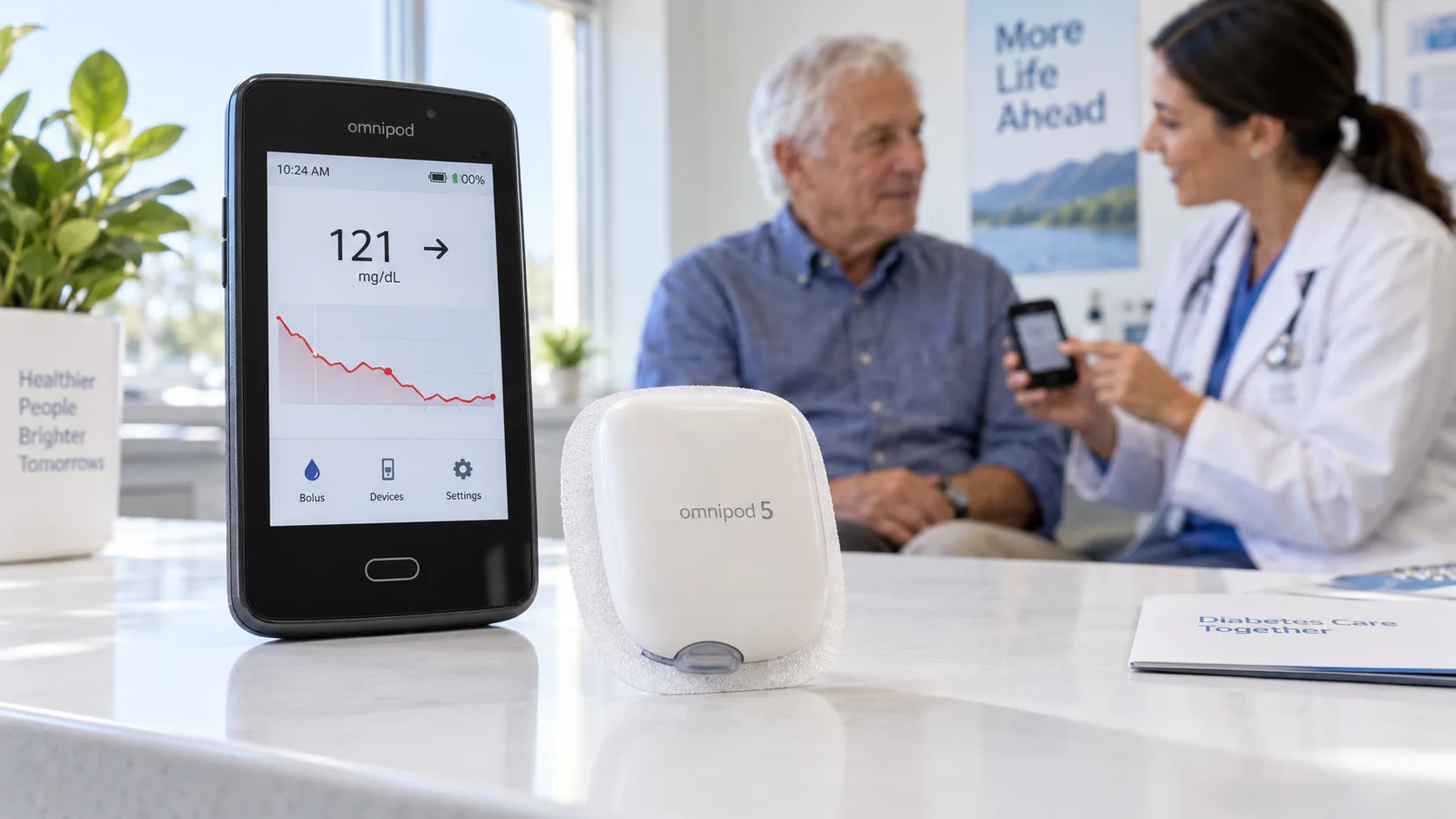
Insulet shares have lost nearly half their value this year, even as revenue climbed more than 23%. The sell-off reflects a costly execution mistake, but the market may be pricing a temporary patient-retention problem as if the company’s long-term growth engine has broken.
One Guidance Cut Erased Years of Investor Confidence
Insulet develops the Omnipod, a wearable, tubeless insulin-delivery system used by people with diabetes. The company entered 2026 with strong momentum, a large recurring-revenue business and a newly expanded opportunity among patients with Type 2 diabetes.
Then one disappointing update changed the market’s perception almost overnight.
Insulet reported second-quarter revenue of $801.7 million, up 23.5% from a year earlier and above the company’s own guidance. Adjusted earnings rose more than 40% to $1.66 per share, while adjusted operating margin expanded by more than 140 basis points.
Those are impressive numbers for a medical-device company.
Investors focused instead on Insulet’s revised full-year forecast. Management lowered its expected U.S. Omnipod growth rate to between 17% and 19%, down from its previous range of 20% to 22%. Companywide revenue growth guidance fell to between 20% and 22%.
Shares plunged roughly 20% following the Aug. 5 report and eventually touched a 52-week intraday low of $126.40. The stock is now down approximately 48% in 2026.
Several Wall Street firms downgraded Insulet after the report, including JPMorgan, Wells Fargo, Leerink Partners and BTIG. The market’s concern is understandable. A high-growth stock that cuts guidance will almost always face multiple compression.
The severity of the punishment, however, suggests investors see a structural deterioration that has yet to appear in the company’s broader results.
Insulet’s Problem Is Concentrated in the First 90 Days
Insulet continues to attract new customers, gain prescribers and generate double-digit growth. Its second-quarter revenue exceeded expectations, U.S. Omnipod sales grew 20.1% and international Omnipod revenue jumped 35.5%.
The trouble emerged after some new Type 2 diabetes patients started using Omnipod.
More than 40% of Insulet’s new U.S. customers during the quarter came from the Type 2 population. That is an encouraging sign for demand, considering the company only received Food and Drug Administration clearance to market Omnipod 5 to this group in 2024.
However, too many of those patients stopped using the system during their first 90 days.
Many Type 2 patients are older, unfamiliar with insulin pumps and managing additional health conditions. They may also rely on Medicare or Medicaid, creating different reimbursement and support requirements than Insulet has historically encountered with its core Type 1 customer base.
Insulet successfully persuaded physicians to prescribe the product and patients to try it. The breakdown occurred during onboarding, when first-time users needed more education and follow-up than the company provided.
Management has responded by increasing patient support, involving primary-care physicians more closely and changing sales incentives to emphasize 90-day retention instead of initial enrollment.
Those steps will take time to produce measurable results. Still, they address a specific operational problem. There is no evidence in the latest results of collapsing demand, widespread market-share losses or material pricing pressure.
The Market May Be Misreading the Guidance Cut
The stock’s collapse becomes more interesting when the entire earnings update is considered.
While Insulet reduced its U.S. growth forecast, it raised expected international Omnipod growth to between 30% and 32%, up from 26% to 28%. The company also increased its adjusted earnings growth forecast to more than 30%, compared with its previous expectation of at least 25%.
Management still expects adjusted operating margin to expand by approximately 100 basis points for the year.
That combination is unusual for a company supposedly facing a broken growth thesis. Insulet lowered one portion of its revenue forecast while raising its international outlook and earnings expectations.
The company’s underlying economics also remain attractive. Each disposable Pod provides up to three days of insulin delivery, requiring customers to purchase replacements continually. This creates recurring revenue with greater predictability than a business built around occasional equipment sales.
Omnipod is distributed primarily through pharmacies, making it easier for many patients to access than traditional durable medical equipment. Its tubeless design also removes one of the most inconvenient features of tethered insulin pumps.
The company has expanded Omnipod 5 compatibility with major continuous-glucose monitors, including Dexcom’s G7 and Abbott’s FreeStyle Libre 3 Plus. That flexibility allows customers to use preferred glucose sensors without being forced into a single manufacturer’s ecosystem.
These product and distribution advantages help explain why Insulet’s revenue continued growing above 20% even as the company encountered its onboarding problem.
Type 2 Diabetes Could Transform the Growth Story
The larger opportunity sits beyond Insulet’s established Type 1 diabetes franchise.
When Omnipod 5 received clearance for Type 2 diabetes patients in September 2024, Insulet estimated that the decision added approximately 6 million insulin-requiring Americans to its addressable market.
Type 2 patients represented more than 40% of new U.S. Omnipod starts in the second quarter. That level of adoption indicates meaningful interest from physicians and patients, even though Insulet has struggled to keep enough first-time users engaged.
The distinction matters for investors.
If demand were weak, Insulet would face the expensive challenge of convincing patients to try an unfamiliar product. Instead, the company must improve the transition from initial prescription to sustained use.
Retention could determine whether the Type 2 opportunity becomes a multiyear earnings driver or remains an expensive source of inconsistent growth. Even a modest improvement could have an outsized financial impact because each retained customer generates recurring Pod purchases.
The market is currently valuing the onboarding setback as a warning that Insulet may struggle across the entire Type 2 population. That conclusion looks premature after only the early stages of a national rollout.
CEO Ashley McEvoy said tens of thousands of Type 2 patients are already using Omnipod and seeing positive results. Insulet is now expanding pilot programs designed to support customers during critical early moments, including their first Pod change and prescription refill.
The third quarter should provide the first meaningful indication of whether those efforts are working.
The GLP-1 Threat May Be Backward
The rapid adoption of GLP-1 drugs such as Eli Lilly’s Zepbound and Novo Nordisk’s Wegovy has weighed on diabetes-device stocks since 2023.
The bear case assumes these medications will reduce diabetes severity and shrink the population requiring insulin-delivery devices. That possibility deserves attention, particularly over long time horizons.
The immediate effect could be more complicated.
GLP-1 drugs do not eliminate the need for insulin among people with Type 1 diabetes, Insulet’s established customer base. For Type 2 patients, the drugs may lead more people into active medical treatment, glucose monitoring and sustained contact with diabetes specialists.
Some of those patients will still require insulin as their disease progresses. Increased diagnosis and engagement could therefore expand the pool of people considered for automated insulin delivery.
This does not make GLP-1 adoption an automatic benefit for Insulet. It does weaken the simplest version of the bear argument, which assumes every patient receiving a GLP-1 prescription represents a lost insulin-pump customer.
The variables investors should follow are insulin initiation, pump adoption and patient retention. Prescription growth for weight-loss drugs alone provides an incomplete picture.
A Depressed Valuation Creates the Opportunity
Insulet historically commanded a premium valuation because of its high revenue growth, recurring sales and large addressable market.
After the sell-off, shares trade near the lowest valuation range the company has seen in roughly a decade. With the stock around $140, it is valued at approximately 20 times the cited consensus estimate of $7 in forward earnings.
Applying a forward price-to-earnings multiple of 28 produces a value of $196 per share. That would represent approximately 40% upside from the stock’s Sept. 8 trading level.
A 28-times multiple would still sit well below Insulet’s historical range of approximately 40 to 60 times forward earnings. The valuation case therefore does not depend on a complete return to the market optimism of previous years.
The market would only need to conclude that Insulet remains a durable growth business facing a solvable execution problem.
There is also a degree of downside protection in the company’s existing performance. Revenue is still growing above 20%, international sales are accelerating and adjusted earnings are expected to increase more than 30%.
Those results do not guarantee the stock has reached its bottom. They do establish a much stronger fundamental foundation than the share-price decline implies.
About Author